Hofheinz Frank, Maus Jens, Zschaeck Sebastian, Rogasch Julian, Schramm Georg, Oehme Liane, Apostolova Ivayla, Kotzerke Jörg, den Hoff Jörg van
PET Center, Institute of Radiopharmaceutical Cancer Research, Helmholtz-Zentrum Dresden-Rossendorf, Bautzner Landstraße 400, Dresden, Germany.
Charité - Universitätsmedizin Berlin, corporate member of Freie Universität Berlin, Humboldt-Universität zu Berlin, and Berlin Institute of Health, Department of Radiation Oncology, Berlin, Germany.
EJNMMI Res. 2019 Mar 4;9(1):23. doi: 10.1186/s13550-019-0486-9.
Today, the standardized uptake value (SUV) is essentially the only means for quantitative evaluation of static [F-]fluorodeoxyglucose (FDG) positron emission tomography (PET) investigations. However, the SUV approach has several well-known shortcomings which adversely affect the reliability of the SUV as a surrogate of the metabolic rate of glucose consumption. The standard uptake ratio (SUR), i.e., the uptake time-corrected ratio of tumor SUV to image-derived arterial blood SUV, has been shown in the first clinical studies to overcome most of these shortcomings, to decrease test-retest variability, and to increase the prognostic value in comparison to SUV. However, it is unclear, to what extent the SUR approach is vulnerable to observer variability of the additionally required blood SUV (BSUV) determination. The goal of the present work was the investigation of the interobserver variability of image-derived BSUV.
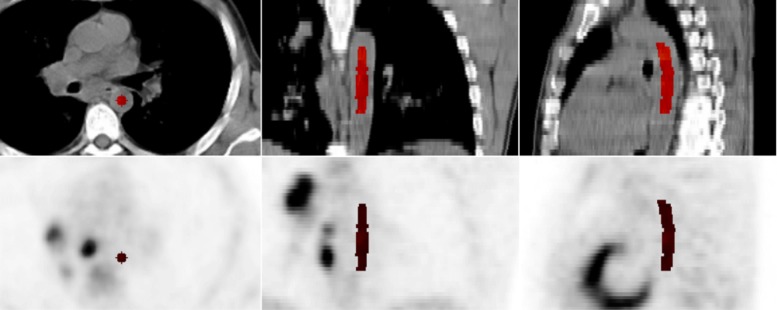
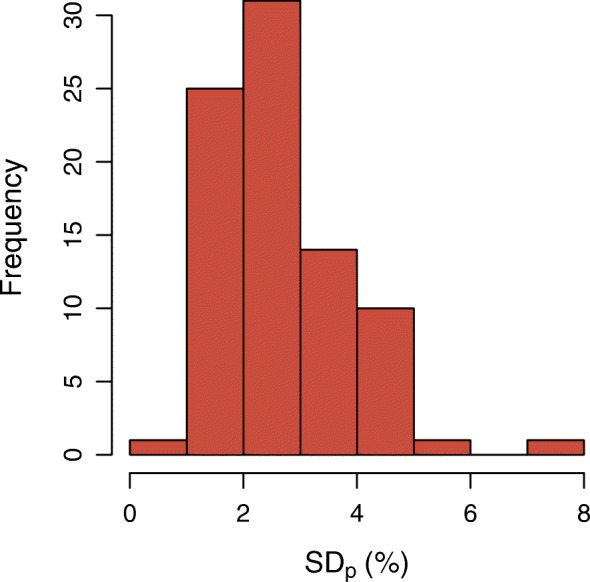
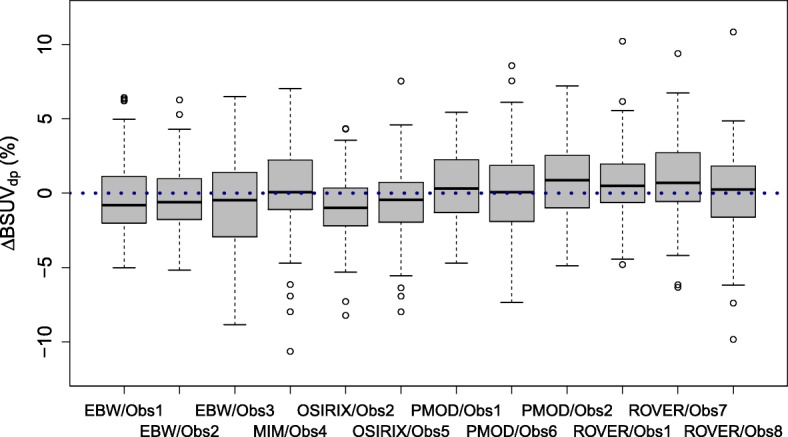
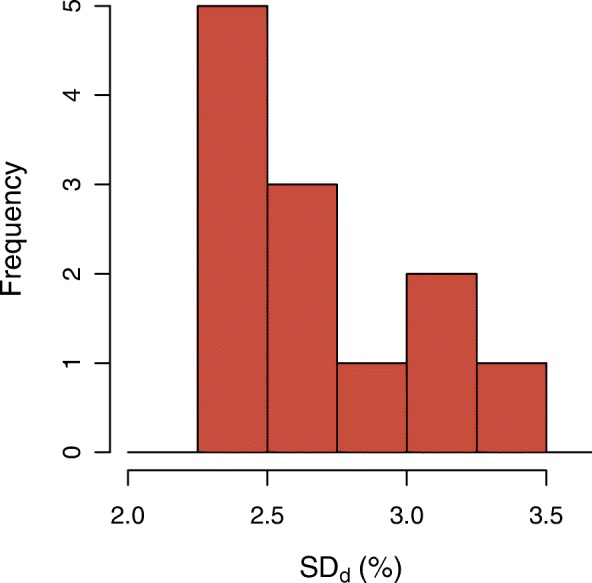
FDG PET/CT scans from 83 patients (72 male, 11 female) with non-small cell lung cancer (N = 46) or head and neck cancer (N = 37) were included. BSUV was determined by 8 individuals, each applying a dedicated delineation tool for the BSUV determination in the aorta. Two of the observers applied two further tools. Altogether, five different delineation tools were used. With each used tool, delineation was performed for the whole patient group, resulting in 12 distinct observations per patient. Intersubject variability of BSUV determination was assessed using the fractional deviations for the individual patients from the patient group average and was quantified as standard deviation (SD ), 95% confidence interval, and range. Interobserver variability of BSUV determination was assessed using the fractional deviations of the individual observers from the observer-average for the considered patient and quantified as standard deviations (SD , SD ) or root mean square (RMS), 95% confidence interval, and range in each patient, each observer, and the pooled data respectively.
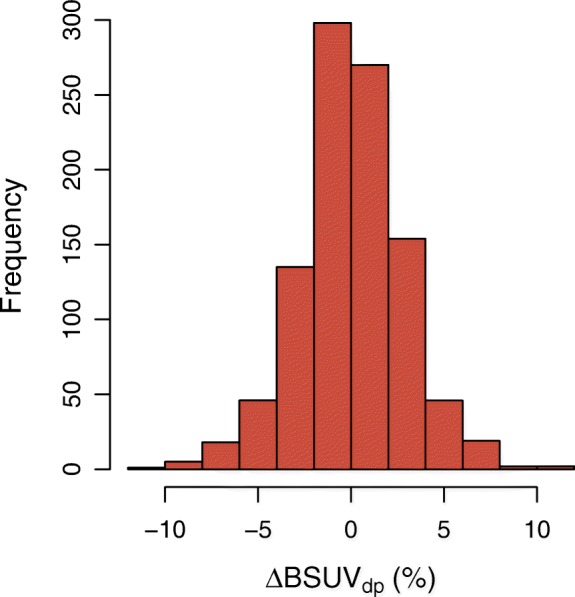
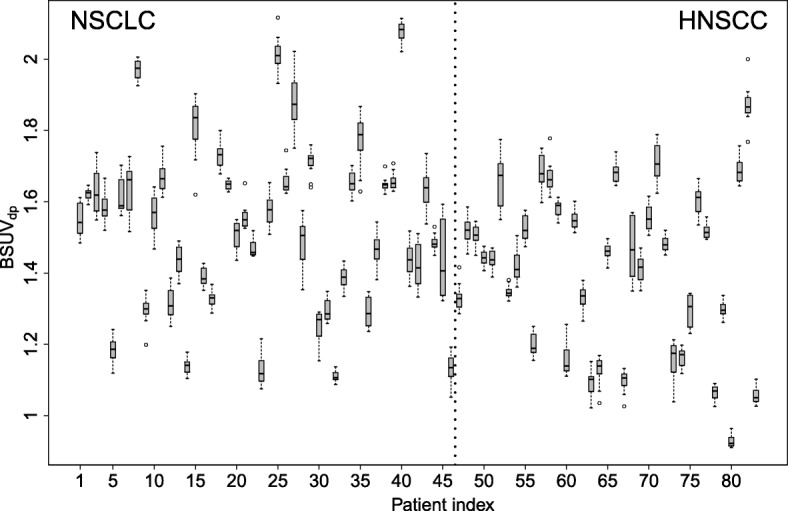
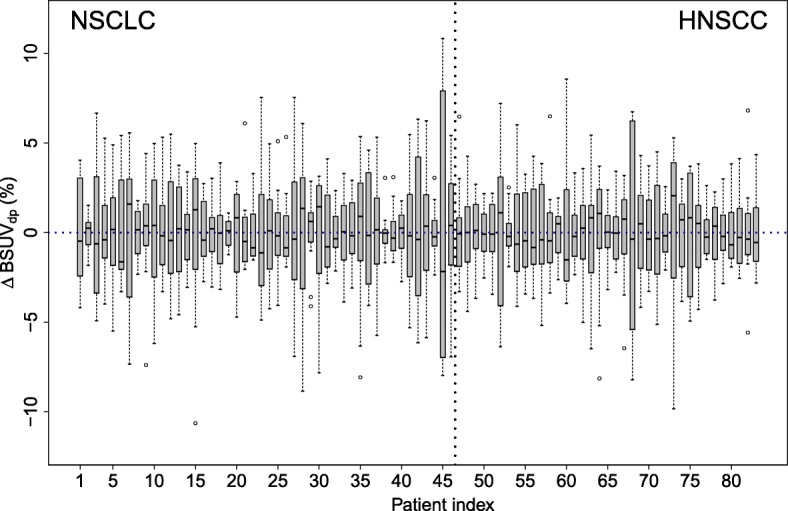
Interobserver variability in the pooled data amounts to RMS = 2.8% and is much smaller than the intersubject variability of BSUV (SD = 16%). Averaged over the whole patient group, deviations of individual observers from the observer average are very small and fall in the range [ - 0.96, 1.05]%. However, interobserver variability partly differs distinctly for different patients, covering a range of [0.7, 7.4]% in the investigated patient group.
The present investigation demonstrates that the image-based manual determination of BSUV in the aorta is sufficiently reproducible across different observers and delineation tools which is a prerequisite for accurate SUR determination. This finding is in line with the already demonstrated superior prognostic value of SUR in comparison to SUV in the first clinical studies.
如今,标准化摄取值(SUV)实质上是静态[F-]氟脱氧葡萄糖(FDG)正电子发射断层扫描(PET)检查定量评估的唯一手段。然而,SUV方法存在几个众所周知的缺点,这些缺点对SUV作为葡萄糖代谢率替代指标的可靠性产生不利影响。标准摄取率(SUR),即肿瘤SUV与图像衍生动脉血SUV的摄取时间校正比值,在首批临床研究中已显示出可克服这些缺点中的大部分,降低重测变异性,并与SUV相比提高预后价值。然而,尚不清楚SUR方法在多大程度上易受额外所需的血SUV(BSUV)测定的观察者变异性影响。本研究的目的是调查图像衍生BSUV的观察者间变异性。
纳入83例非小细胞肺癌(N = 46)或头颈癌(N = 37)患者(72例男性,11例女性)的FDG PET/CT扫描。由8名个体测定BSUV,每人使用一种专门的描绘工具在主动脉中测定BSUV。其中两名观察者还使用了另外两种工具。总共使用了五种不同的描绘工具。对每个使用的工具,对整个患者组进行描绘,每位患者产生12个不同的观察值。使用个体患者相对于患者组平均值的分数偏差评估BSUV测定的受试者间变异性,并量化为标准差(SD)、95%置信区间和范围。使用个体观察者相对于所考虑患者的观察者平均值的分数偏差评估BSUV测定的观察者间变异性,并分别量化为每位患者、每位观察者和汇总数据的标准差(SD、SD)或均方根(RMS)、95%置信区间和范围。
汇总数据中的观察者间变异性为RMS = 2.8%,远小于BSUV的受试者间变异性(SD = 16%)。在整个患者组中平均,个体观察者相对于观察者平均值的偏差非常小,落在[-0.96, 1.05]%范围内。然而,不同患者之间的观察者间变异性部分存在明显差异,在所研究的患者组中范围为[0.7, 7.4]%。
本研究表明,基于图像的主动脉中BSUV手动测定在不同观察者和描绘工具之间具有足够的可重复性,这是准确测定SUR的前提条件。这一发现与首批临床研究中已证明的SUR相对于SUV的优越预后价值一致。