Department of Neurology, Brigham & Women's Hospital, Boston, MA, United States of America.
Harvard Medical School, Boston, MA, United States of America.
PLoS One. 2019 Mar 4;14(3):e0213321. doi: 10.1371/journal.pone.0213321. eCollection 2019.
Fibroblast growth factor 23 is an emerging vascular biomarker, recently associated with cerebral small vessel disease and poor cognition in patients on dialysis. It also interacts with klotho, an anti-aging and cognition enhancing protein.
To determine if circulating Fibroblast growth factor 23 (FGF23) is associated with new-onset cognitive outcomes in a community-based cohort of cognitively healthy adults with long-term follow-up.
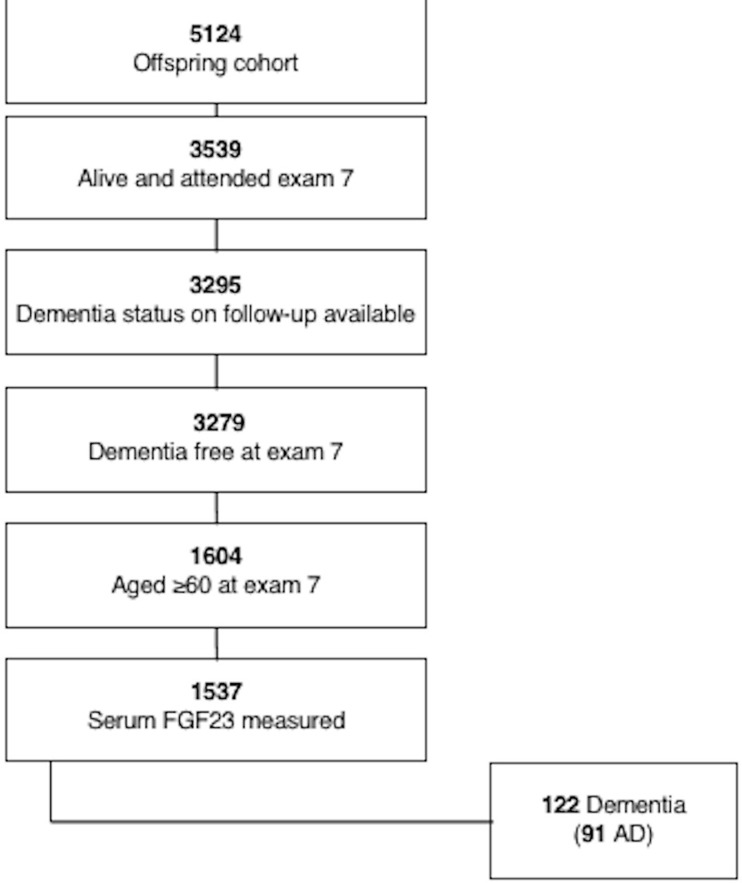
We measured serum FGF23 levels in 1537 [53% women, mean age 68.7 (SD 5.7)] dementia-free Framingham Offspring participants at their 7th quadrennial examination (1998-2001), and followed these participants for the development of clinical all-cause dementia and Alzheimer's disease (AD). Secondary outcomes included MRI-based structural brain measures, and neurocognitive test performance at exam 7.
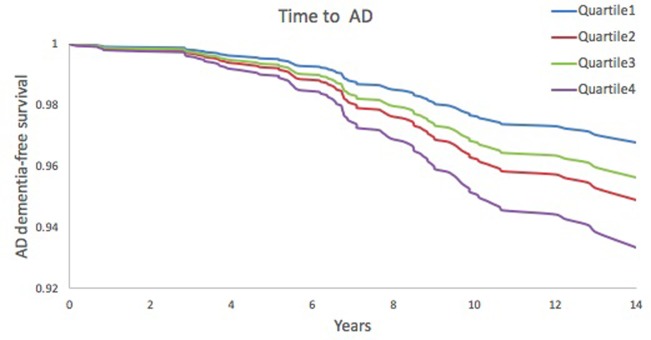
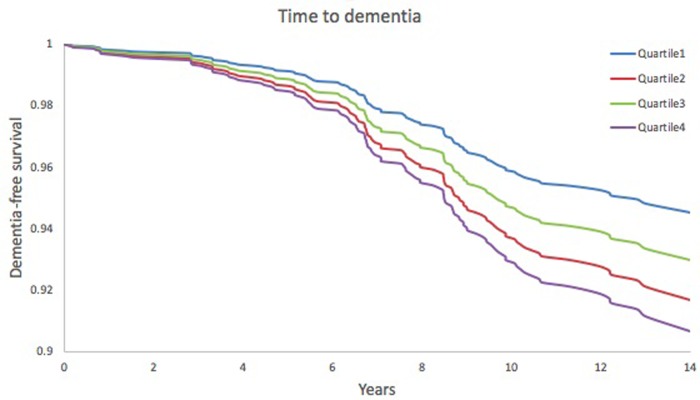
During a median (Q1, Q3) 12-year (7.0, 13.3) follow up, 122 (7.9%) participants developed dementia, of whom 91 (5.9%) had AD. Proportional-hazards regression analysis, adjusted for age, sex, education, systolic blood pressure, antihypertensive medication, prevalent cardiovascular disease, diabetes mellitus, smoking status and apoE ε4 carrier status, revealed that higher serum FGF23 levels were associated with an increased risk of incident dementia and AD (Hazard ratio [HR] per 1 standard deviation increment in inverse transformed FGF23 level 1.25, 95% CI 1.02-1.53, and 1.32, 95% CI 1.04-1.69, respectively). There was no significant interaction according to presence/absence of significant renal impairment (eGFR <30 versus ≥30ml/min) and risk of dementia (based on 1537; p = 0.97).
Higher circulating FGF23 is associated with an increased risk of dementia, suggesting that FGF23-related biological pathways may play a role in the development of dementia.
成纤维细胞生长因子 23(FGF23)是一种新兴的血管生物标志物,最近与透析患者的脑小血管疾病和认知功能下降有关。它还与抗衰老和增强认知能力的 klotho 蛋白相互作用。
在一个具有长期随访的认知健康成年人的社区队列中,确定循环成纤维细胞生长因子 23(FGF23)是否与新发认知结局相关。
我们在第 7 次(1998-2001 年)四年一次的检查中测量了 1537 名(53%为女性,平均年龄 68.7[5.7])无痴呆的弗雷明汉后代参与者的血清 FGF23 水平,并对这些参与者进行了临床全因痴呆和阿尔茨海默病(AD)的发展情况进行了随访。次要结局包括 MRI 结构脑测量和第 7 次检查的神经认知测试表现。
在中位(Q1,Q3)12 年(7.0,13.3)随访期间,122 名(7.9%)参与者发生痴呆,其中 91 名(5.9%)患有 AD。经年龄、性别、教育程度、收缩压、降压药物、已确诊心血管疾病、糖尿病、吸烟状况和 apoE ε4 携带者状态校正的比例风险回归分析显示,较高的血清 FGF23 水平与痴呆和 AD 的发病风险增加相关(按逆变换 FGF23 水平每增加 1 个标准差的风险比分别为 1.25,95%CI 1.02-1.53,和 1.32,95%CI 1.04-1.69)。根据有无显著肾功能损害(eGFR<30 与≥30ml/min)和痴呆风险(基于 1537 名参与者),无显著交互作用(p=0.97)。
较高的循环 FGF23 与痴呆风险增加相关,提示 FGF23 相关的生物学途径可能在痴呆的发生发展中起作用。