Medical Research Council Integrative Epidemiology Unit, University of Bristol, BS8 2BN Bristol, UK.
Population Health Sciences, Bristol Medical School, University of Bristol, BS8 2BN Bristol, UK.
Genes (Basel). 2019 Mar 1;10(3):193. doi: 10.3390/genes10030193.
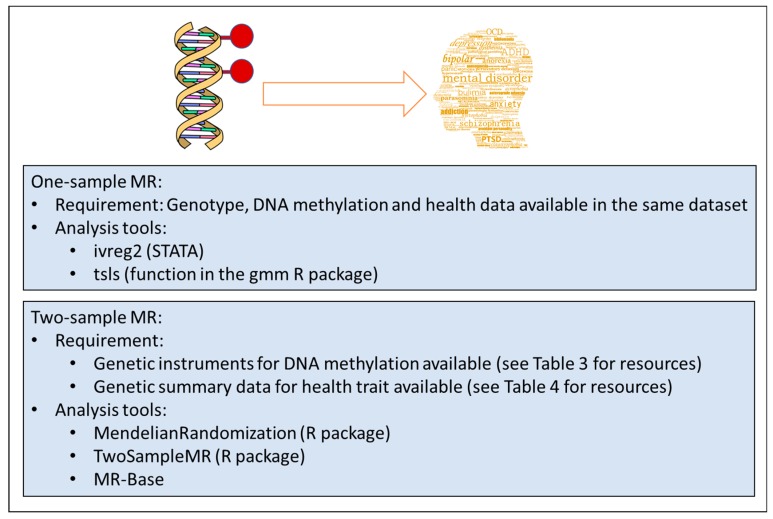
The recent focus on the role of epigenetic mechanisms in mental health has led to several studies examining the association of epigenetic processes with psychiatric conditions and neurodevelopmental traits. Some studies suggest that epigenetic changes might be causal in the development of the psychiatric condition under investigation. However, other scenarios are possible, e.g., statistical confounding or reverse causation, making it particularly challenging to derive conclusions on causality. In the present review, we examine the evidence from human population studies for a possible role of epigenetic mechanisms in neurodevelopment and mental health and discuss methodological approaches on how to strengthen causal inference, including the need for replication, (quasi-)experimental approaches and Mendelian randomization. We signpost openly accessible resources (e.g., "MR-Base" "EWAS catalog" as well as tissue-specific methylation and gene expression databases) to aid the application of these approaches.
最近,人们关注表观遗传机制在心理健康中的作用,这促使一些研究检查了表观遗传过程与精神疾病和神经发育特征之间的关联。一些研究表明,表观遗传变化可能是正在研究的精神疾病发展的原因。然而,也可能存在其他情况,例如统计混杂或反向因果关系,这使得得出关于因果关系的结论特别具有挑战性。在本综述中,我们检查了人类群体研究中关于表观遗传机制在神经发育和心理健康中可能作用的证据,并讨论了如何加强因果推理的方法,包括复制、(准)实验方法和孟德尔随机化的必要性。我们为这些方法的应用指明了公开可获取的资源(例如,“MR-Base”“EWAS 目录”以及组织特异性甲基化和基因表达数据库)。