Ito Tetsuhide, Tori Masayuki, Hashigaki Satoshi, Kimura Nobuyuki, Sato Kazuo, Ohki Emiko, Sawaki Akira, Okusaka Takuji
Department of Hepato-Biliary-Pancreatic Medicine, Fukuoka Sanno Hospital, International University of Health and Welfare, Tokyo 814-0001, Japan.
Department of Endocrine Surgery, Osaka Police Hospital, Osaka 543-0035, Japan.
Jpn J Clin Oncol. 2019 Apr 1;49(4):354-360. doi: 10.1093/jjco/hyz009.
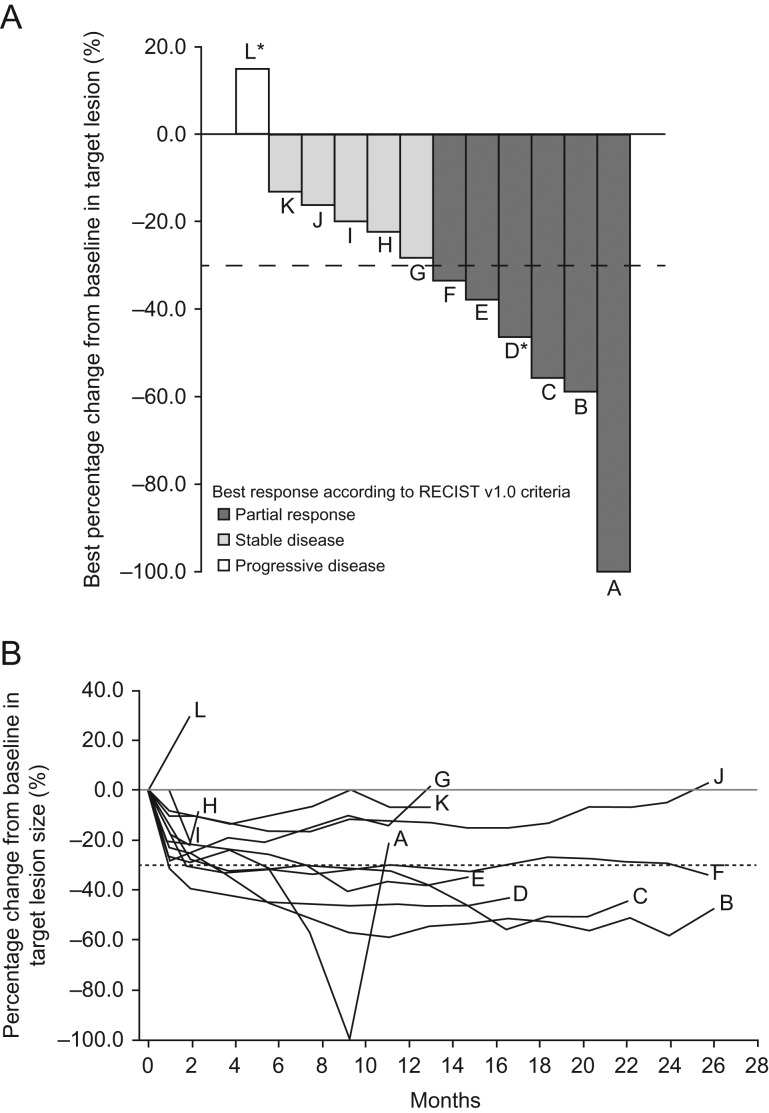
In an interim analysis of a Phase II trial in Japanese patients with pancreatic neuroendocrine tumors (panNETs), sunitinib demonstrated antitumor activity with an objective response rate (ORR) of 50% (95% confidence interval [CI], 21-79) and a median progression-free survival (PFS) of 16.8 months (95% CI, 9.3-26.2). Here, we report the final analyses of efficacy and safety, as well as additional analyses, from this Phase II study.
This was a multicenter, open-label, Phase II trial (NCT01121562) of sunitinib in Japanese patients with panNETs. Patients received oral sunitinib 37.5 mg/day on a continuous daily dosing schedule. Dose modifications were permitted. The primary endpoint was clinical benefit rate (CBR). Secondary endpoints included ORR, PFS, overall survival (OS), safety and pharmacokinetics.
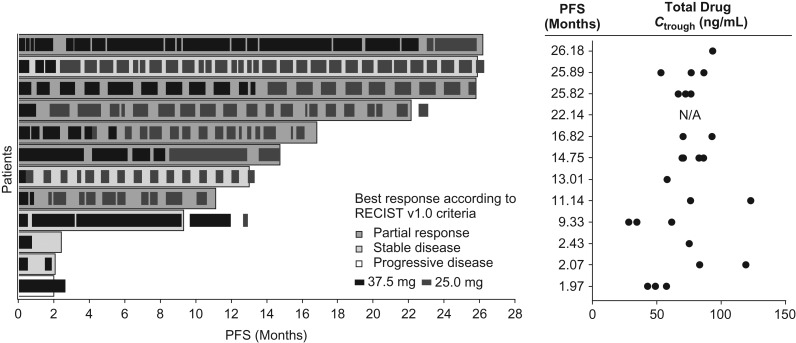
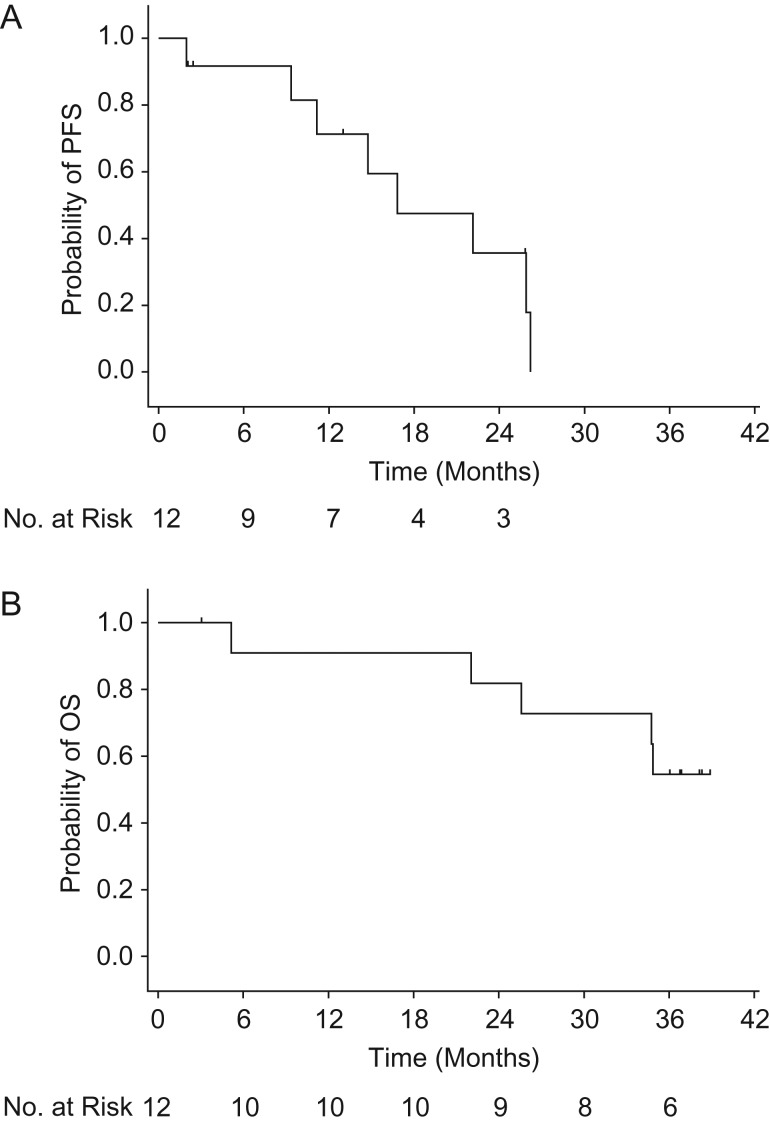
Of 12 patients enrolled and treated, all discontinued treatment-the majority (n = 8) owing to disease progression. Most patients were male (n = 8), <65 years of age (n = 11) and had a non-functional tumor (n = 10). The median (range) number of days on drug was 323.5 (22-727). The CBR (95% CI) was 75.0% (42.8-94.5). ORR (95% CI) was 50.0% (21.1-78.9). Median (95% CI) PFS was 16.8 (9.3-26.2) months; however, median (95% CI) OS was not reached (22.0-not estimable). Most common adverse events (AEs; all-causality) were diarrhea (n = 10; 83.3%), hand-foot syndrome (n = 8; 66.7%) and hypertension (n = 8; 66.7%).
These results support the efficacy and safety of sunitinib in Japanese patients with panNETs. Appropriate AE management through dose reduction and interruption may prolong sunitinib treatment and maximize its efficacy.
在一项针对日本胰腺神经内分泌肿瘤(panNETs)患者的II期试验的中期分析中,舒尼替尼显示出抗肿瘤活性,客观缓解率(ORR)为50%(95%置信区间[CI],21 - 79),中位无进展生存期(PFS)为16.8个月(95% CI,9.3 - 26.2)。在此,我们报告这项II期研究的疗效和安全性的最终分析以及其他分析结果。
这是一项针对日本panNETs患者的舒尼替尼多中心、开放标签的II期试验(NCT01121562)。患者接受口服舒尼替尼37.5 mg/天,采用持续每日给药方案。允许调整剂量。主要终点是临床受益率(CBR)。次要终点包括ORR、PFS、总生存期(OS)、安全性和药代动力学。
在纳入并接受治疗的12例患者中,所有患者均停止治疗,大多数(n = 8)是由于疾病进展。大多数患者为男性(n = 8),年龄<65岁(n = 11),且患有无功能性肿瘤(n = 10)。药物治疗的中位(范围)天数为323.5天(22 - 727天)。CBR(95% CI)为75.0%(42.8 - 94.5)。ORR(95% CI)为50.0%(21.1 - 78.9)。中位(95% CI)PFS为16.8(9.3 - 26.2)个月;然而,中位(95% CI)OS未达到(22.0 - 不可估计)。最常见的不良事件(AE;所有原因)为腹泻(n = 10;83.3%)、手足综合征(n = 8;66.7%)和高血压(n = 8;66.7%)。
这些结果支持舒尼替尼在日本panNETs患者中的疗效和安全性。通过剂量减少和中断进行适当的AE管理可能会延长舒尼替尼治疗时间并使其疗效最大化。