Huzhou Key Laboratory of Molecular Medicine, Huzhou Central Hospital, Huzhou, Zhejiang 313000, China.
Department of Thoracic Surgery, Huzhou Central Hospital, Huzhou, Zhejiang 313000, China.
Anal Cell Pathol (Amst). 2019 Jan 29;2019:4265040. doi: 10.1155/2019/4265040. eCollection 2019.
The receptor-type tyrosine-protein phosphatase (PTPRK) is a candidate tumor suppressor involved in the tumorigenesis of various organs. However, its expression and biological roles in non-small-cell lung cancer (NSCLC) have not yet been investigated.
PTPRK expression in NSCLC tissues and cell lines was examined using real-time PCR and western blotting. In addition, the effects of PTPRK on cell migration, invasion, and proliferation were evaluated . Furthermore, we explored whether the downregulation of PTPRK led to STAT3 activation in NSCLC cell lines by western blotting. The expression of phospho-STAT3 in primary human NSCLC tissues was evaluated by immunohistochemistry.
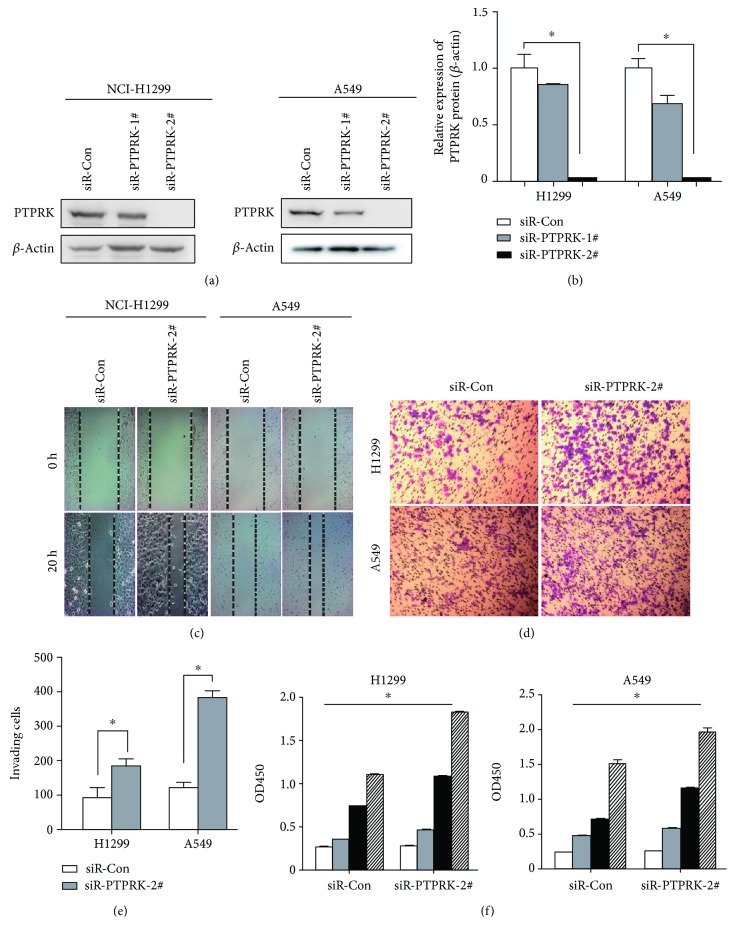
The results showed that PTPRK expression was frequently reduced in NSCLC tissues with lymph node metastasis and cell lines. The inhibition of PTPRK expression resulted in increased proliferation, invasion, and migration of NSCLC cells . Additionally, after silencing of PTPRK, phospho-STAT3 was significantly increased in NSCLC cells. Moreover, the phospho-STAT3 levels of NSCLC tissues were positively correlated with lymph node metastasis and significantly inversely correlated with the expression of PTPRK ( < 0.05).
These results suggested that PTPRK functions as a novel tumor suppressor in NSCLC, and its suppressive ability may be involved in STAT3 activation.
受体型酪氨酸蛋白磷酸酶(PTPRK)是一种候选肿瘤抑制因子,参与多种器官的肿瘤发生。然而,其在非小细胞肺癌(NSCLC)中的表达和生物学作用尚未得到研究。
使用实时 PCR 和 Western blot 检测 NSCLC 组织和细胞系中的 PTPRK 表达。此外,评估了 PTPRK 对细胞迁移、侵袭和增殖的影响。进一步通过 Western blot 探讨了 PTPRK 下调是否导致 NSCLC 细胞系中 STAT3 的激活。通过免疫组织化学评估原发性人 NSCLC 组织中磷酸化 STAT3 的表达。
结果表明,PTPRK 表达在具有淋巴结转移的 NSCLC 组织和细胞系中经常降低。抑制 PTPRK 表达导致 NSCLC 细胞的增殖、侵袭和迁移增加。此外,沉默 PTPRK 后,NSCLC 细胞中的磷酸化 STAT3 显著增加。此外,NSCLC 组织中的磷酸化 STAT3 水平与淋巴结转移呈正相关,与 PTPRK 的表达呈显著负相关(<0.05)。
这些结果表明,PTPRK 在 NSCLC 中作为一种新型肿瘤抑制因子发挥作用,其抑制能力可能涉及 STAT3 激活。