School of Pharmacy, College of Health Sciences, Addis Ababa University, Addis Ababa, Ethiopia.
School of Medicine, College of Health Sciences, Addis Ababa University, Addis Ababa, Ethiopia.
PLoS One. 2019 Mar 7;14(3):e0213557. doi: 10.1371/journal.pone.0213557. eCollection 2019.
Imatinib has shown to be highly efficacious in the treatment of chronic myeloid leukemia (CML) but continuous dosing and patient adherence is essential treatment success. The study aimed to assess prevalence and reasons for non-adherence to Imatinib in newly diagnosed patients with CML in the first 3-months of treatment.
The study was conducted from October 1, 2016 to November 30, 2017 at Tikur Anbessa Specialized Hospital, Addis Ababa, Ethiopia. A total of 147 newly diagnosed patients were followed and their adherence status was determined using the 8-items Morisky Medication Adherence Scale and reasons for their non-adherence were evaluated using semi-structured questionnaire. Descriptive statistics were used to summarize the data while multivariable logistic regression was employed to explore associations among variables of interest.
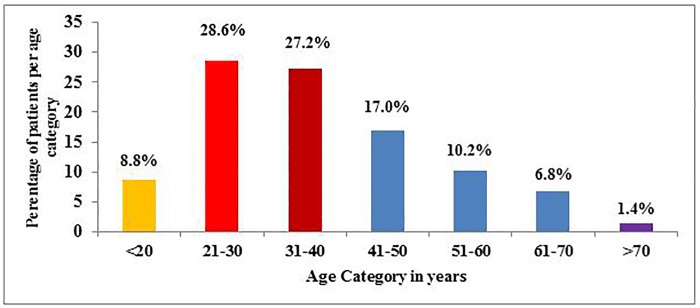
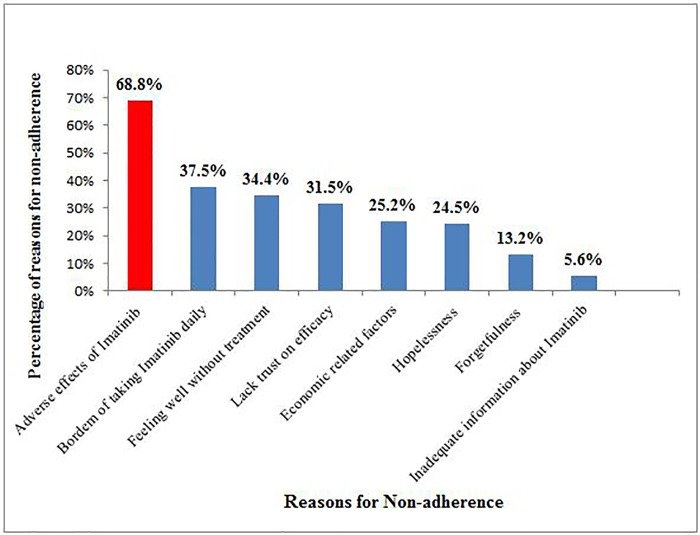
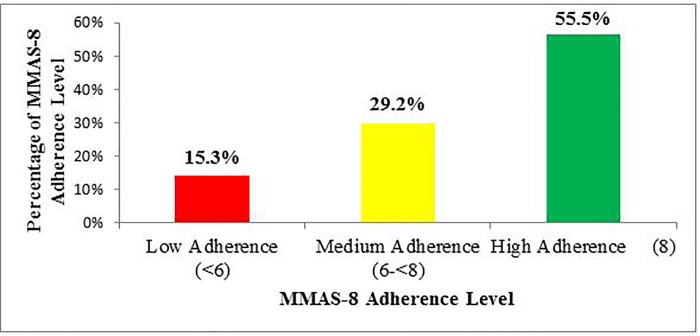
Participants' median age at time of confirmed diagnosis was 36 years; with most of them in the age group of <40 years (64.6%). Males comprised 59.2%. Adherence rate was found to be 55.1%. Those who lived in rural area, had low income, adverse drug events and comorbidity were significantly associated with treatment non-adherence. Most (68.4%) patients missed their medication due to adverse drug events. Three patients were lost-to-follow-up. Among 144 patients who finished the 3-month follow-up, 91.7% of them achieved complete hematologic remission. Morisky high adherent (AOR = 8.6, 95%CI:4.32-11.1) was positively associated with complete hematologic remission.
Overall treatment adherence is suboptimal. Thus, efforts should be made to improve adherence and further study is required to explore impact adherence on the cytogenetic and molecular responses of Ethiopian patients with CML.
伊马替尼已被证明在治疗慢性髓性白血病(CML)方面非常有效,但持续用药和患者依从性是治疗成功的关键。本研究旨在评估新诊断的 CML 患者在治疗的头 3 个月内不依从伊马替尼的发生率和原因。
本研究于 2016 年 10 月 1 日至 2017 年 11 月 30 日在埃塞俄比亚亚的斯亚贝巴提克里安巴塞萨专科医院进行。共随访了 147 例新诊断的患者,使用 8 项 Morisky 药物依从性量表确定他们的依从性状况,并使用半结构问卷评估他们不依从的原因。使用描述性统计对数据进行总结,同时使用多变量逻辑回归探索感兴趣变量之间的关联。
参与者确诊时的中位年龄为 36 岁,其中大多数年龄在<40 岁(64.6%)。男性占 59.2%。发现依从率为 55.1%。居住在农村地区、收入低、药物不良反应和合并症的患者与治疗不依从显著相关。大多数(68.4%)患者因药物不良反应而漏服药物。有 3 例患者失访。在完成 3 个月随访的 144 例患者中,91.7%的患者达到完全血液学缓解。Morisky 高依从(AOR=8.6,95%CI:4.32-11.1)与完全血液学缓解呈正相关。
总体治疗依从性不理想。因此,应努力提高依从性,并进一步研究依从性对埃塞俄比亚 CML 患者细胞遗传学和分子反应的影响。