Colella Barbara, Faienza Fiorella, Di Bartolomeo Sabrina
Department of Biosciences and Territory, University of Molise, 86090 Pesche (IS), Italy.
Department of Biology, University of Rome Tor Vergata, 00133 Rome, Italy.
Cancers (Basel). 2019 Mar 6;11(3):312. doi: 10.3390/cancers11030312.
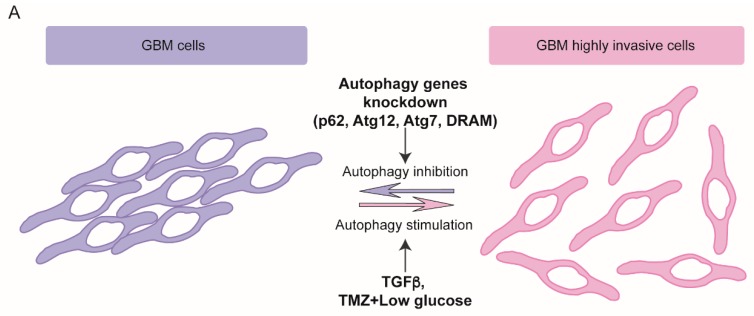
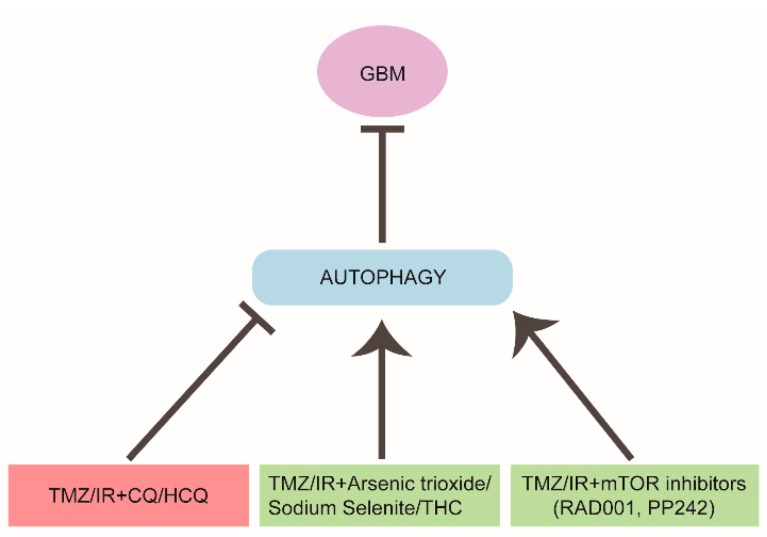
Epithelial-to-mesenchymal transition (EMT) and its reverse process MET naturally occur during development and in tissue repair in vertebrates. EMT is also recognized as the crucial event by which cancer cells acquire an invasive phenotype through the activation of specific transcription factors and signalling pathways. Even though glial cells have a mesenchymal phenotype, an EMT-like process tends to exacerbate it during gliomagenesis and progression to more aggressive stages of the disease. Autophagy is an evolutionary conserved degradative process that cells use in order to maintain a proper homeostasis, and defects in autophagy have been associated to several pathologies including cancer. Besides modulating cell resistance or sensitivity to therapy, autophagy also affects the migration and invasion capabilities of tumor cells. Despite this evidence, few papers are present in literature about the involvement of autophagy in EMT-like processes in glioblastoma (GBM) so far. This review summarizes the current understanding of the interplay between autophagy and EMT in cancer, with special regard to GBM model. As the invasive behaviour is a hallmark of GBM aggressiveness, defining a new link between autophagy and EMT can open a novel scenario for targeting these processes in future therapeutical approaches.
上皮-间质转化(EMT)及其逆向过程间充质-上皮转化(MET)在脊椎动物的发育和组织修复过程中自然发生。EMT也被认为是癌细胞通过激活特定转录因子和信号通路获得侵袭性表型的关键事件。尽管胶质细胞具有间充质表型,但在胶质瘤发生过程中,类似EMT的过程往往会使其加剧,并促使疾病发展到更具侵袭性的阶段。自噬是一种进化保守的降解过程,细胞利用它来维持适当的内环境稳定,自噬缺陷与包括癌症在内的多种疾病有关。除了调节细胞对治疗的抗性或敏感性外,自噬还影响肿瘤细胞的迁移和侵袭能力。尽管有这些证据,但迄今为止,关于自噬在胶质母细胞瘤(GBM)类似EMT过程中的作用,文献中报道较少。本综述总结了目前对癌症中自噬与EMT相互作用的理解,特别是关于GBM模型。由于侵袭行为是GBM侵袭性的标志,确定自噬与EMT之间的新联系可为未来治疗方法中针对这些过程开辟新的前景。