Valdes Leah, Laidre Mark E
Department of Biological Sciences Dartmouth College Hanover New Hampshire.
Ecol Evol. 2019 Feb 10;9(4):2171-2179. doi: 10.1002/ece3.4912. eCollection 2019 Feb.
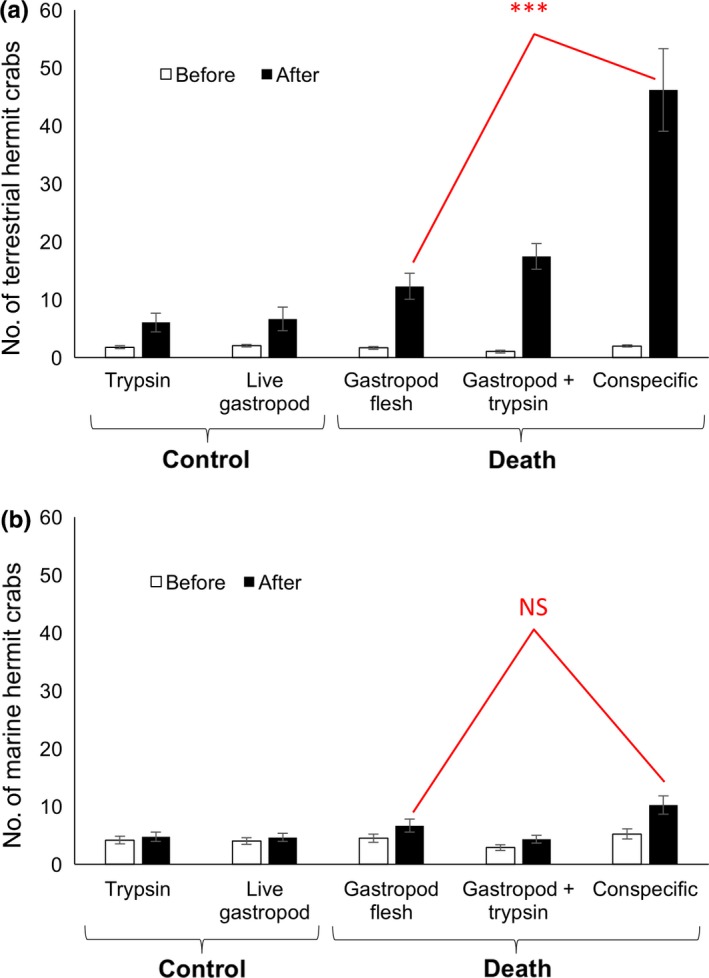
All living organisms must eventually die, though in some cases their death can bring life-giving opportunities. Few studies, however, have experimentally tested how animals capitalize on conspecific death and why this specialization would evolve. Here, we conducted experiments on the phylogenetically most closely-related marine and terrestrial hermit crabs to investigate the evolution of responses to death during the sea-to-land transition. In the sea, death of both conspecifics and heterospecifics generates unremodeled shells needed by marine hermit crabs. In contrast, on land, terrestrial hermit crabs are specialized to live in architecturally remodeled shells, and the sole opportunity to acquire these essential resources is conspecific death. We experimentally tested these different species' responsiveness to the scent of conspecific versus heterospecific death, predicting that conspecific death would have special attractive value for the terrestrial species. We found the terrestrial species was overwhelmingly attracted to conspecific death, rapidly approaching and forming social groupings around conspecific death sites that dwarfed those around heterospecific death sites. This differential responsiveness to conspecific versus heterospecific death was absent in marine species. Our results thus reveal that on land a reliance on resources associated exclusively with conspecifics has favored the evolution of an extreme collective attraction to conspecific death.
所有生物最终都必定会死亡,不过在某些情况下,它们的死亡能带来赋予生命的机遇。然而,很少有研究通过实验来检验动物如何利用同种生物的死亡,以及这种特性为何会进化。在此,我们对在系统发育上关系最为密切的海洋和陆地寄居蟹进行了实验,以探究在从海洋到陆地的转变过程中对死亡反应的进化。在海洋中,同种生物和异种生物的死亡都会产生海洋寄居蟹所需的未改造的贝壳。相比之下,在陆地上,陆地寄居蟹专门生活在经过结构改造的贝壳中,而获取这些必要资源的唯一机会就是同种生物的死亡。我们通过实验测试了这些不同物种对同种生物与异种生物死亡气味的反应,预测同种生物的死亡对陆地物种具有特殊的吸引力。我们发现陆地物种被同种生物的死亡强烈吸引,会迅速靠近并在同种生物死亡地点周围形成社会群体,这比在异种生物死亡地点周围形成的群体规模大得多。海洋物种对同种生物与异种生物死亡的这种差异反应并不存在。因此,我们的研究结果表明,在陆地上,对仅与同种生物相关的资源的依赖有利于进化出对同种生物死亡的极端集体吸引力。