Monsef Kasmaee Vahid, Zia Zibari Seyed Mahdi, Aghajani Nargesi Marjan
Guilan Road Trauma Research Center, School of Health, Guilan University of Medical Sciences, Rasht, Iran. E-mail:
Department of Emergency Medicine, School of Medicine, Guilan University of Medical Sciences, Rasht, Iran. E-mail:
Arch Acad Emerg Med. 2019 Jan 25;7(1):e10. eCollection 2019 Winter.
Procedural sedation and analgesia (PSA) is a fundamental skill for every emergency physician. This study aimed to compare the PSA characteristics of remifentanil with propofol/fentanyl combination.
In this double-blind randomized clinical trial, the procedural characteristics and number of failures, as well as adverse events were compared between groups treated with either remifentanil or propofol/fentanyl combination consisting of 15-60 year old patients referring to emergency department following acute anterior shoulder dislocation.
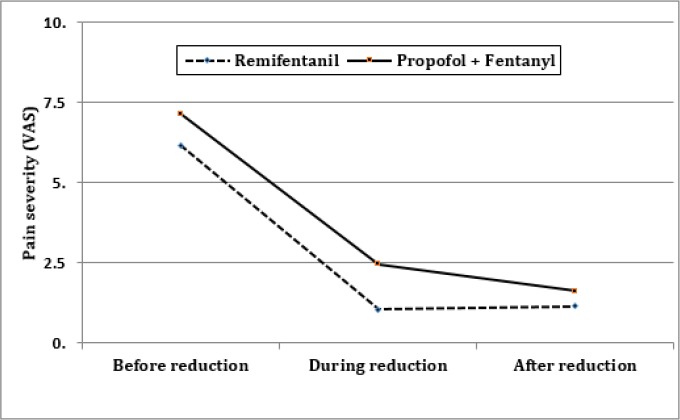
64 patients were randomly assigned to either remifentanil (32 cases) or propofol/fentanyl, (32 cases) groups. The two groups were similar regarding mean age, sex, and pain severity at the time of presentation to ED. The two regimens had the same efficiency regarding pain management (100% success rate). 22 (68.8%) cases in remifentanil group and 4 (12.5%) cases in propofol/fentanyl group had failed in muscle relaxation (p < 0.001). In the group receiving remifentanil, onset of action (p = 0.043) and recovery time (p < 0.001) were significantly shorter. 10 (31.3%) cases in remifentanil group and 11 (34.4%) cases in the other group experienced adverse events (p =0.790). There was a significant difference between groups regarding the type of adverse events (p = 0.003).
Compared to propofol/fentanyl combination, remifentanil has equal efficiency in pain management, lower success rate in muscle relaxation, significantly higher frequency of apnea, and shorter onset of action and recovery times in PSA for reduction of anterior shoulder dislocation.
程序镇静与镇痛(PSA)是每位急诊医生的一项基本技能。本研究旨在比较瑞芬太尼与丙泊酚/芬太尼联合用药的PSA特征。
在这项双盲随机临床试验中,对15至60岁因急性前肩关节脱位前来急诊科就诊的患者,比较了接受瑞芬太尼或丙泊酚/芬太尼联合用药治疗的两组患者的操作特征、失败次数及不良事件。
64例患者被随机分为瑞芬太尼组(32例)和丙泊酚/芬太尼组(32例)。两组患者在就诊时的平均年龄、性别和疼痛严重程度方面相似。两种方案在疼痛管理方面效率相同(成功率均为100%)。瑞芬太尼组22例(68.8%)和丙泊酚/芬太尼组4例(12.5%)肌肉松弛失败(p<0.001)。接受瑞芬太尼治疗的组,起效时间(p=0.043)和恢复时间(p<0.001)明显更短。瑞芬太尼组10例(31.3%)和另一组11例(34.4%)发生不良事件(p=0.790)。两组在不良事件类型方面存在显著差异(p=0.003)。
与丙泊酚/芬太尼联合用药相比,瑞芬太尼在疼痛管理方面效率相当,肌肉松弛成功率较低,呼吸暂停发生率显著更高,且在用于复位前肩关节脱位的PSA中起效时间和恢复时间更短。