Pharmacotherapy Outcomes Research Center and Department of Pharmacotherapy, University of Utah, Salt Lake City, Utah.
Global Health Economics and Value Assessment, Sanofi Inc., Bridgewater, New Jersey.
Diabetes Obes Metab. 2019 Jul;21(7):1725-1733. doi: 10.1111/dom.13694. Epub 2019 Apr 5.
To identify change in glycated haemoglobin (HbA1c) for 1 year after treatment intensification in patients with HbA1c >53 mmol/mol (7.0%) while on two classes of oral antidiabetic drugs (OADs).
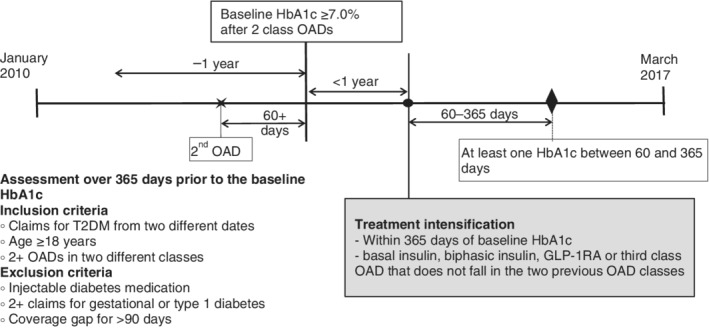
A retrospective cohort study was conducted using a regional health plan claims database for the period January 1, 2010 to March 31, 2017. Patients with type 2 diabetes (T2DM) whose treatment was intensified with insulin, a glucagon-like peptide-1 receptor agonist or a third OAD within 365 days of having HbA1c ≥53 mmol/mol (7.0%) on two OADs were included. The HbA1c trajectory for 1 year after intensification was estimated using a mixed-effects regression model.
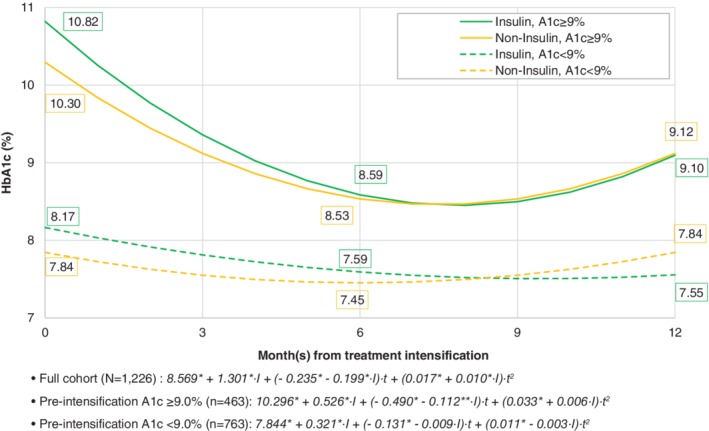
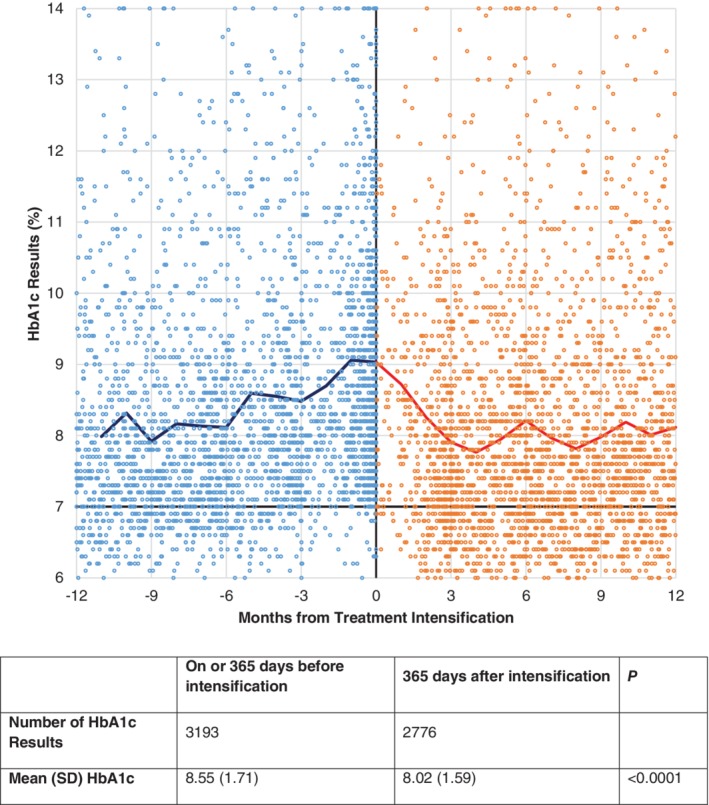
The analysis included 1226 patients with a mean ± SD HbA1c at treatment intensification of 74.2 ± 18.7 mmol/mol (8.93 ± 1.7%). HbA1c was higher in the insulin group (74.2 mmol/mol) than in the non-insulin group (70.6 mmol/mol), as was the HbA1c decrease (P < 0.01) over the 1-year follow-up, particularly in patients with baseline HbA1c >9%. After intensification, insulin- and non-insulin-treated patients achieved an average change by month in HbA1c of -4.7 mmol/mol and -2.6 mmol/mol points, respectively. The analysis predicted HbA1c to be the lowest at 6 to 10 months post intensification, depending on intensification treatment and HbA1c at intensification; however, on average, HbA1c remained above 64.0 mmol/mol (8.0%).
In patients with T2DM, intensification following an HbA1c value ≥53 mmol/mol (7.0%) while on two OADs was associated with a significant improvement in glycaemic control. Patients intensified with insulin had a higher baseline HbA1c but greater HbA1c reduction than those intensified with a non-insulin agent. However, HbA1c remained above 64 mmol/mol (8.0%) overall. Additional opportunity exists to further intensify therapy to improve glycaemic control.
在接受两种口服降糖药(OAD)治疗时,糖化血红蛋白(HbA1c)>53mmol/mol(7.0%)的患者经治疗强化后,确定 1 年内 HbA1c 的变化情况。
对 2010 年 1 月 1 日至 2017 年 3 月 31 日期间使用区域健康计划理赔数据库进行了回顾性队列研究。纳入在接受两种 OAD 治疗时,HbA1c≥53mmol/mol(7.0%)且在 365 天内接受胰岛素、胰高血糖素样肽-1 受体激动剂或第三种 OAD 强化治疗的 2 型糖尿病(T2DM)患者。使用混合效应回归模型估算强化治疗后 1 年内的 HbA1c 轨迹。
该分析共纳入 1226 例患者,强化治疗时的平均 HbA1c±SD 为 74.2±18.7mmol/mol(8.93±1.7%)。胰岛素组的 HbA1c(74.2mmol/mol)高于非胰岛素组(70.6mmol/mol),并且在 1 年随访期间 HbA1c 下降幅度更大(P<0.01),基线 HbA1c>9%的患者尤其如此。强化治疗后,胰岛素治疗和非胰岛素治疗的患者 HbA1c 每月平均变化分别为-4.7mmol/mol 和-2.6mmol/mol。分析预测,根据强化治疗和强化治疗时的 HbA1c,HbA1c 在强化治疗后 6 至 10 个月达到最低水平;然而,平均而言,HbA1c 仍高于 64.0mmol/mol(8.0%)。
在接受两种 OAD 治疗时,HbA1c 值≥53mmol/mol(7.0%)的 T2DM 患者强化治疗后,血糖控制得到显著改善。与接受非胰岛素药物强化治疗的患者相比,接受胰岛素强化治疗的患者基线 HbA1c 更高,但 HbA1c 降低幅度更大。然而,总体而言,HbA1c 仍高于 64mmol/mol(8.0%)。还有进一步强化治疗以改善血糖控制的机会。