• 文献检索
  • 文档翻译
  • 深度研究
  • 学术资讯
  • Suppr Zotero 插件Zotero 插件
  • 邀请有礼
  • 套餐&价格
  • 历史记录
应用&插件
Suppr Zotero 插件Zotero 插件浏览器插件Mac 客户端Windows 客户端微信小程序
定价
高级版会员购买积分包购买API积分包
服务
文献检索文档翻译深度研究API 文档MCP 服务
关于我们
关于 Suppr公司介绍联系我们用户协议隐私条款
关注我们

Suppr 超能文献

核心技术专利:CN118964589B侵权必究
粤ICP备2023148730 号-1Suppr @ 2026

文献检索

告别复杂PubMed语法,用中文像聊天一样搜索,搜遍4000万医学文献。AI智能推荐,让科研检索更轻松。

立即免费搜索

文件翻译

保留排版,准确专业,支持PDF/Word/PPT等文件格式,支持 12+语言互译。

免费翻译文档

深度研究

AI帮你快速写综述,25分钟生成高质量综述,智能提取关键信息,辅助科研写作。

立即免费体验

肯尼亚产科瘘女性患者恢复正常和重新融入社会的扎根理论。

A grounded theory of regaining normalcy and reintegration of women with obstetric fistula in Kenya.

机构信息

University of Nairobi, School of Nursing Sciences, P.O. Box 30197-00100, Nairobi, Kenya.

African Population and Health Research Centre, P.O. Box 10787-00100, Nairobi, Kenya.

出版信息

Reprod Health. 2019 Mar 8;16(1):29. doi: 10.1186/s12978-019-0692-y.

DOI:10.1186/s12978-019-0692-y
PMID:30849992
原文链接:https://pmc.ncbi.nlm.nih.gov/articles/PMC6408802/
Abstract

BACKGROUND

Obstetric fistula is a reproductive health problem causing immense suffering to 1% of women in Kenya that is formed as sequelae of prolonged obstructed labour. It is a chronic illness that disrupts women lives, causing stigma and isolation. Fistula illness often introduces a crisis in women's life begetting feelings of shame and serious disruption to their social, psychological, physical and economic lives, in addition to dealing with moral and hygiene challenges. Currently, women undergo free of charge surgery at vesicovaginal fistula (VVF) camps held in national referral hospitals and dedicated fistula centres generating a significant pool of women who have undergone surgery and are ready to regain normal lives.

OBJECTIVE

The purpose of this study was to explore experiences of women immersing back into communities and their return to normalcy after surgery in three VVF repair centres in Kenya. We set out to answer the question: what strategies improve obstetric fistula patients' reintegration process?

METHODS

We used grounded theory methodology to capture the reintegration and regaining normalcy experiences of women after surgery. Narrative interviews were held with 60 women during community follow-up visits in their homes after 6-19 months postoperatively. Grounded theory processes of theoretical sampling, repeated measurement; constant comparative coding in three stage open, axial and selective coding; memoing, reflexivity and positionality were applied. Emergent themes helped generate a grounded theory of reintegration and regaining normalcy for fistula patients.

RESULTS

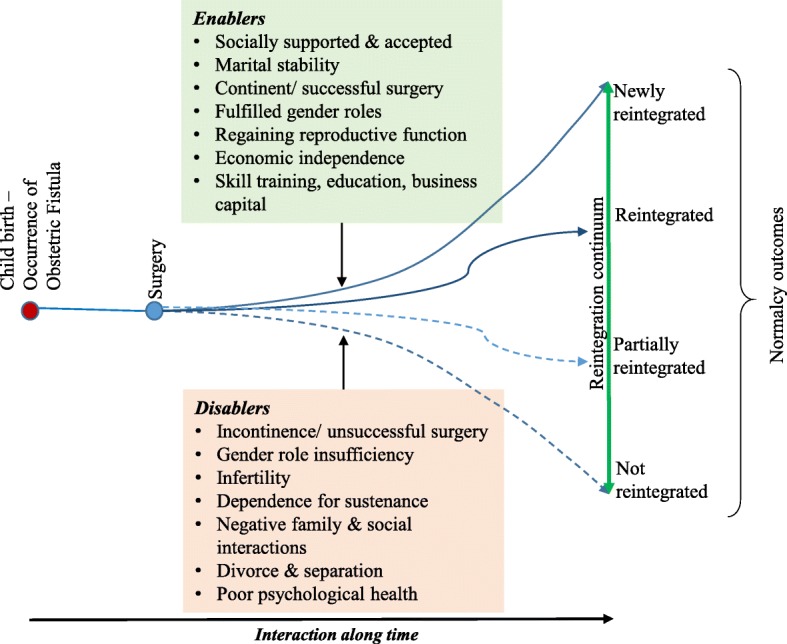
To regain normal healthy lives, women respond to fistula illness by seeking surgery.. After surgery, four possible outcomes of the reintegration process present; reintegration fully or partially back into their previous communities, not reintegrated or newly integrating away from previous social and family settings. The reintegration statuses point to the diversity outcomes of care for fistula patients and the necessity of tailoring treatment programs to cater for individual patient needs.

CONCLUSION

The emerging substantive theory on the process of reintegration and regaining normalcy for fistula patients is presented. The study findings have implications for fistula care, training and policy regarding women's health, suggesting a model of care that encompasses physical, social, economic and psychological aspects of care after surgery and discharge.

摘要

背景

产科瘘是一种生殖健康问题,在肯尼亚,1%的女性深受其害,它是由长时间难产导致的后遗症。这是一种慢性疾病,扰乱了女性的生活,给她们带来耻辱感和孤立感。瘘病常常给女性的生活带来危机,使她们感到羞耻,并严重扰乱她们的社会、心理、身体和经济生活,此外还面临道德和卫生方面的挑战。目前,女性在国家转诊医院和专门的瘘管中心举办的免费膀胱阴道瘘(VVF)营地接受手术,这为已经接受手术并准备恢复正常生活的大量女性提供了机会。

目的

本研究旨在探讨肯尼亚三个 VVF 修复中心的女性重返社区和术后恢复正常生活的经历。我们旨在回答以下问题:哪些策略可以改善产科瘘患者的重返社会过程?

方法

我们使用扎根理论方法来捕捉女性术后重返社会和恢复正常生活的经历。在术后 6-19 个月,对 60 名女性进行了家庭随访中的叙事访谈。扎根理论的过程包括理论抽样、重复测量、三阶段开放式、轴向和选择性编码的反复编码;记笔记、反思和定位。出现的主题有助于为瘘管患者的重新融入和恢复正常生活生成一个扎根理论。

结果

为了恢复正常健康的生活,女性会因瘘病寻求手术。手术后,重新融入过程可能会出现四种结果;完全或部分重新融入以前的社区,无法重新融入或新的社会和家庭环境中重新融入。重新融入的状态表明了对瘘管患者护理的多样性结果,以及根据患者个体需求定制治疗方案的必要性。

结论

提出了关于瘘管患者重新融入和恢复正常生活过程的新兴实质性理论。研究结果对瘘管护理、培训和妇女健康政策具有启示意义,表明手术后和出院后的护理模式应包括身体、社会、经济和心理方面的护理。
https://cdn.ncbi.nlm.nih.gov/pmc/blobs/9175/6408802/490ac8529f61/12978_2019_692_Fig1_HTML.jpg

相似文献

1
A grounded theory of regaining normalcy and reintegration of women with obstetric fistula in Kenya.肯尼亚产科瘘女性患者恢复正常和重新融入社会的扎根理论。
Reprod Health. 2019 Mar 8;16(1):29. doi: 10.1186/s12978-019-0692-y.
2
'I stayed with my illness': a grounded theory study of health seeking behaviour and treatment pathways of patients with obstetric fistula in Kenya.“我与疾病相伴”:一项关于肯尼亚产科瘘患者求医行为及治疗途径的扎根理论研究
BMC Womens Health. 2017 Sep 29;17(1):92. doi: 10.1186/s12905-017-0451-6.
3
Secrecy inhibits support: A grounded theory of community perspectives of women suffering from obstetric fistula, in Kenya.保密阻碍支持:肯尼亚社区对患有产科瘘管病妇女看法的扎根理论
Midwifery. 2016 Nov;42:54-60. doi: 10.1016/j.midw.2016.10.001. Epub 2016 Oct 4.
4
Exploring the needs and challenges of women reintegrating after obstetric fistula repair in northern Ghana.探索加纳北部产科瘘修补术后妇女重新融入社会的需求与挑战。
Midwifery. 2017 Jul;50:55-61. doi: 10.1016/j.midw.2017.03.013. Epub 2017 Mar 27.
5
Reintegration needs of young women following genitourinary fistula surgery in Uganda.乌干达年轻女性泌尿生殖瘘手术后的重新融入需求。
Int Urogynecol J. 2019 Jul;30(7):1101-1110. doi: 10.1007/s00192-019-03896-y. Epub 2019 Feb 27.
6
"I became a person again": Social inclusion and participation experiences of Ethiopian women post-obstetric fistula surgical repair.“我又成为了一个人”:埃塞俄比亚女性产后瘘手术后的社会包容和参与经历。
PLoS One. 2024 Jul 11;19(7):e0307021. doi: 10.1371/journal.pone.0307021. eCollection 2024.
7
"Hoping for a normal life again": reintegration after fistula repair in rural Tanzania.“渴望重归正常生活”:坦桑尼亚农村地区肛瘘修复术后的重新融入
J Obstet Gynaecol Can. 2012 Oct;34(10):927-938. doi: 10.1016/S1701-2163(16)35406-8.
8
Beyond repair - family and community reintegration after obstetric fistula surgery: study protocol.无法修复——产科瘘修补术后家庭与社区重新融入:研究方案
Reprod Health. 2015 Dec 18;12:115. doi: 10.1186/s12978-015-0100-1.
9
Understanding the lived experience of women before and after fistula repair: a qualitative study in Kenya.了解肯尼亚女性瘘管修复前后的生活体验:一项定性研究。
BJOG. 2017 Feb;124(3):503-510. doi: 10.1111/1471-0528.13902. Epub 2016 Feb 19.
10
Obstetric fistula in southern Mozambique: a qualitative study on women's experiences of care pregnancy, delivery and post-partum.莫桑比克南部的产科瘘:对妇女在怀孕、分娩和产后期间的护理经历的定性研究。
Reprod Health. 2020 Jan 31;17(1):21. doi: 10.1186/s12978-020-0860-0.

引用本文的文献

1
Supporting Women after Obstetric Fistula Surgery to Enhance Their Social Participation and Inclusion.支持产科瘘手术后的妇女,增强其社会参与和包容。
Int J Environ Res Public Health. 2024 Sep 10;21(9):1201. doi: 10.3390/ijerph21091201.
2
Factors associated with reintegration trajectory following female genital fistula surgery in Uganda.乌干达女性生殖器瘘管手术后与重新融入轨迹相关的因素。
AJOG Glob Rep. 2023 Aug 12;3(4):100261. doi: 10.1016/j.xagr.2023.100261. eCollection 2023 Nov.
3
Social Immersion for Women After Repair for Obstetric Fistula: An Experience in Guinea.

本文引用的文献

1
'I stayed with my illness': a grounded theory study of health seeking behaviour and treatment pathways of patients with obstetric fistula in Kenya.“我与疾病相伴”:一项关于肯尼亚产科瘘患者求医行为及治疗途径的扎根理论研究
BMC Womens Health. 2017 Sep 29;17(1):92. doi: 10.1186/s12905-017-0451-6.
2
Fistula recurrence, pregnancy, and childbirth following successful closure of female genital fistula in Guinea: a longitudinal study.女性生殖器瘘管成功关闭后瘘管复发、妊娠和分娩:一项纵向研究。
Lancet Glob Health. 2017 Nov;5(11):e1152-e1160. doi: 10.1016/S2214-109X(17)30366-2. Epub 2017 Sep 21.
3
Development and preliminary validation of a post-fistula repair reintegration instrument among Ugandan women.
产科瘘修补术后妇女的社会融入:几内亚的一项经验
Front Glob Womens Health. 2021 Sep 3;2:713350. doi: 10.3389/fgwh.2021.713350. eCollection 2021.
4
Health-related quality of life of hospitalized COVID-19 survivors: An initial exploration in Nanning city, China.住院 COVID-19 幸存者的健康相关生活质量:中国南宁市的初步探索。
Soc Sci Med. 2021 Apr;274:113748. doi: 10.1016/j.socscimed.2021.113748. Epub 2021 Feb 12.
5
Integrated mental health screening for obstetric fistula patients in Mali: From evidence to policy.马里产科瘘患者的综合心理健康筛查:从证据到政策。
PLoS One. 2020 Sep 4;15(9):e0238777. doi: 10.1371/journal.pone.0238777. eCollection 2020.
6
Rehabilitation and reintegration programming adjunct to female genital fistula surgery: A systematic scoping review.康复和重新融入方案作为女性生殖器瘘管手术的辅助手段:系统范围界定综述。
Int J Gynaecol Obstet. 2020 Jan;148 Suppl 1(Suppl 1):42-58. doi: 10.1002/ijgo.13039.
发展并初步验证了一款用于乌干达女性瘘管修复后重返社会的工具。
Reprod Health. 2017 Sep 2;14(1):109. doi: 10.1186/s12978-017-0372-8.
4
Unsettling the fistula narrative: cultural pathology, biomedical redemption, and inequities of health access in Niger and Ethiopia.打破瘘管病的叙事:文化病理学、生物医学救赎以及尼日尔和埃塞俄比亚的医疗获取不平等问题
Anthropol Med. 2017 Apr;24(1):81-95. doi: 10.1080/13648470.2016.1249252. Epub 2017 Jan 31.
5
Beyond repair - family and community reintegration after obstetric fistula surgery: study protocol.无法修复——产科瘘修补术后家庭与社区重新融入:研究方案
Reprod Health. 2015 Dec 18;12:115. doi: 10.1186/s12978-015-0100-1.
6
Obstetric Fistula "Disease" and Ensuing Care: Patients' Views in West-Africa.产科瘘“疾病”及后续护理:西非患者的观点
Afr J Reprod Health. 2015 Mar;19(1):112-23.
7
Prevalence of symptoms of vaginal fistula in 19 sub-Saharan Africa countries: a meta-analysis of national household survey data.撒哈拉以南非洲 19 个国家阴道瘘症状的患病率:国家家庭调查数据的荟萃分析。
Lancet Glob Health. 2015 May;3(5):e271-8. doi: 10.1016/S2214-109X(14)70348-1.
8
Rehabilitation experiences after obstetric fistula repair: systematic review of qualitative studies.产科瘘修补术后的康复经历:定性研究的系统评价
Trop Med Int Health. 2015 May;20(5):554-568. doi: 10.1111/tmi.12469. Epub 2015 Feb 18.
9
Quality of life of Ethiopian women after fistula repair: implications on rehabilitation and social reintegration policy and programming.埃塞俄比亚妇女瘘管修补术后的生活质量:对康复及社会重新融入政策与规划的影响
Cult Health Sex. 2015;17(2):150-64. doi: 10.1080/13691058.2014.964320. Epub 2014 Oct 15.
10
Profiles and experiences of women undergoing genital fistula repair: findings from five countries.女性生殖器瘘管修复患者的特征和经历:来自五个国家的调查结果。
Glob Public Health. 2013;8(8):926-42. doi: 10.1080/17441692.2013.824018. Epub 2013 Aug 16.