Department of Biomedical Sciences, City University of Hong Kong, Kowloon Tong, Hong Kong.
Singapore Centre for Environmental Life Sciences Engineering (SCELSE), Nanyang Technological University, Singapore.
Appl Environ Microbiol. 2019 May 2;85(10). doi: 10.1128/AEM.00152-19. Print 2019 May 15.
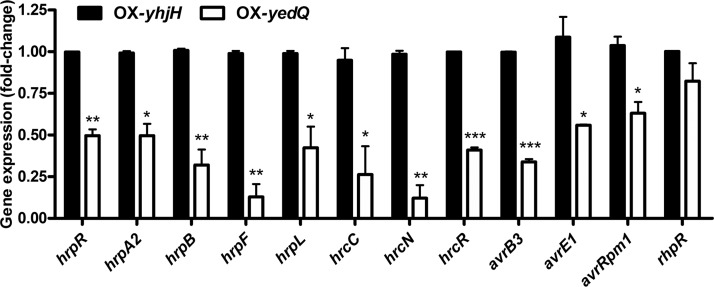
Although the ubiquitous bacterial secondary messenger cyclic diguanylate (c-di-GMP) has important cellular functions in a wide range of bacteria, its function in the model plant pathogen remains largely elusive. To this end, we overexpressed diguanylate cyclase (YedQ) and phosphodiesterase (YhjH) in , resulting in high and low levels of c-di-GMP, respectively. Via genome-wide RNA sequencing of these two strains, we found that c-di-GMP regulates (i) , , and , which are associated with flagellar assembly; (ii) and , which are related to the exopolysaccharide biosynthesis pathway; (iii) , , and , which are associated with the siderophore biosynthesis pathway; and (iv) , which encodes a superoxide dismutase. In particular, we identified three promoters that are sensitive to elevated levels of c-di-GMP and inserted them into luciferase-based reporters that respond effectively to the c-di-GMP levels in ; these promoters could be useful in the measurement of levels of c-di-GMP in real time. Further phenotypic assays validated the RNA sequencing (RNA-seq) results and confirmed the effect on c-di-GMP-associated pathways, such as repressing the type III secretion system (T3SS) and motility while inducing biofilm production, siderophore production, and oxidative stress resistance. Taken together, these results demonstrate that c-di-GMP regulates the virulence and stress response in , which suggests that tuning its level could be a new strategy to protect plants from attacks by this pathogen. The present work comprehensively analyzed the transcriptome and phenotypes that were regulated by c-di-GMP in Given that the majority of diguanylate cyclases and phosphodiesterases have not been characterized in , this work provided a very useful database for the future study on regulatory mechanism (especially its relationship with T3SS) of c-di-GMP in In particular, we identified three promoters that were sensitive to elevated c-di-GMP levels and inserted them into luciferase-based reporters that effectively respond to intracellular levels of c-di-GMP in , which could be used as an economic and efficient way to measure relative c-di-GMP levels in the future.
尽管普遍存在的细菌第二信使环二鸟苷酸(c-di-GMP)在广泛的细菌中具有重要的细胞功能,但它在模式植物病原体中的功能在很大程度上仍是未知的。为此,我们在 中过表达了环二鸟苷酸合酶(YedQ)和磷酸二酯酶(YhjH),分别导致 c-di-GMP 的水平升高和降低。通过对这两个菌株的全基因组 RNA 测序,我们发现 c-di-GMP 调节(i)与鞭毛组装相关的 、 、 ;(ii)与胞外多糖生物合成途径相关的 、 ;(iii)与铁载体生物合成途径相关的 、 、 ;以及(iv)编码超氧化物歧化酶的 。特别是,我们鉴定了三个对 c-di-GMP 水平升高敏感的启动子,并将它们插入基于荧光素酶的报告基因中,这些报告基因对 中的 c-di-GMP 水平反应灵敏;这些启动子可能在实时测量 c-di-GMP 的水平方面很有用。进一步的表型分析验证了 RNA 测序(RNA-seq)结果,并证实了 c-di-GMP 相关途径的影响,如抑制 III 型分泌系统(T3SS)和运动性,同时诱导生物膜形成、铁载体产生和氧化应激抗性。总之,这些结果表明 c-di-GMP 调节 在中的毒力和应激反应,这表明调节其水平可能是保护植物免受这种病原体攻击的一种新策略。本工作全面分析了 c-di-GMP 在 中调节的转录组和表型。鉴于大多数环二鸟苷酸合酶和磷酸二酯酶尚未在 中得到表征,这项工作为未来研究 c-di-GMP 在 中的调节机制(特别是与 T3SS 的关系)提供了一个非常有用的数据库。特别是,我们鉴定了三个对 c-di-GMP 水平升高敏感的启动子,并将它们插入基于荧光素酶的报告基因中,这些报告基因对 中的细胞内 c-di-GMP 水平反应灵敏,这可以作为一种经济高效的方法,用于未来测量相对 c-di-GMP 水平。