Georgetown Lombardi Comprehensive Cancer Center, Georgetown University Medical Center, 4000 Reservoir Road NW, 120 Building D, Washington, DC, 20057-1400, USA.
MedStar Heart & Vascular Institute, Washington, DC, USA.
Breast Cancer Res Treat. 2019 Jun;175(3):595-603. doi: 10.1007/s10549-019-05191-2. Epub 2019 Mar 9.
HER2-targeted therapies have substantially improved the outcome of patients with breast cancer, however, they can be associated with cardiac toxicity. Guidelines recommend holding HER2-targeted therapies until resolution of cardiac dysfunction. SAFE-HEaRt is the first trial that prospectively tests whether these therapies can be safely administered without interruptions in patients with cardiac dysfunction.
Patients with stage I-IV HER2-positive breast cancer candidates for trastuzumab, pertuzumab or ado-trastuzumab emtansine (TDM-1), with left ventricular ejection fraction (LVEF) 40-49% and no symptoms of heart failure (HF) were enrolled. All patients underwent cardiology visits, serial echocardiograms and received beta blockers and ACE inhibitors unless contraindicated. The primary endpoint was completion of the planned HER2-targeted therapies without developing either a cardiac event (CE) defined as HF, myocardial infarction, arrhythmia or cardiac death or significant asymptomatic worsening of LVEF. The study was considered successful if planned oncology therapy completion rate was at least 30%.
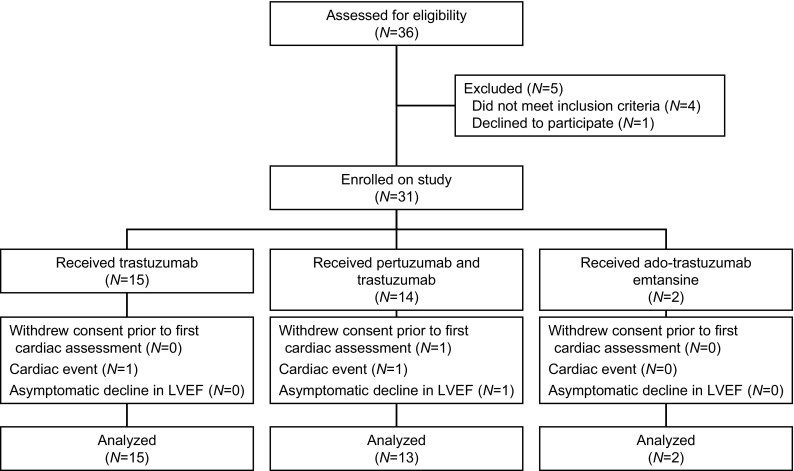
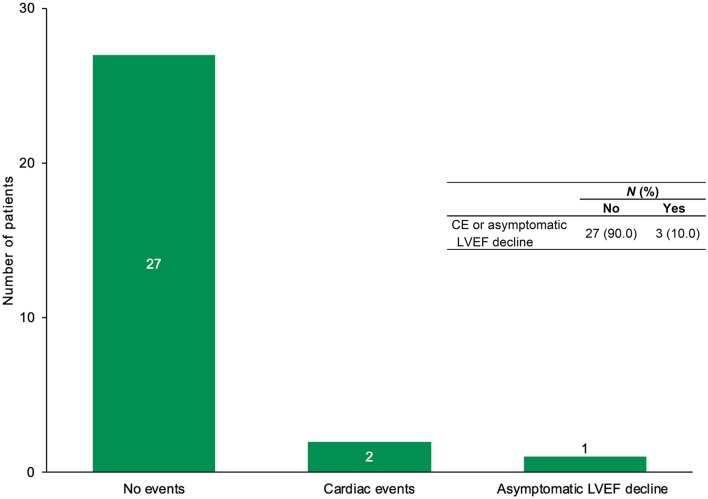
Of 31 enrolled patients, 30 were evaluable. Fifteen patients were treated with trastuzumab, 14 with trastuzumab and pertuzumab, and 2 with TDM-1. Mean LVEF was 45% at baseline and 46% at the end of treatment. Twenty-seven patients (90%) completed the planned HER2-targeted therapies. Two patients experienced a CE and 1 had an asymptomatic worsening of LVEF to ≤ 35%.
This study provides safety data of HER2-targeted therapies in patients with breast cancer and reduced LVEF while receiving cardioprotective medications and close cardiac monitoring. Our results demonstrate the importance of collaboration between cardiology and oncology providers to allow for delivery of optimal oncologic care to this unique population.
HER2 靶向治疗显著改善了乳腺癌患者的预后,但可能与心脏毒性相关。指南建议在心脏功能障碍解决之前暂停使用 HER2 靶向治疗。SAFE-HEaRt 是首个前瞻性试验,旨在测试在伴有心脏功能障碍的患者中,这些治疗方法是否可以在不停药的情况下安全使用。
本研究纳入了适合接受曲妥珠单抗、帕妥珠单抗或恩美曲妥珠单抗(T-DM1)治疗的 I-IV 期 HER2 阳性乳腺癌患者,这些患者的左心室射血分数(LVEF)为 40%-49%,且无心力衰竭(HF)症状。所有患者均接受了心脏病学检查、连续超声心动图检查,并接受了β受体阻滞剂和血管紧张素转换酶抑制剂(ACEI)治疗,除非有禁忌症。主要终点是在不发生心脏事件(CE)的情况下完成计划的 HER2 靶向治疗,CE 定义为 HF、心肌梗死、心律失常或心脏死亡或 LVEF 无症状恶化。如果计划的肿瘤学治疗完成率至少为 30%,则认为该研究成功。
31 例入组患者中,30 例可评估。15 例患者接受曲妥珠单抗治疗,14 例患者接受曲妥珠单抗和帕妥珠单抗治疗,2 例患者接受 T-DM1 治疗。基线时平均 LVEF 为 45%,治疗结束时为 46%。27 例(90%)患者完成了计划的 HER2 靶向治疗。2 例患者发生了 CE,1 例患者出现了无症状的 LVEF 下降至≤35%。
这项研究提供了在接受心脏保护药物和密切心脏监测的同时,接受乳腺癌和降低 LVEF 的患者使用 HER2 靶向治疗的安全性数据。我们的结果表明,心脏病学和肿瘤学提供者之间的合作对于为这一独特人群提供最佳肿瘤学护理非常重要。