Kim Jeongtae, Ahn Meejung, Choi Yuna, Ekanayake Poornima, Park Chul Min, Moon Changjong, Jung Kyungsook, Tanaka Akane, Matsuda Hiroshi, Shin Taekyun
Department of Veterinary Anatomy, College of Veterinary Medicine and Veterinary Medical Research Institute, Jeju National University, Jeju 63243, Korea.
Department of Obstetrics and Gynecology, School of Medicine, Jeju National University, Jeju 63243, Korea.
Exp Neurobiol. 2019 Feb;28(1):74-84. doi: 10.5607/en.2019.28.1.74. Epub 2019 Feb 28.
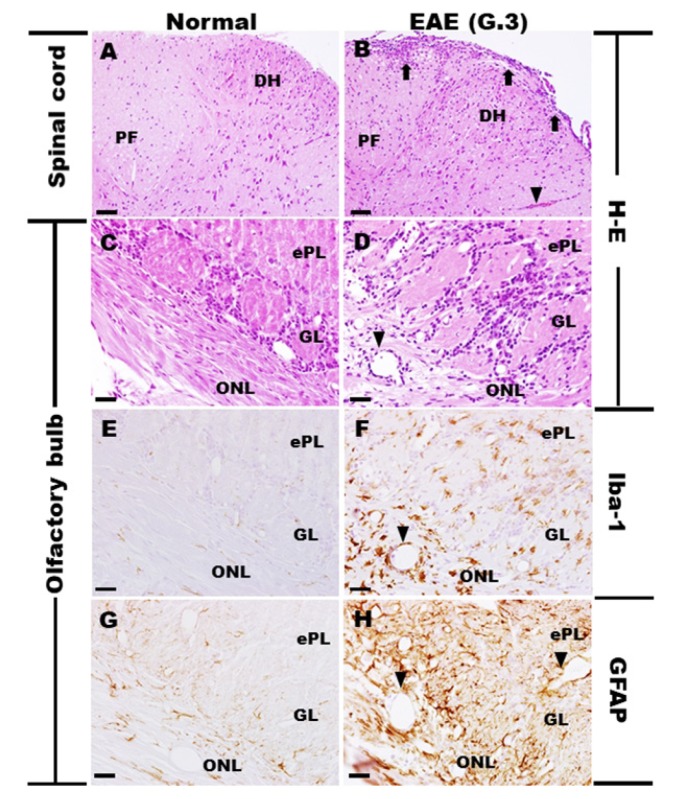
Olfactory dysfunction occurs in multiple sclerosis in humans, as well as in an animal model of experimental autoimmune encephalomyelitis (EAE). The aim of this study was to analyze differentially expressed genes (DEGs) in olfactory bulb of EAE-affected mice by next generation sequencing, with a particular focus on changes in olfaction-related signals. EAE was induced in C57BL/6 mice following immunization with myelin oligodendrocyte glycoprotein and adjuvant. Inflammatory lesions were identified in the olfactory bulbs as well as in the spinal cord of immunized mice. Analysis of DEGs in the olfactory bulb of EAE-affected mice revealed that 44 genes were upregulated (and which were primarily related to inflammatory mediators), while 519 genes were downregulated; among the latter, olfactory marker protein and stomatin-like 3, which have been linked to olfactory signal transduction, were significantly downregulated (log2 [fold change] >1 and p-value <0.05). These findings suggest that inflammation in the olfactory bulb of EAE-affected mice is associated with the downregulation of some olfactory signal transduction genes, particularly olfactory marker protein and stomatin-like 3, which may lead to olfactory dysfunction in an animal model of human multiple sclerosis.
嗅觉功能障碍在人类多发性硬化症以及实验性自身免疫性脑脊髓炎(EAE)动物模型中均有发生。本研究的目的是通过下一代测序分析EAE感染小鼠嗅球中的差异表达基因(DEG),特别关注嗅觉相关信号的变化。用髓鞘少突胶质细胞糖蛋白和佐剂免疫C57BL/6小鼠诱导EAE。在免疫小鼠的嗅球以及脊髓中发现了炎性病变。对EAE感染小鼠嗅球中的DEG分析显示,44个基因上调(主要与炎症介质相关),而519个基因下调;在后者中,与嗅觉信号转导相关的嗅觉标记蛋白和类stomatin 3显著下调(log2[倍数变化]>1且p值<0.05)。这些发现表明,EAE感染小鼠嗅球中的炎症与一些嗅觉信号转导基因的下调有关,特别是嗅觉标记蛋白和类stomatin 3,这可能导致人类多发性硬化症动物模型中的嗅觉功能障碍。