Sohn Mira, Balla Tamas
Section on Molecular Signal Transduction, Program for Developmental Neuroscience, Eunice Kennedy Shriver NICHD, National Institutes of Health, Bethesda, Maryland 20892, USA.
J Rare Dis Res Treat. 2016;2(1):47-51. doi: 10.29245/2572-9411/2017/1.1080. Epub 2016 Dec 29.
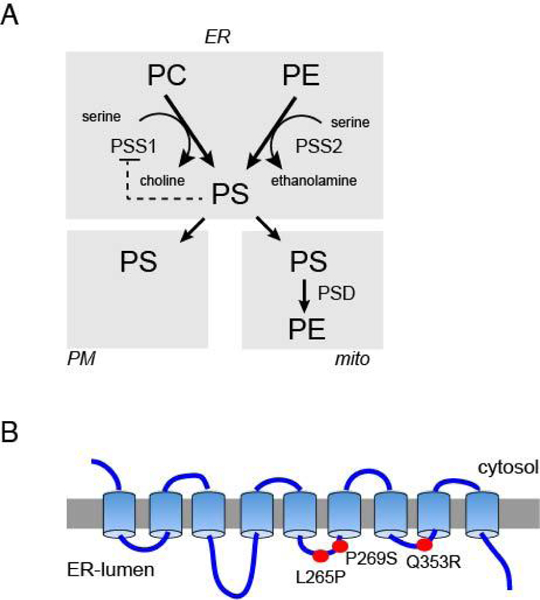
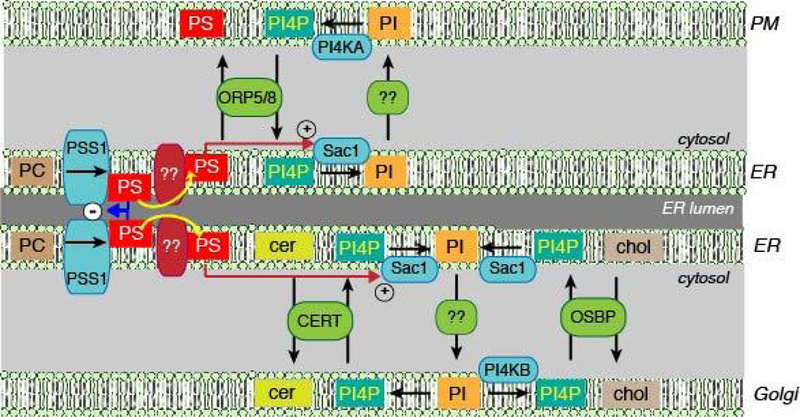
Lenz-Majewski syndrome (LMS) is a rare disease presenting with complex physical and mental abnormalities. Whole exome sequencing performed on five LMS-affected individuals has identified gain-of-function mutations in the PTDSS1 gene encoding phosphatidylserine synthase 1 (PSS1) enzyme. These mutations all rendered PSS1 insensitive to PS-mediated product inhibition. In a recent study we showed that uncontrolled PS production by these mutant PSS1 enzymes lead to the accumulation of PS in the ER where it is not detected in normal cells. This increased PS in the ER in turn, activated the Sac1 phosphatase, which is responsible for the dephosphorylation of the minor lipid, phosphatidylinositol 4-phosphate (PI4P) in the ER. Increased Sac1 activity decreased PI4P levels both in the Golgi and the plasma membrane thereby dissipating the PI4P gradients set up by PI 4-kinase enzymes (PI4Ks) between these membranes and the ER. Such PI4P gradients at membrane contact sites have been shown to support the transports of structural lipids such as cholesterol and PS out of the ER by non-vesicular lipid transfer. Therefore, uncontrolled production of PS not only affects the PS status of cells but also initiates an avalanche of changes in the metabolism of other membrane lipids via affecting PI4P gradients throughout the cell. Recognition of the close metabolic interaction between PS synthesis and PI4P metabolism provided a new clue to better understand the molecular underpinning of this rare and severe disease.
伦茨-马耶夫斯基综合征(LMS)是一种表现出复杂身心异常的罕见疾病。对五名受LMS影响的个体进行的全外显子组测序已在编码磷脂酰丝氨酸合酶1(PSS1)的PTDSS1基因中鉴定出功能获得性突变。这些突变均使PSS1对PS介导的产物抑制不敏感。在最近的一项研究中,我们表明这些突变的PSS1酶不受控制的PS产生导致PS在内质网中积累,而在正常细胞中未检测到这种情况。内质网中PS的增加进而激活了Sac1磷酸酶,该酶负责内质网中次要脂质磷脂酰肌醇4-磷酸(PI4P)的去磷酸化。Sac1活性的增加降低了高尔基体和质膜中的PI4P水平,从而消除了由PI 4-激酶(PI4Ks)在内质网与这些膜之间建立的PI4P梯度。膜接触位点处的这种PI4P梯度已被证明通过非囊泡脂质转运支持胆固醇和PS等结构脂质从内质网中转运出来。因此,不受控制的PS产生不仅影响细胞的PS状态,还通过影响整个细胞中的PI4P梯度引发其他膜脂质代谢的一系列变化。认识到PS合成与PI4P代谢之间密切的代谢相互作用为更好地理解这种罕见严重疾病的分子基础提供了新线索。