Nalado Aishatu Mohammed, Mahlangu Johnny N, Waziri Bala, Duarte Raquel, Paget Graham, Olorunfemi Gbenga, Naicker Saraladevi
Department of Internal Medicine, School of Clinical Medicine, Faculty of Health Science, University of the Witwatersrand, Johannesburg, South Africa,
Department of Internal Medicine, College of Health Sciences, Bayero University, Kano, Nigeria,
Int J Nephrol Renovasc Dis. 2019 Feb 18;12:19-32. doi: 10.2147/IJNRD.S179802. eCollection 2019.
Anemia is a complication of chronic kidney disease (CKD) that can greatly impact on its prognosis. However, the risk factors for anemia, including the influence of ethnicity, are not well established among the CKD population in Johannesburg.
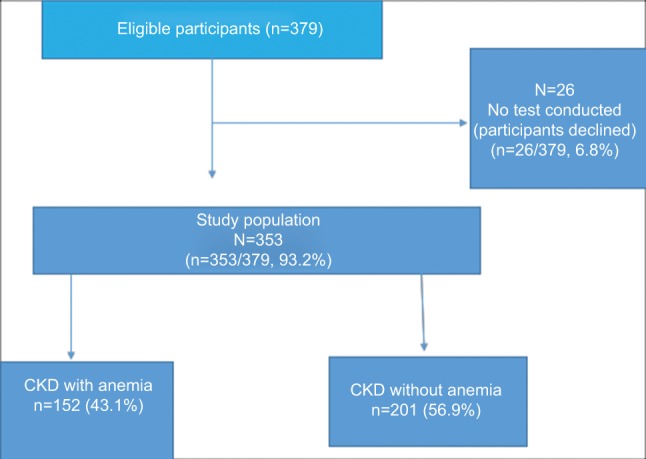
This was a cross-sectional study of 353 adult CKD patients attending the renal outpatient clinic of the Charlotte Maxeke Johannesburg Academic Hospital (Johannesburg, South Africa) from June 1, 2016 to December 30, 2016. Sociodemographic and clinical characteristics were obtained using a proforma. Blood samples were collected for serum electrolytes and hematological parameters. Predictors of low hemoglobin and iron deficiency anemia (IDA) were evaluated using multivariable binary logistic regression.
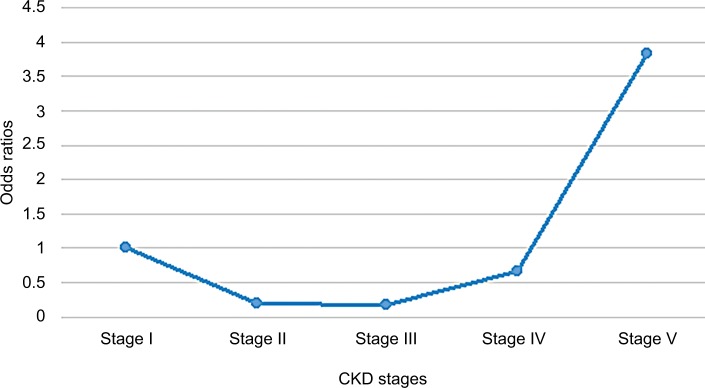
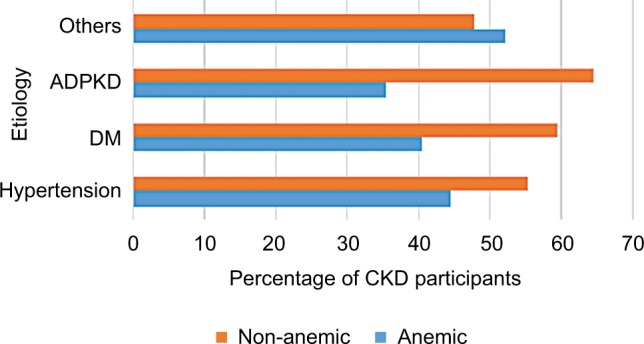
The mean age and prevalence of anemia among the CKD participants were 55.3±15.0 years and 43.18% (95% CI: 38.1%-48.4%), respectively. Blacks had the highest prevalence of anemia (46.9%), while Indians/Asians had the lowest (18.2%). Although the odds of anemia was 3.8-fold higher (odds ratio =3.8, -value =0.059) among CKD stage V participants as compared to CKD stage I, the relationship between anemia and stages of CKD was non-linear. Diabetes mellitus (odds ratio =2.31, -value =0.005) had a strong association with anemia among the CKD participants.
Almost half of the CKD participants were anemic, and the odds of anemia did not increase linearly with increasing severity of CKD. There was a marked ethnic disparity in anemia prevalence. Our study highlights the need for risk-based management of anemia among CKD patients.
贫血是慢性肾脏病(CKD)的一种并发症,会对其预后产生重大影响。然而,在约翰内斯堡的CKD人群中,贫血的危险因素,包括种族的影响,尚未完全明确。
这是一项横断面研究,研究对象为2016年6月1日至2016年12月30日期间在夏洛特·马克西克约翰内斯堡学术医院(南非约翰内斯堡)肾脏门诊就诊的353例成年CKD患者。通过表格获取社会人口统计学和临床特征。采集血样检测血清电解质和血液学参数。使用多变量二元逻辑回归评估低血红蛋白和缺铁性贫血(IDA)的预测因素。
CKD参与者的平均年龄为55.3±15.0岁,贫血患病率为43.18%(95%CI:38.1%-48.4%)。黑人的贫血患病率最高(46.9%),而印度人/亚洲人的患病率最低(18.2%)。尽管与CKD I期参与者相比,CKD V期参与者贫血的几率高3.8倍(优势比=3.8,P值=0.059),但贫血与CKD分期之间的关系并非线性。糖尿病(优势比=2.31,P值=0.005)在CKD参与者中与贫血有很强的关联。
几乎一半的CKD参与者患有贫血,且贫血几率并未随CKD严重程度的增加而呈线性增加。贫血患病率存在明显的种族差异。我们的研究强调了对CKD患者进行基于风险的贫血管理的必要性。