Wang Jie, Li Dong, Xu Zhipeng, Diao Zhenyu, Zhou Jianjun, Lin Fei, Zhang Ningyuan
Reproductive Medical Center, Drum Tower Hospital Affiliated to Nanjing University Medical College, Zhongshan Road 321, Nanjing, 210008 China.
Mol Cytogenet. 2019 Feb 26;12:11. doi: 10.1186/s13039-019-0423-7. eCollection 2019.
To analyse the meiotic segregation modes of chromosomal structural rearrangements (PGT-SR) of reciprocal translocation in biopsied blastocysts from preimplantation genetic testing and to investigate whether any features of reciprocal translocation, such as carrier gender or the presence of acrocentric chromosomes or terminal breakpoints, affect meiotic segregation modes.
Comprehensive chromosomal screening was performed by next generation sequencing (NGS) on 378 biopsied blastocysts from 102 PGD cycles of 89 reciprocal translocation carriers. The segregation modes of a quadrivalent in 378 blastocysts were analysed according to the carrier's gender, chromosome type and the location of chromosome breakpoints.
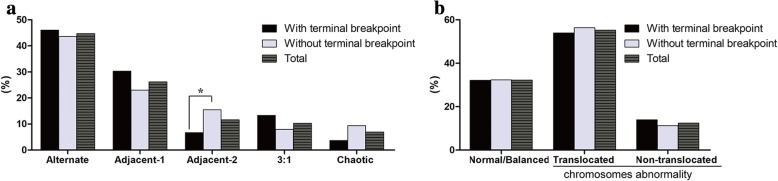
The results showed that 122 out of 378 blastocysts (32.3%) were normal or balanced, 209 (55.3%) were translocated chromosomal abnormalities, and 47 (12.4%) were abnormalities of non-translocated chromosomes. The proportion of translocated chromosomal abnormalities in translocations without acrocentric chromosomes was significantly higher than that in blastocysts from carriers with acrocentric chromosomes (14.8% versus 5.9%, = 0.032). Translocation with acrocentric chromosomes exhibited a significantly higher proportion of 3:1 segregation (24.8% versus 5.1%, < 0.0001) and a lower rate of 2:2 segregation (70.3% versus 87.0%, = 0.00028) compared with the proportions in blastocysts from carriers without acrocentric chromosomes. The frequency of adjacent-2 segregation was significantly different in translocations with terminal breakpoints compared to the frequency in blastocysts from carriers without terminal breakpoints (6.7% versus 15.5%, = 0.013).
This study indicates that the segregation modes in blastocysts were affected by the presence of acrocentric chromosomes and terminal breakpoints, but not by the carrier's sex. Our data may be useful for predicting the segregation pattern of a reciprocal translocation and could support genetic counselling for balanced translocation carriers for PGT cycles using blastocyst biopsy.
分析植入前基因检测中活检囊胚相互易位的染色体结构重排(PGT-SR)的减数分裂分离模式,并研究相互易位的任何特征,如携带者性别、近端着丝粒染色体的存在或末端断点,是否会影响减数分裂分离模式。
对89名相互易位携带者的102个PGD周期的378个活检囊胚进行下一代测序(NGS)以进行全面的染色体筛查。根据携带者的性别、染色体类型和染色体断点位置,分析378个囊胚中四价体的分离模式。
结果显示,378个囊胚中有122个(32.3%)正常或平衡,209个(55.3%)为易位染色体异常,47个(12.4%)为非易位染色体异常。无近端着丝粒染色体的易位中易位染色体异常的比例显著高于有近端着丝粒染色体携带者的囊胚(14.8%对5.9%,P = 0.032)。与无近端着丝粒染色体携带者的囊胚相比,有近端着丝粒染色体的易位显示出显著更高的3:1分离比例(24.8%对5.1%,P < 0.0001)和更低的2:2分离率(70.3%对87.0%,P = 0.00028)。与无末端断点携带者的囊胚相比,有末端断点的易位中相邻-2分离的频率有显著差异(6.7%对15.5%,P = 0.013)。
本研究表明,囊胚中的分离模式受近端着丝粒染色体和末端断点的存在影响,但不受携带者性别影响。我们的数据可能有助于预测相互易位的分离模式,并可为使用囊胚活检的PGT周期中平衡易位携带者的遗传咨询提供支持。