Department of Neurosurgery, University Hospital Heidelberg, Heidelberg, Germany
Division of Neurosurgery, Toronto Western Hospital, University Health Network, Toronto, ON, Canada.
EMBO Mol Med. 2019 Apr;11(4). doi: 10.15252/emmm.201809575.
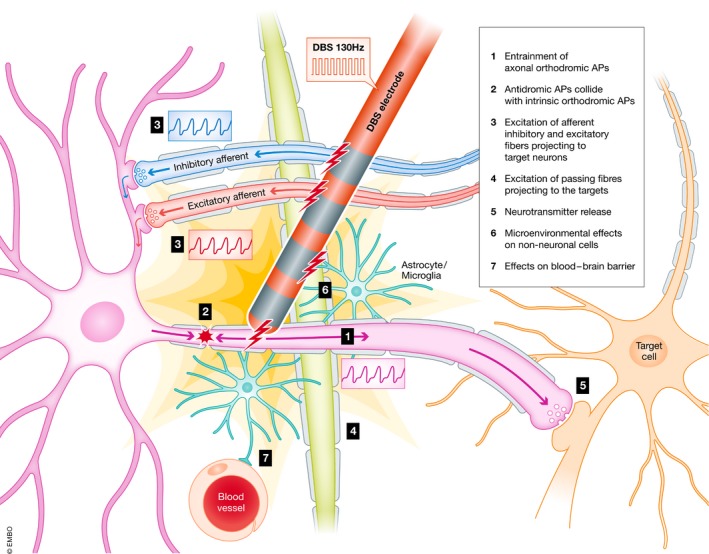
Deep brain stimulation (DBS) has been successfully used to treat movement disorders, such as Parkinson's disease, for more than 25 years and heralded the advent of electrical neuromodulation to treat diseases with dysregulated neuronal circuits. DBS is now superseding ablative techniques, such as stereotactic radiofrequency lesions. While serendipity has played a role in developing DBS as a therapy, research during the past two decades has shown that electrical neuromodulation is far more than a functional lesion that can be switched on and off. This understanding broadens the field to enable new types of stimulation, clinical indications, and research. This review highlights the complex effects of DBS from the single cell to the neuronal network. Specifically, we examine the electrical, cellular, molecular, and neurochemical mechanisms of DBS as applied to Parkinson's disease and other emerging applications.
深部脑刺激(DBS)已成功用于治疗运动障碍 25 年以上,如帕金森病,并开创了电神经调节技术,用于治疗神经元回路失调的疾病。DBS 现在正在取代诸如立体定向射频消融等消融技术。尽管 DBS 的发展具有一定的偶然性,但在过去二十年的研究表明,电神经调节远不止是一种可以开启和关闭的功能性损伤。这种理解拓宽了研究领域,使新的刺激类型、临床适应证和研究成为可能。这篇综述从单细胞到神经网络层面强调了 DBS 的复杂作用。具体来说,我们研究了 DBS 在帕金森病和其他新兴应用中的电、细胞、分子和神经化学机制。