Zhu Guang, Zhang Yuan, Wang Qianrong, Che Shuanlong, Yang Yang, Chen Liyan, Lin Zhenhua
Department of Pathology and Cancer Research Center, Yanbian University Medical College, Yanji 133002, China,
Key Laboratory of the Science and Technology Department of Jilin Province, Yanji 133002, China,
Cancer Manag Res. 2019 Feb 21;11:1741-1752. doi: 10.2147/CMAR.S195093. eCollection 2019.
Tiam1 has been identified as an oncogene and acts as an activator of GTPase Rac. Tiam1 was reported to be a promoter of cancer progression in various cancer types, while in lung adenocarcinoma, its mechanism of action is poorly understood.
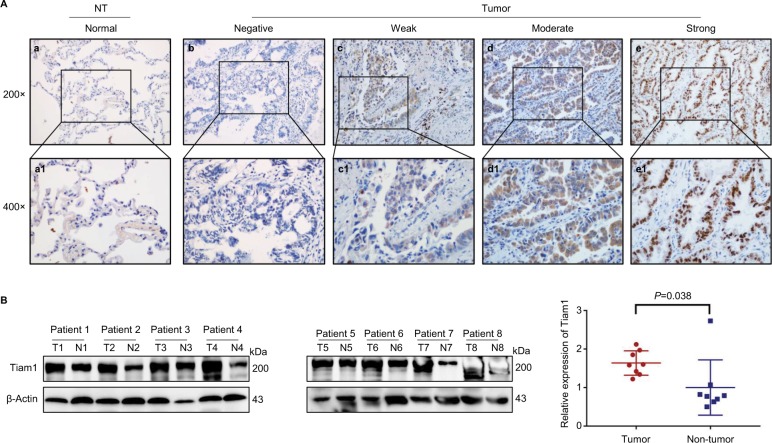
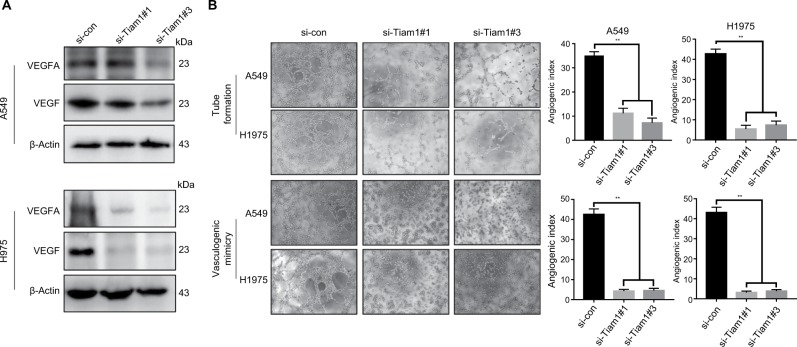
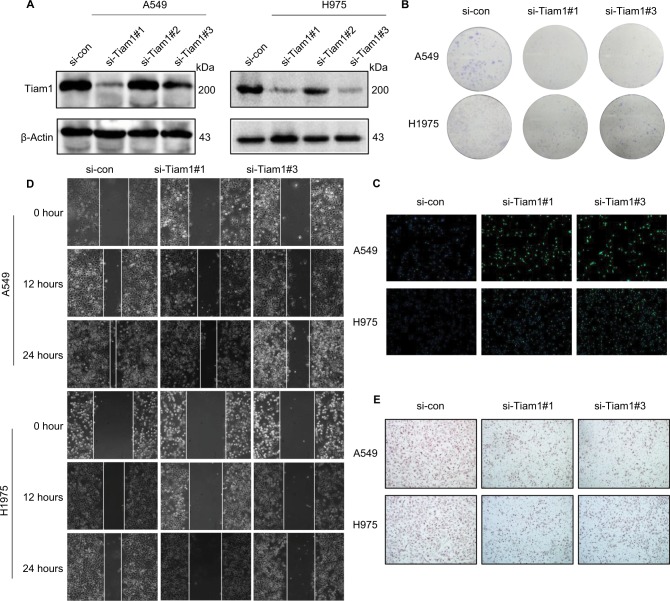
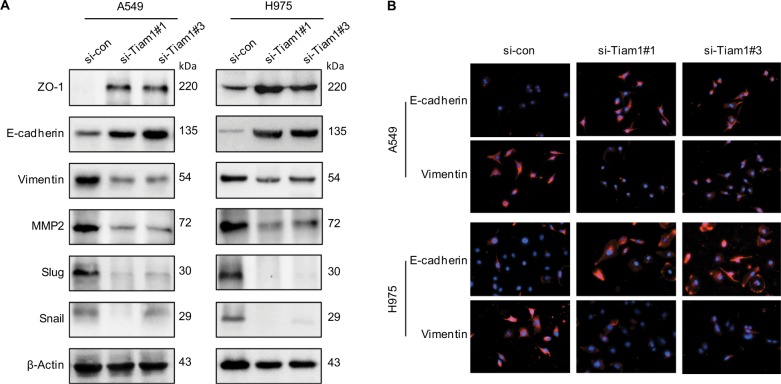
Immunohistochemistry staining and Western blot assay were used to determine Tiam1 expression in lung adenocarcinoma tissues, and its association with prognosis was determined by statistical analysis. We depleted Tiam1 in both A549 and H1975 cancer cell lines. Carboxyfluorescein diacetate succinimidyl ester staining and colony formation assays were used to evaluate its impact on cell proliferation ability after depletion. Transwell migration assay and wound healing assays were performed to determine its impact on migration ability of both cell lines. Western blot assay and immunofluorescence staining were used to analyze the association between Tiam1 and epithelial-mesenchymal transition (EMT) progression. Tube formation assay and vasculogenic mimicry assay were used to show the impact of Tiam1 depletion on cancer angiogenesis.
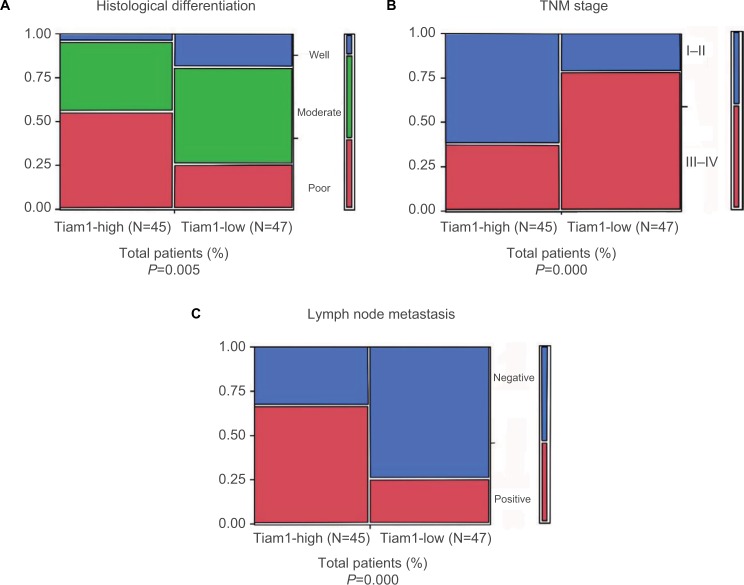
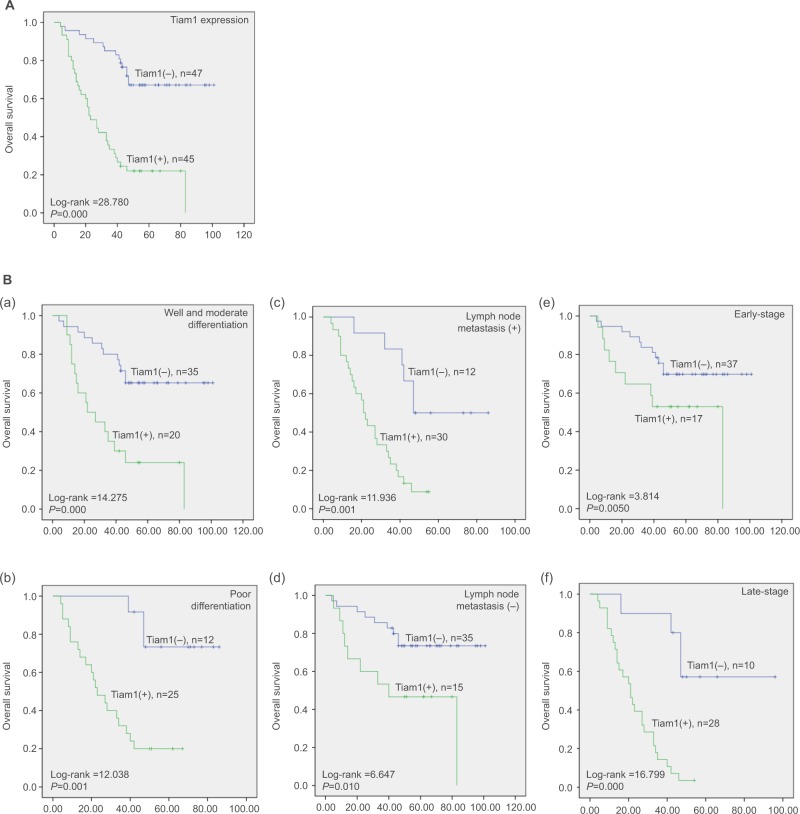
In this study, we demonstrated that Tiam1 overexpression in lung adenocarcinoma was significantly associated with advanced tumor grade and poor prognosis. In vitro assays indicated that Tiam1 depletion significantly inhibited cell proliferation, colony formation, and migration capacities in A549 and H1975 cells. Further investigations revealed that Tiam1 plays an important role in EMT program enhancement, angiogenesis, and accelerated tumor progression. Notably, Tiam1 depletion in cancer cells strongly inhibited human umbilical vein endothelial cell angiogenesis and vasculogenic mimicry capacities of both cancer cell lines.
Tiam1 overexpression is associated with lung adenocarcinoma progression and may indicate poor prognosis. Tiam1 accelerated tumor progression due to EMT and angiogenesis enhancement. Our data may provide a novel therapeutic target for lung adenocarcinoma.
Tiam1已被确定为一种癌基因,可作为GTP酶Rac的激活剂。据报道,Tiam1在多种癌症类型中是癌症进展的促进因子,然而在肺腺癌中,其作用机制尚不清楚。
采用免疫组织化学染色和蛋白质印迹分析来确定肺腺癌组织中Tiam1的表达,并通过统计分析确定其与预后的关系。我们在A549和H1975癌细胞系中使Tiam1缺失。使用羧基荧光素二乙酸琥珀酰亚胺酯染色和集落形成试验来评估其缺失后对细胞增殖能力的影响。进行Transwell迁移试验和伤口愈合试验以确定其对两种细胞系迁移能力的影响。采用蛋白质印迹分析和免疫荧光染色来分析Tiam1与上皮-间质转化(EMT)进程之间的关系。使用管腔形成试验和血管生成拟态试验来显示Tiam1缺失对癌症血管生成的影响。
在本研究中,我们证明肺腺癌中Tiam1的过表达与肿瘤分级高和预后不良显著相关。体外试验表明,Tiam1缺失显著抑制A549和H1975细胞的细胞增殖、集落形成和迁移能力。进一步研究表明,Tiam1在增强EMT程序、血管生成和加速肿瘤进展中起重要作用。值得注意的是,癌细胞中Tiam1的缺失强烈抑制人脐静脉内皮细胞血管生成以及两种癌细胞系的血管生成拟态能力。
Tiam1过表达与肺腺癌进展相关,可能预示预后不良。Tiam1通过增强EMT和血管生成加速肿瘤进展。我们的数据可能为肺腺癌提供一个新的治疗靶点。