Georgiou Polymnia, Zanos Panos, Jenne Carleigh E, Gould Todd D
Department of Psychiatry, School of Medicine, University of Maryland, Baltimore, MD, United States.
Department of Pharmacology, School of Medicine, University of Maryland, Baltimore, MD, United States.
Front Psychiatry. 2019 Feb 26;10:81. doi: 10.3389/fpsyt.2019.00081. eCollection 2019.
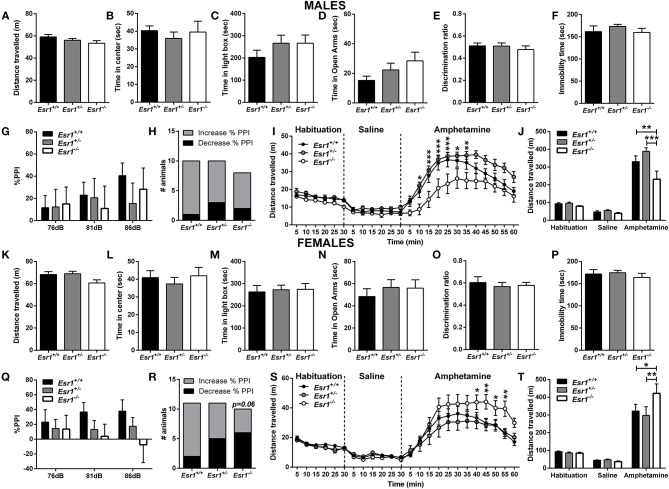
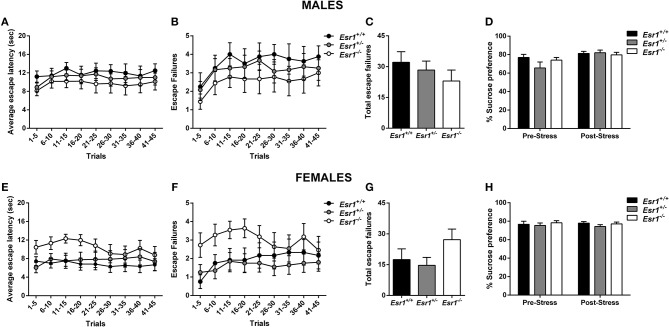
Fluctuating hormone levels, such as estradiol might underlie the difference in the prevalence of psychiatric disorders observed in women vs. men. Estradiol exert its effects primarily through binding on the two classical estrogen receptor subtypes, alpha (ERα) and beta (ERβ). Both receptors have been suggested to a have role in the development of psychiatric disorders, however, most of the current literature is limited to their role in females. We investigated the role of estrogen receptors on cognition (novel-object recognition), anxiety (open-field test, elevated-plus maze, and light/dark box), stress-responsive behaviors (forced-swim test, learned helplessness following inescapable shock, and sucrose preference), pre-pulse inhibition (PPI) and amphetamine-induced hyperlocomotion in both male and female mice either lacking the ERα or ERβ receptor. We found that female mice have attenuated pre-pulse inhibition, whereas female mice manifested enhanced pre-pulse inhibition. No pre-pulse inhibition difference was observed in male and mice. Moreover, amphetamine-induced hyperlocomotion was decreased in male , but not mice, while female and mice showed an enhanced response. Genetic absence of ERα did not alter the escape capability or sucrose preference following inescapable shock in both male and female mice. In contrast, female, but not male mice, manifested decreased escape failures compared with controls. Lack of gene in male mice was associated with decreased sucrose preference following inescapable shock, suggesting susceptibility for development of anhedonia following stress. No sucrose preference differences were found in female mice following inescapable shock stress. Lastly, we demonstrated that lack of or genes had no effect on memory and anxiety-like behaviors in both male and female mice. Our findings indicate a differential sex-specific involvement of estrogen receptors in the development of stress-mediated maladaptive behaviors as well as psychomotor activation responses suggesting that these receptors might act as potential treatment targets in a sex-specific manner.
诸如雌二醇等波动的激素水平可能是女性与男性精神疾病患病率差异的潜在原因。雌二醇主要通过与两种经典雌激素受体亚型,即α型(ERα)和β型(ERβ)结合来发挥其作用。两种受体均被认为在精神疾病的发生发展中起作用,然而,目前大多数文献仅限于它们在女性中的作用。我们研究了雌激素受体对认知(新物体识别)、焦虑(旷场试验、高架十字迷宫和明暗箱试验)、应激反应行为(强迫游泳试验、不可逃避电击后的习得性无助和蔗糖偏好)、前脉冲抑制(PPI)以及苯丙胺诱导的运动亢进在缺乏ERα或ERβ受体的雄性和雌性小鼠中的作用。我们发现,雌性小鼠的前脉冲抑制减弱,而雌性小鼠的前脉冲抑制增强。在雄性和小鼠中未观察到前脉冲抑制差异。此外,雄性小鼠中苯丙胺诱导的运动亢进减少,但小鼠未减少,而雌性和小鼠表现出增强的反应。ERα基因缺失并未改变雄性和雌性小鼠在不可逃避电击后的逃避能力或蔗糖偏好。相比之下,与对照组相比,雌性小鼠而非雄性小鼠的逃避失败次数减少。雄性小鼠中基因缺失与不可逃避电击后蔗糖偏好降低有关,表明应激后易患快感缺失。在不可逃避电击应激后,雌性小鼠中未发现蔗糖偏好差异。最后,我们证明,基因或基因缺失对雄性和雌性小鼠的记忆和焦虑样行为均无影响。我们的研究结果表明,雌激素受体在应激介导的适应不良行为以及精神运动激活反应的发展中存在性别特异性差异,提示这些受体可能以性别特异性方式作为潜在的治疗靶点。