Song Jin, Merbs Shannath L, Sokoll Lori J, Chan Daniel W, Zhang Zhen
1Center for Biomarker Discovery and Translation, Department of Pathology, Johns Hopkins University School of Medicine, Baltimore, MD 21287 USA.
3Department of Pathology, Johns Hopkins University School of Medicine, 419 North Caroline Street, Baltimore, MD 21231 USA.
Clin Proteomics. 2019 Mar 5;16:10. doi: 10.1186/s12014-019-9230-8. eCollection 2019.
Approximately 50% of uveal melanoma (UM) patients develop metastases preferentially in the liver leading to death within 15 months. Currently, there is no effective treatment for metastatic UM, in part because the tumor burden is typically high when liver metastases are detected through abnormal liver function tests (LFTs) or imaging studies. The use of LFTs results followed by diagnostic tests has high specificity and predictive values but low sensitivity, and better tests are needed for early diagnosis of the primary tumor as well as its metastatic spread. To evaluate serum biomarkers for the early detection of UM, multiplex immunoassays were developed.
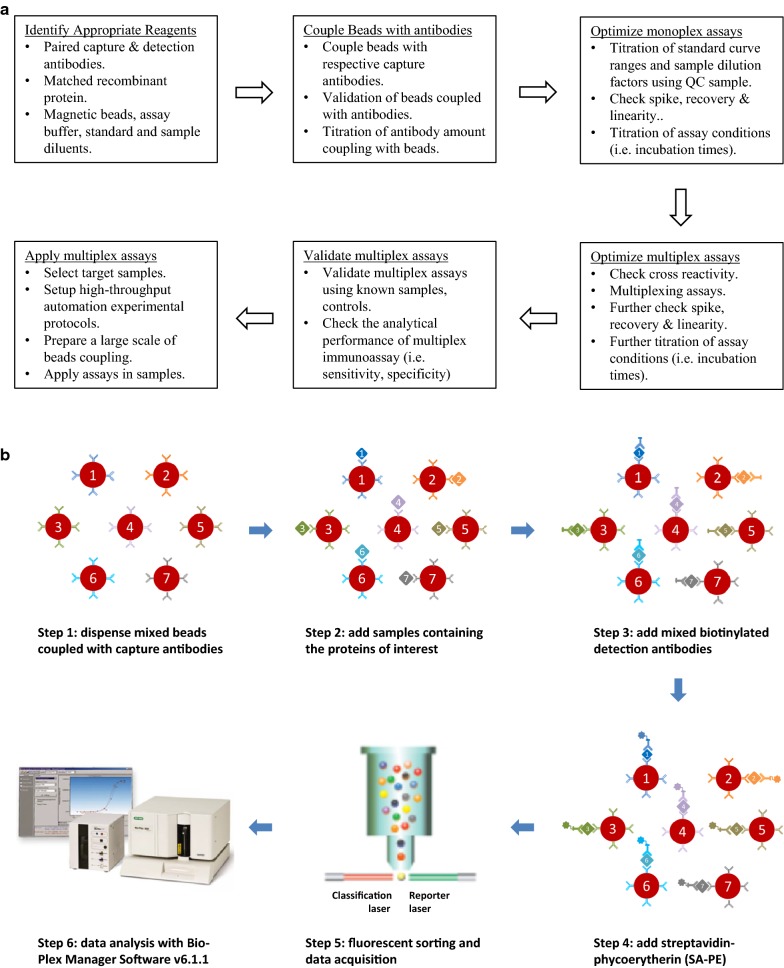
Magnetic bead-based multiplex immunoassays were developed for the selected serum biomarkers using a Bio-Plex 200 system. The dynamic ranges, lower limits of detection and quantification, cross-reactivity, and intra- and inter-assay precision were assessed. All proteins were analyzed in sera of 48 patients diagnosed with UM (14 metastatic, 9 disease-free (DF) ≥ 5 years, 25 unknown) and 36 healthy controls. The performance of the biomarkers was evaluated individually and in combination for their ability to detect UM.
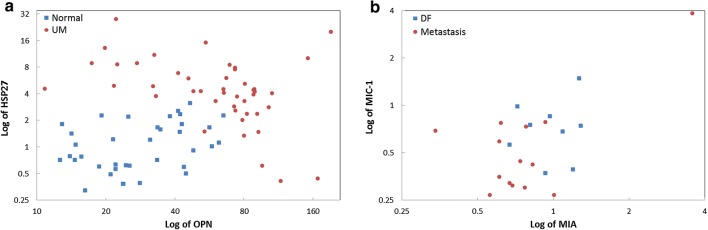
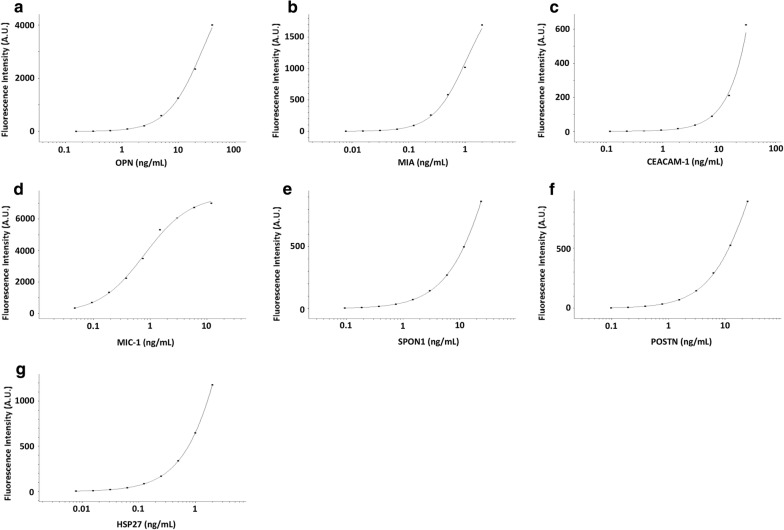
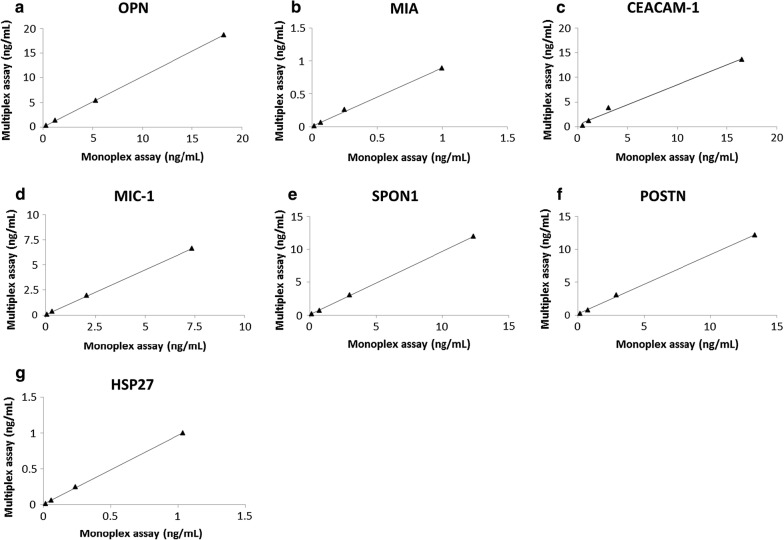
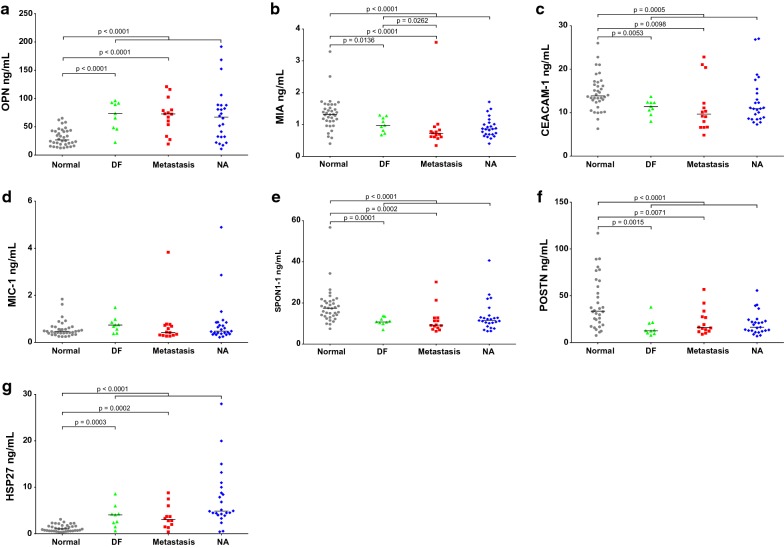
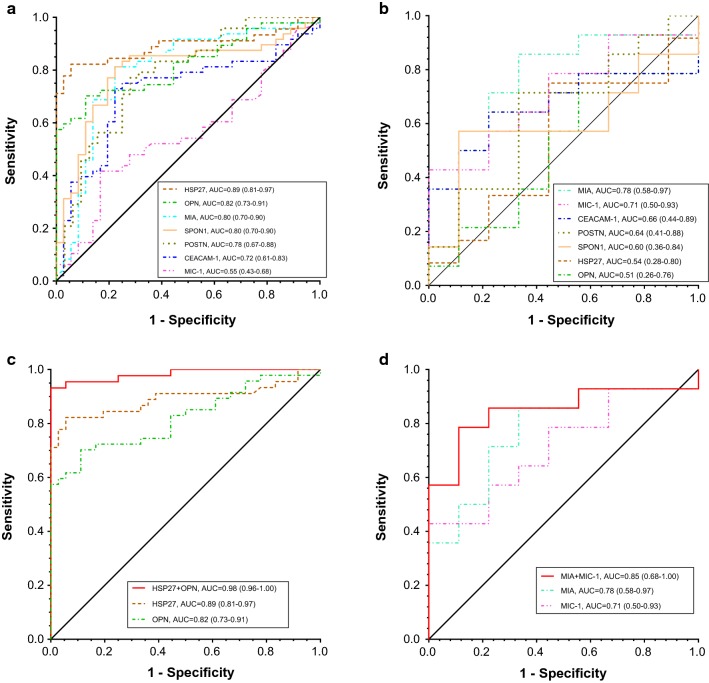
A 7-plex immunoassay of OPN, MIA, CEACAM-1, MIC-1, SPON1, POSTN and HSP27 was developed with negligible cross-reactivity, recovery of 84-105%, and intra-assay and inter-assay precision of 2.3-7.5% or 2.8-20.8%, respectively. Logistic regression identified a two-marker panel of HSP27 and OPN that significantly improved the individual biomarker performance in discriminating UM from healthy controls. The improved discrimination of a two-marker panel of MIA and MIC-1 was also observed between metastatic UM and DF, however not statistically significant due to the small sample size.
The multiplex immunoassay provides sufficient analytical performance to evaluate serum biomarkers that complement each other in detection of UM, and warrants further validation with a larger number of patient samples.
约50%的葡萄膜黑色素瘤(UM)患者会优先发生肝转移,导致在15个月内死亡。目前,对于转移性UM尚无有效治疗方法,部分原因在于通过肝功能检查(LFTs)或影像学检查发现肝转移时,肿瘤负荷通常已很高。采用LFTs结果后进行诊断性检查具有高特异性和预测价值,但敏感性低,因此需要更好的检查方法用于原发性肿瘤及其转移扩散的早期诊断。为评估用于UM早期检测的血清生物标志物,开发了多重免疫测定法。
使用Bio-Plex 200系统针对选定的血清生物标志物开发基于磁珠的多重免疫测定法。评估了动态范围、检测和定量下限、交叉反应性以及批内和批间精密度。对48例诊断为UM的患者(1个转移,9例无病(DF)≥5年,25例情况不明)和36例健康对照的血清中的所有蛋白质进行了分析。分别单独和联合评估生物标志物检测UM的能力。
开发了一种包含骨桥蛋白(OPN)、黑色素瘤抑制活性蛋白(MIA)、癌胚抗原相关细胞黏附分子1(CEACAM-1)、巨噬细胞抑制因子(MIC-1)、血小板反应蛋白1(SPON1)、骨膜蛋白(POSTN)和热休克蛋白27(HSP27)的7重免疫测定法,交叉反应性可忽略不计,回收率为84% - 105%,批内和批间精密度分别为2.3% - 7.5%或2.8% - 20.8%。逻辑回归确定了由HSP27和OPN组成的双标志物组合,其在区分UM与健康对照方面显著提高了单个生物标志物的性能。在转移性UM和DF之间也观察到由MIA和MIC-1组成的双标志物组合的区分能力有所提高,但由于样本量小,差异无统计学意义。
多重免疫测定法具有足够的分析性能来评估在UM检测中相互补充的血清生物标志物,并且需要用更多患者样本进行进一步验证。