China-Japan Friendship Hospital, Beijing, China.
Nanjing First Hospital, Nanjing, China.
Diabetes Obes Metab. 2019 Jul;21(7):1652-1660. doi: 10.1111/dom.13703. Epub 2019 Apr 4.
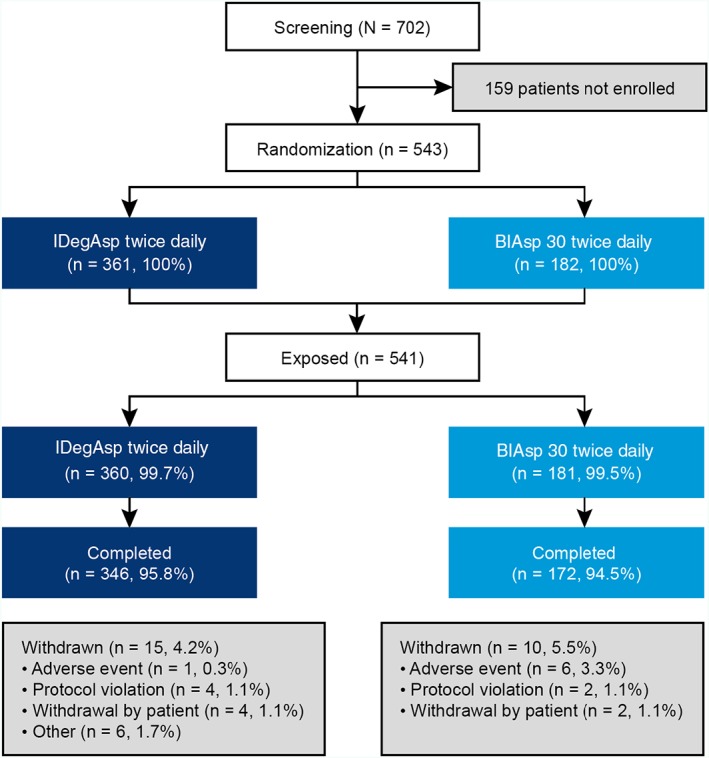
To assess the efficacy and safety of twice-daily insulin degludec/insulin aspart (IDegAsp) versus biphasic insulin aspart 30 (BIAsp 30) twice daily, both ± metformin, in Chinese adults (N = 543) with type 2 diabetes (T2D) inadequately controlled on premixed/self-mixed or basal insulin ± metformin.
We conducted a 26-week, phase III, open-label, treat-to-target, 2:1 randomized trial. Hierarchical testing was used with non-inferiority of glycated haemoglobin (HbA1c) change from baseline to week 26 as the primary endpoint and superiority for the confirmatory secondary endpoints which were as follows: change from baseline in fasting plasma glucose (FPG); nocturnal confirmed hypoglycaemic episodes (12:01-5:59 am, inclusive); total confirmed hypoglycaemic episodes (severe or plasma glucose <3.1 mmol/L with/without symptoms); body weight; and percentage of responders (HbA1c <53 mmol/mol [<7.0%]) without confirmed hypoglycaemic episodes.
Non-inferiority for change from baseline to week 26 in HbA1c and superiority of IDegAsp twice daily versus BIAsp 30 twice daily for change in FPG, nocturnal confirmed and total confirmed hypoglycaemic episodes, was demonstrated. Estimated rates of nocturnal confirmed and total confirmed hypoglycaemic episodes were 47% and 43% lower, respectively, with IDegAsp twice daily versus BIAsp 30 twice daily. Superiority for change in body weight was not confirmed. Participants were more likely to reach the HbA1c goal of <53 mmol/mol (<7.0%) without confirmed hypoglycaemia with IDegAsp twice daily versus BIAsp 30 twice daily by trial end. No new safety signals were identified.
The efficacy and safety of IDegAsp in Chinese patients with T2D was demonstrated, confirming results from international trials.
评估每日两次胰岛素德谷胰岛素/门冬胰岛素(IDegAsp)与每日两次预混胰岛素类似物 30(BIAsp 30)相比,在二甲双胍治疗下,对血糖控制不佳的中国 2 型糖尿病(T2D)成年患者(N=543)的疗效和安全性。
我们进行了一项 26 周、III 期、开放标签、靶向治疗、2:1 随机试验。采用分层检验,以从基线到第 26 周糖化血红蛋白(HbA1c)变化的非劣效性作为主要终点,以以下确证次要终点的优越性为确证性次要终点:从基线到第 26 周空腹血糖(FPG)的变化;夜间确认的低血糖发作(12:01-5:59 am,包括);总确认的低血糖发作(严重或血糖<3.1mmol/L,有/无症状);体重;以及无确认低血糖发作的应答者比例(HbA1c<53mmol/mol [<7.0%])。
从基线到第 26 周,HbA1c 的变化显示非劣效性,IDegAsp 每日两次与 BIAsp 30 每日两次相比,FPG、夜间确认和总确认的低血糖发作均显示优越性。估计夜间确认和总确认的低血糖发作率分别降低了 47%和 43%,IDegAsp 每日两次与 BIAsp 30 每日两次相比。体重变化的优越性未得到确认。与 BIAsp 30 每日两次相比,IDegAsp 每日两次治疗结束时,达到 HbA1c 目标<53mmol/mol(<7.0%)且无确认低血糖的患者比例更高。未发现新的安全性信号。
IDegAsp 在中国 2 型糖尿病患者中的疗效和安全性得到了证实,与国际试验结果一致。