Nutrition and Metabolism Section, International Agency for Research on Cancer (IARC/WHO), 150 cours Albert Thomas, 69372 Lyon CEDEX 08, France.
National Institute of Public Health, Centre for Population Health Research, Universidad No. 655 Colonia Santa María Ahuacatitlán, Cerrada Los Pinos y Caminera C.P., Cuernavaca 62100, Morelos, México.
Nutrients. 2019 Mar 12;11(3):603. doi: 10.3390/nu11030603.
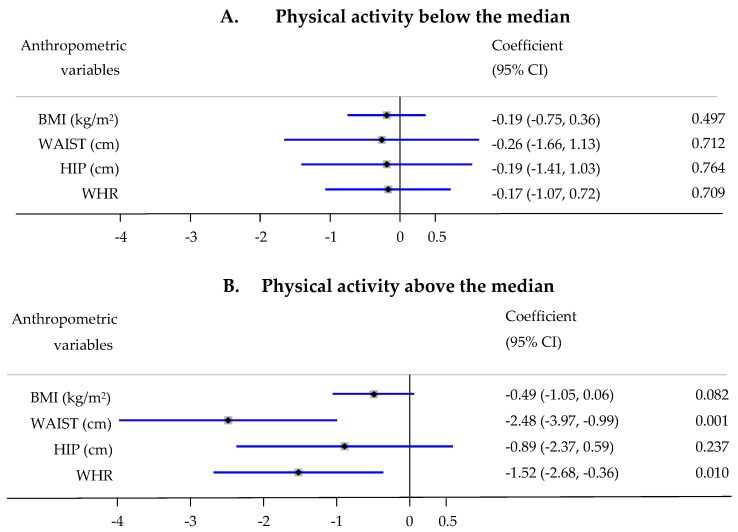
This cross-sectional study aimed to evaluate associations between a priori defined dietary patterns and anthropometric measures in Mexican women. A total of 1062 women aged 35 to 69 years old from the control participants of the CAMA (Cancer de Mama) study, a multi-center population-based case-control study on breast cancer conducted in Mexico, were interviewed and dietary intakes were assessed using questionnaires. The following indices were derived from these data: Dietary Approaches to Stop Hypertension (DASH) score, the Healthy Eating Index (HEI), the Mediterranean Diet Score (aMED), the Diet Quality Index (DQI), glycemic index (GI) and glycemic load (GL). Adjusting for age, center, educational level, physical activity and energy intake, a high GI was positively associated with a higher body mass index (BMI) and waist circumference (WC). Higher adherence to aMED was associated with lower WC and waist-to-hip ratio (WHR) but no significant association was observed with other a priori dietary patterns. In this population of Mexican women, higher adherence to Mediterranean diet was associated with lower WC but other a priori dietary scores appeared to be of limited value in exploring the association between diet and anthropometric measures.
本横断面研究旨在评估墨西哥女性中预先定义的饮食模式与人体测量指标之间的关联。该研究共纳入了 1062 名年龄在 35 至 69 岁之间的女性,她们来自 CAMA(乳腺癌)研究的对照组,这是一项在墨西哥开展的多中心基于人群的乳腺癌病例对照研究。通过问卷对这些女性进行了访谈和饮食摄入评估。从这些数据中得出了以下指标:停止高血压的饮食方法(DASH)评分、健康饮食指数(HEI)、地中海饮食评分(aMED)、饮食质量指数(DQI)、血糖指数(GI)和血糖负荷(GL)。在调整年龄、中心、教育水平、身体活动和能量摄入后,高 GI 与较高的体重指数(BMI)和腰围(WC)呈正相关。较高的 aMED 依从性与较低的 WC 和腰臀比(WHR)相关,但与其他预先定义的饮食模式没有显著关联。在这群墨西哥女性中,较高的地中海饮食依从性与较低的 WC 相关,但其他预先定义的饮食评分在探索饮食与人体测量指标之间的关联方面似乎价值有限。