Department of Pathology and Laboratory Medicine, University of Louisville, Louisville, KY, 40292, USA.
Department of Biomedical Informatics, University of Arkansas for Medical Sciences, Little Rock, AR, 72205, USA.
Acta Neuropathol Commun. 2019 Mar 15;7(1):42. doi: 10.1186/s40478-019-0689-3.
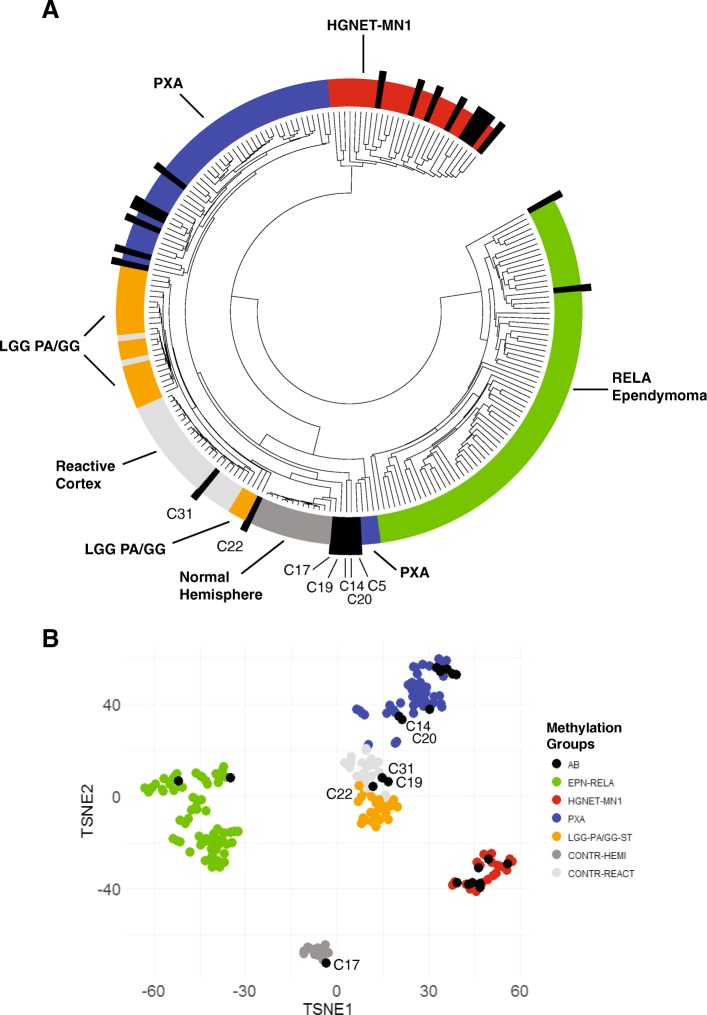
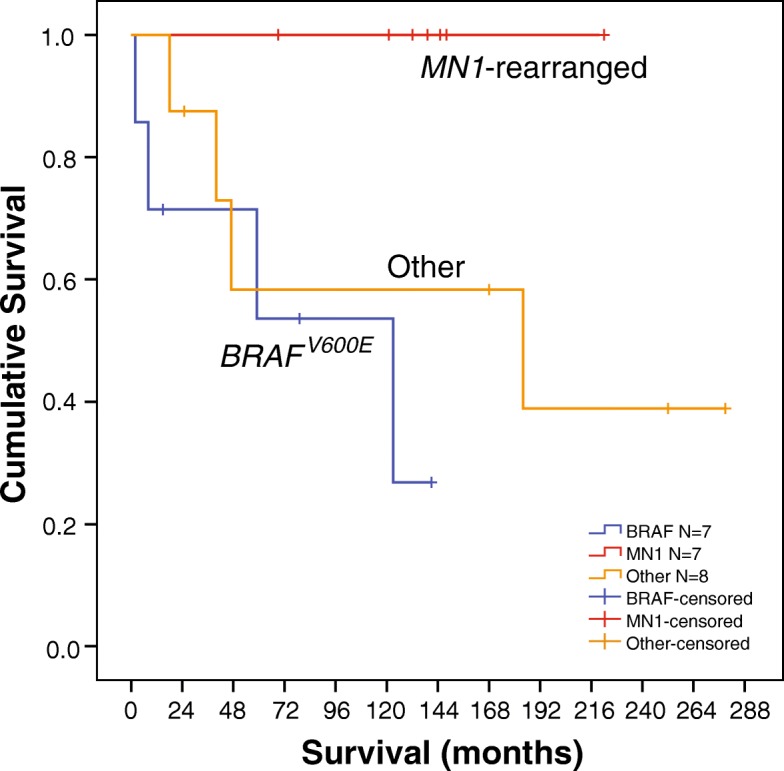
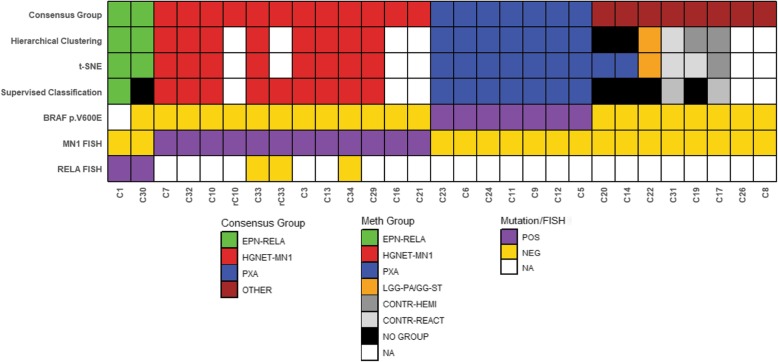
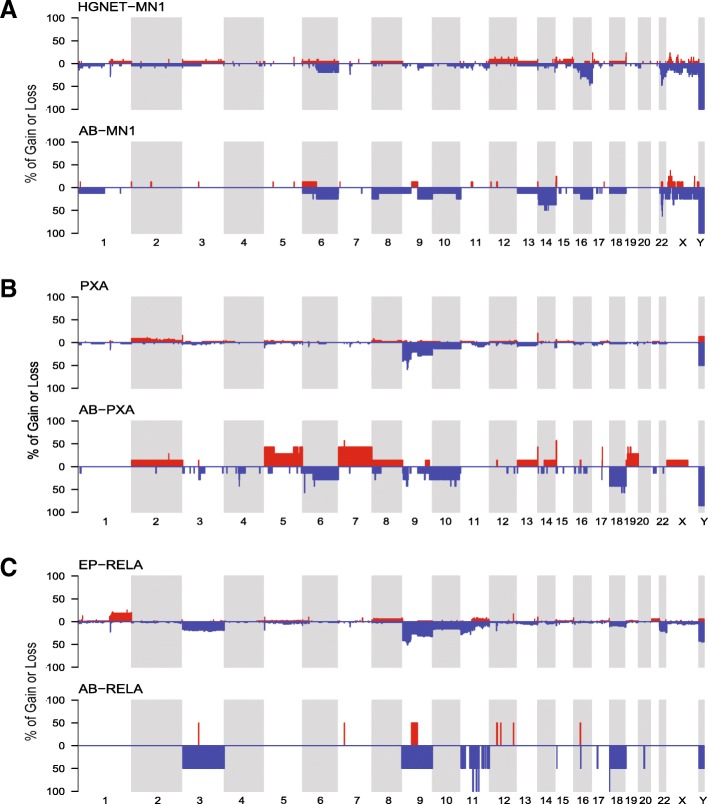
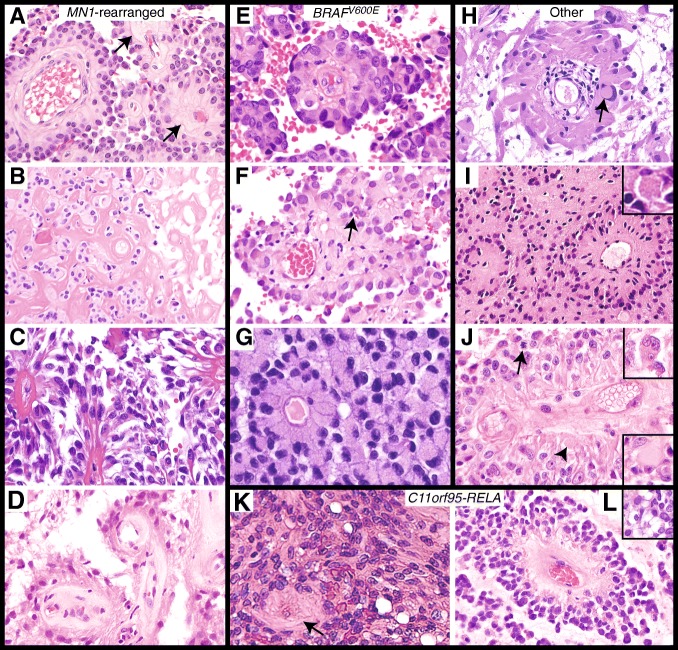
Astroblastoma (AB) is a rare CNS tumor demonstrating abundant astroblastomatous pseudorosettes. Its molecular features have not been comprehensively studied and its status as a tumor entity is controversial. We analyzed a cohort of 27 histologically-defined ABs using DNA methylation profiling, copy number analysis, FISH and site-directed sequencing. Most cases demonstrated mutually exclusive MN1 rearrangements (n = 10) or BRAF mutations (n = 7). Two additional cases harbored RELA rearrangements. Other cases lacked these specific genetic alterations (n = 8). By DNA methylation profiling, tumors with MN1 or RELA rearrangement clustered with high-grade neuroepithelial tumor with MN1 alteration (HGNET-MN1) and RELA-fusion ependymoma, respectively. In contrast, BRAF-mutant tumors grouped with pleomorphic xanthoastrocytoma (PXA). Six additional tumors clustered with either supratentorial pilocytic astrocytoma and ganglioglioma (LGG-PA/GG-ST), normal or reactive cerebrum, or with no defined DNA methylation class. While certain histologic features favored one genetic group over another, no group could be reliably distinguished by histopathology alone. Survival analysis between genetic AB subtypes was limited by sample size, but showed that MN1-rearranged AB tumors were characterized by better overall survival compared to other genetic subtypes, in fact, significantly better than BRAF-mutant tumors (P = 0.013). Our data confirm that histologically-defined ABs are molecularly heterogeneous and do not represent a single entity. They rather encompass several low- to higher-grade glial tumors including neuroepithelial tumors with MN1 rearrangement, PXA-like tumors, RELA ependymomas, and possibly yet uncharacterized lesions. Genetic subtyping of tumors exhibiting AB histology, particularly determination of MN1 and BRAF status, is necessary for important prognostic and possible treatment implications.
星形母细胞瘤(AB)是一种罕见的中枢神经系统肿瘤,表现出丰富的星形母细胞瘤样假玫瑰花结。其分子特征尚未得到全面研究,其肿瘤实体地位存在争议。我们使用 DNA 甲基化谱分析、拷贝数分析、FISH 和靶向测序分析了一组 27 例组织学定义的 AB。大多数病例表现出相互排斥的 MN1 重排(n=10)或 BRAF 突变(n=7)。另外两个病例存在 RELA 重排。其他病例缺乏这些特定的遗传改变(n=8)。通过 DNA 甲基化谱分析,具有 MN1 或 RELA 重排的肿瘤与高级别神经上皮肿瘤伴 MN1 改变(HGNET-MN1)和 RELA 融合性室管膜瘤分别聚类。相比之下,BRAF 突变肿瘤与多形性黄色星形细胞瘤(PXA)聚类。另外 6 个肿瘤与幕上毛细胞星形细胞瘤和神经节细胞瘤(LGG-PA/GG-ST)、正常或反应性大脑或无明确 DNA 甲基化分类聚类。虽然某些组织学特征有利于某一遗传组,但仅凭组织病理学无法可靠地区分任何一组。由于样本量有限,遗传 AB 亚型之间的生存分析受到限制,但结果表明 MN1 重排 AB 肿瘤的总体生存率优于其他遗传亚型,事实上明显优于 BRAF 突变肿瘤(P=0.013)。我们的数据证实,组织学定义的 AB 是分子上异质性的,不代表单一实体。它们包括几种低至高级别的神经胶质瘤,包括具有 MN1 重排的神经上皮肿瘤、PXA 样肿瘤、RELA 室管膜瘤,以及可能尚未确定的病变。具有 AB 组织学表现的肿瘤的基因亚型分类,特别是 MN1 和 BRAF 状态的确定,对于重要的预后和可能的治疗意义是必要的。