Research Unit of General Practice, Department of Public Health, University of Southern Denmark, Odense, Denmark.
Psychiatric Research Unit, Psychiatry, Region Zealand, Slagelse, Denmark.
BMJ Open. 2019 Mar 15;9(3):e023844. doi: 10.1136/bmjopen-2018-023844.
To evaluate if perceived barriers to accessing mental healthcare (MHC) among individuals with symptoms of depression are associated with their socio-economic position (SEP).
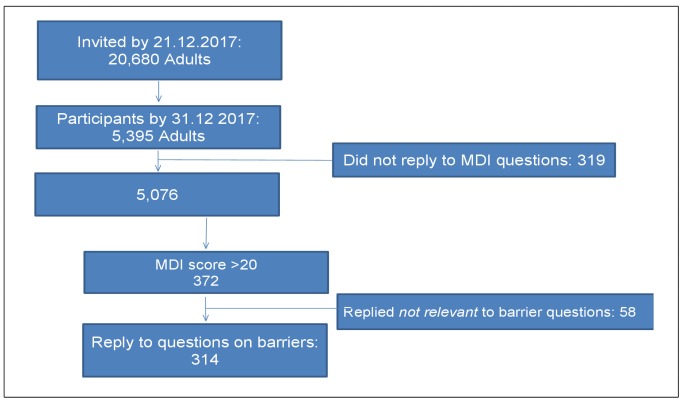
Cross-sectional questionnaire-based population survey from the Lolland-Falster Health Study (LOFUS) 2016-17 of 5076 participants.
The study included 372 individuals, with positive scores for depression according to the Major Depression Inventory (MDI), participating in LOFUS .
A set of five questions on perceived barriers to accessing professional care for mental health problem was posed to individuals with symptoms of depression (MDI score >20).
The association between SEP (as measured by educational attainment, employment status and financial strain) and five different types of barriers to accessing MHC were analysed in separate multivariable logistic regression models adjusted for gender and age.
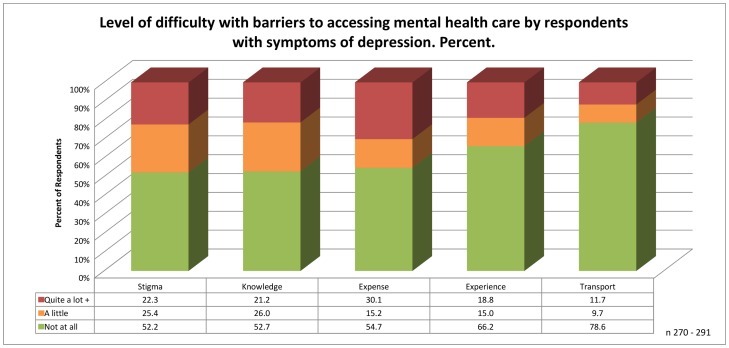
A total of 314 out of 372 (84%) completed the survey questions and reported experiencing barriers to MHC access. Worry about expenses related to seeking or continuing MHC was a considerable barrier for 30% of the individuals responding and, as such, the greatest problem among the five types of barriers. 22% perceived as a barrier to accessing MHC, but there was no association between perceived and SEP. Transportation was not only the barrier of least concern for individuals in general but also the issue with the greatest and most consistent socio-economic disparity (OR 2.99, 95% CI 1.19 to 7.52) for the lowest vs highest educational groups and, likewise, concerning x (OR 2.77, 95% CI 1.34 to 5.76) for the same groups.
Issues associated with and were more frequently perceived as barriers to accessing MHC for people in low SEP compared with people in high SEP. showed no association with SEP.Informed written consent was obtained. Region Zealand's Ethical Committee on Health Research (SJ-421) and the Danish Data Protection Agency (REG-24-2015) approved the study.
评估抑郁症患者在获取精神卫生保健(MHC)方面的感知障碍是否与他们的社会经济地位(SEP)相关。
2016-17 年洛兰岛-法尔斯特健康研究(LOFUS)的横断面问卷调查,共纳入 5076 名参与者。
该研究纳入了 372 名参与者,他们的主要抑郁量表(MDI)评分呈阳性,表明有抑郁症状,并参加了 LOFUS。
对有抑郁症状(MDI 评分>20)的个体提出了一套五个关于获取专业心理健康问题的感知障碍问题。
在调整了性别和年龄的情况下,分别在五个不同的 MHC 感知障碍类型的多变量逻辑回归模型中分析了 SEP(通过教育程度、就业状况和经济压力来衡量)与五个不同类型的 MHC 感知障碍之间的关系。
22%的人认为获得 MHC 的机会是一种障碍,但这与 SEP 之间没有关联。交通不仅是一般人最不关心的障碍,也是社会经济差距最大和最一致的问题(OR 2.99,95%CI 1.19 至 7.52),对于最低和最高教育组,情况也是如此(OR 2.77,95%CI 1.34 至 5.76)。与高 SEP 人群相比,与低 SEP 人群相比,与 和 相关的问题更容易被认为是获取 MHC 的障碍。与 SEP 没有关联。获得了知情书面同意。西兰地区健康研究伦理委员会(SJ-421)和丹麦数据保护局(REG-24-2015)批准了该研究。