Lin Chin-Yu, Crowley Samuel Thomas, Uchida Satoshi, Komaki Yuji, Kataoka Kazunori, Itaka Keiji
Institute of New Drug Development, China Medical University, Taichung 40402, Taiwan; Innovation Center of NanoMedicine, Kawasaki Institute of Industrial Promotion, Kawasaki, Kanagawa 210-0821, Japan.
Innovation Center of NanoMedicine, Kawasaki Institute of Industrial Promotion, Kawasaki, Kanagawa 210-0821, Japan; Department of Biofunction Research, Institute of Biomaterials and Bioengineering, Tokyo Medical and Dental University (TMDU), Chiyoda-ku, Tokyo 101-0062, Japan.
Mol Ther Nucleic Acids. 2019 Jun 7;16:162-171. doi: 10.1016/j.omtn.2019.02.012. Epub 2019 Feb 22.
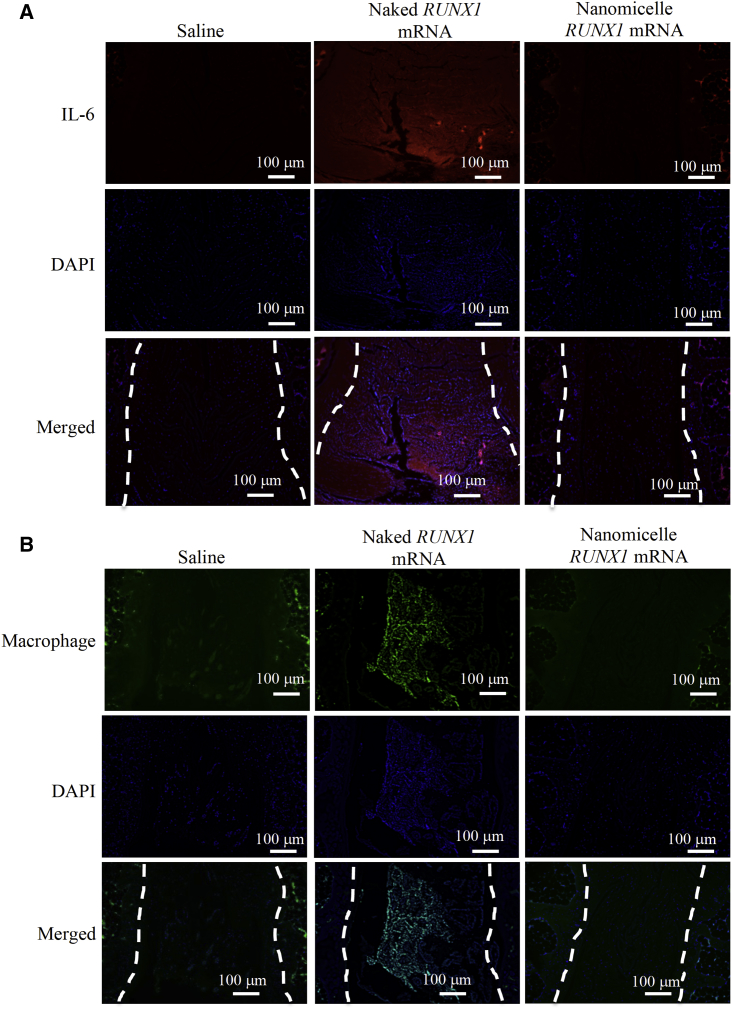
Intervertebral disk (IVD) degeneration is often associated with severity of lower back pain. IVD core is an avascular, highly hydrated tissue composed of type II collagen, glycosaminoglycans, and proteoglycans. The disk degeneration is not only a destruction of IVD structure but also is related to a disorder of the turnover of the disk matrix, leading the jelly-like IVD core to be replaced by fibrous components. Here we present a disease-modifying strategy for IVD degenerative diseases by direct regulation of the cells in the IVD using mRNA medicine, to alter the misbalanced homeostasis during disk degeneration. When mRNA encoding a cartilage-anabolic transcription factor, runt-related transcription factor-1, was administered to a rat model of coccygeal disk degeneration using a polyplex nanomicelle composed of polyethylene glycol-polyamino acid block copolymers and mRNA, the disk height was maintained to a significantly higher extent (≈81%) compared to saline control (69%), with prevention of fibrosis in the disk tissue. In addition, the use of nanomicelles effectively prevented inflammation, which was observed by injection of naked mRNA into the disk. This proof-of-concept study revealed that mRNA medicine has a potential for treating IVD degenerative diseases by introducing a cartilage-anabolic factor into the host cells, proposing a new therapeutic strategy using mRNA medicine.
椎间盘(IVD)退变常与下腰痛的严重程度相关。IVD髓核是一种无血管、高度水合的组织,由II型胶原蛋白、糖胺聚糖和蛋白聚糖组成。椎间盘退变不仅是IVD结构的破坏,还与椎间盘基质周转紊乱有关,导致果冻样的IVD髓核被纤维成分取代。在此,我们提出一种针对IVD退行性疾病的疾病修饰策略,即使用mRNA药物直接调控IVD中的细胞,以改变椎间盘退变过程中失衡的内环境稳态。当使用由聚乙二醇-聚氨基酸嵌段共聚物和mRNA组成的多聚体纳米胶束,将编码软骨合成转录因子( runt相关转录因子-1)的mRNA施用于大鼠尾椎间盘退变模型时,与生理盐水对照组(69%)相比,椎间盘高度在显著更高的程度上(≈81%)得以维持,同时椎间盘组织中的纤维化得到预防。此外,纳米胶束的使用有效预防了炎症,而裸mRNA注射到椎间盘中则会观察到炎症。这项概念验证研究表明,mRNA药物通过将软骨合成因子引入宿主细胞,具有治疗IVD退行性疾病的潜力,提出了一种使用mRNA药物的新治疗策略。