HIV Dynamics and Replication Program, National Cancer Institute, National Institutes of Health, Frederick, Maryland, USA.
Department of Infectious Diseases and Microbiology, University of Pittsburgh Graduate School of Public Health, Pittsburgh, Pennsylvania, USA.
J Virol. 2019 May 15;93(11). doi: 10.1128/JVI.00224-19. Print 2019 Jun 1.
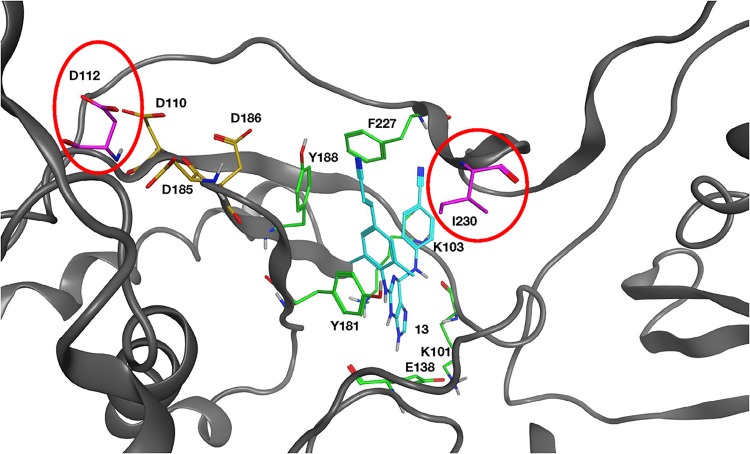
Two mutations, G112D and M230I, were selected in the reverse transcriptase (RT) of human immunodeficiency virus type 1 (HIV-1) by a novel nonnucleoside reverse transcriptase inhibitor (NNRTI). G112D is located near the HIV-1 polymerase active site; M230I is located near the hydrophobic region where NNRTIs bind. Thus, M230I could directly interfere with NNRTI binding but G112D could not. Biochemical and virological assays were performed to analyze the effects of these mutations individually and in combination. M230I alone caused a reduction in susceptibility to NNRTIs, while G112D alone did not. The G112D/M230I double mutant was less susceptible to NNRTIs than was M230I alone. In contrast, both mutations affected the ability of RT to incorporate nucleoside analogs. We suggest that the mutations interact with each other via the bound nucleic acid substrate; the nucleic acid forms part of the polymerase active site, which is near G112D. The positioning of the nucleic acid is influenced by its interactions with the "primer grip" region and could be influenced by the M230I mutation. Although antiretroviral therapy (ART) is highly successful, drug-resistant variants can arise that blunt the efficacy of ART. New inhibitors that are broadly effective against known drug-resistant variants are needed, although such compounds might select for novel resistance mutations that affect the sensitivity of the virus to other compounds. Compound 13 selects for resistance mutations that differ from traditional NNRTI resistance mutations. These mutations cause increased sensitivity to NRTIs, such as AZT.
两种突变,G112D 和 M230I,是通过一种新型非核苷类逆转录酶抑制剂(NNRTI)在人类免疫缺陷病毒 1 型(HIV-1)的逆转录酶(RT)中选择的。G112D 位于 HIV-1 聚合酶活性部位附近;M230I 位于 NNRTIs 结合的疏水区附近。因此,M230I 可以直接干扰 NNRTI 的结合,但 G112D 不能。进行了生化和病毒学测定,以分析这些突变单独和组合的影响。单独的 M230I 导致对 NNRTIs 的敏感性降低,而单独的 G112D 则不会。G112D/M230I 双突变体对 NNRTIs 的敏感性低于单独的 M230I。相比之下,这两种突变都影响了 RT 掺入核苷类似物的能力。我们建议这些突变通过结合的核酸底物相互作用;核酸构成聚合酶活性部位的一部分,该部位靠近 G112D。核酸的位置受其与“引物夹”区域的相互作用影响,并且可能受 M230I 突变的影响。尽管抗逆转录病毒疗法(ART)非常成功,但可能会出现耐药变体,从而削弱 ART 的疗效。需要新型的广泛有效的抑制剂来对抗已知的耐药变体,尽管这些化合物可能会选择影响病毒对其他化合物敏感性的新的耐药突变。化合物 13 选择的耐药突变与传统的 NNRTI 耐药突变不同。这些突变导致对 NRTIs(如 AZT)的敏感性增加。