Biogéosciences, UMR6282 CNRS/université Bourgogne Franche-Comté, Dijon, France.
ThéMA, UMR6049 CNRS/université Bourgogne Franche-Comté, Besançon, France.
Sci Rep. 2019 Mar 20;9(1):4919. doi: 10.1038/s41598-019-41398-5.
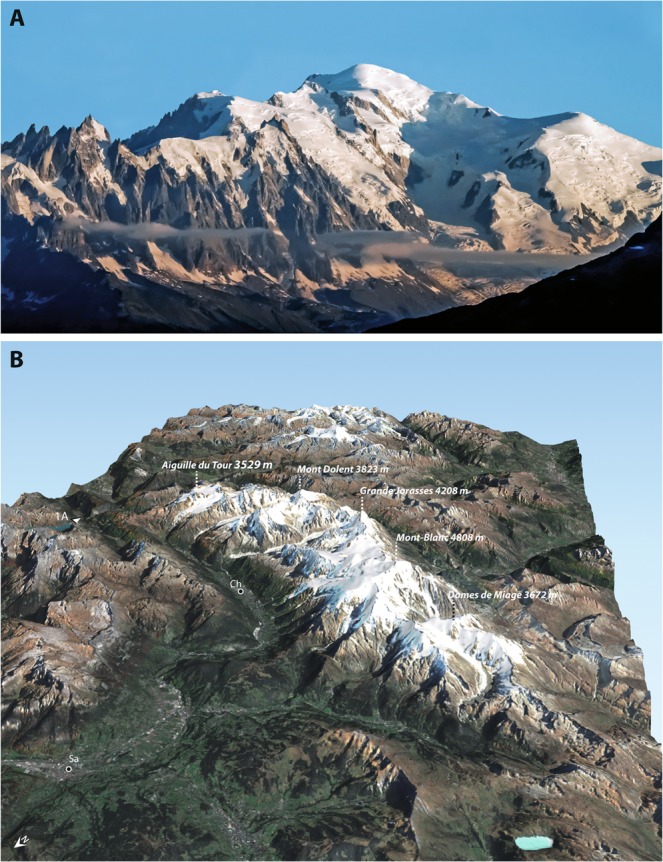
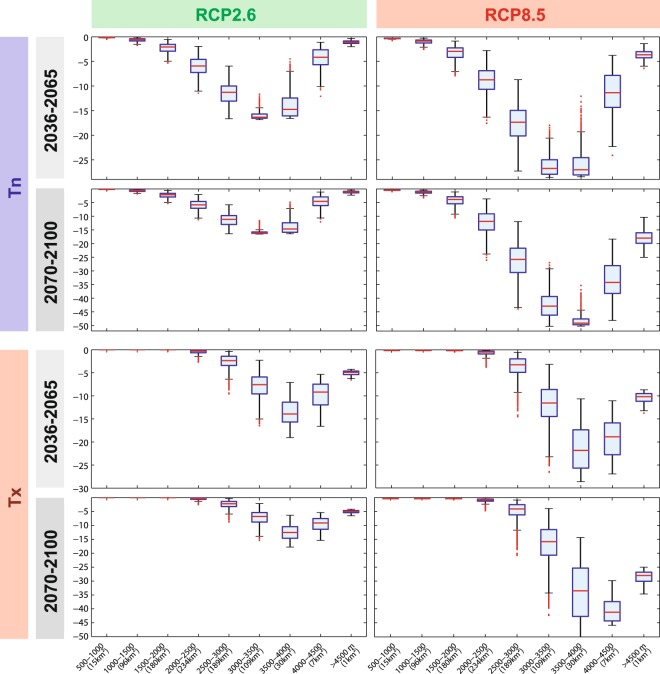
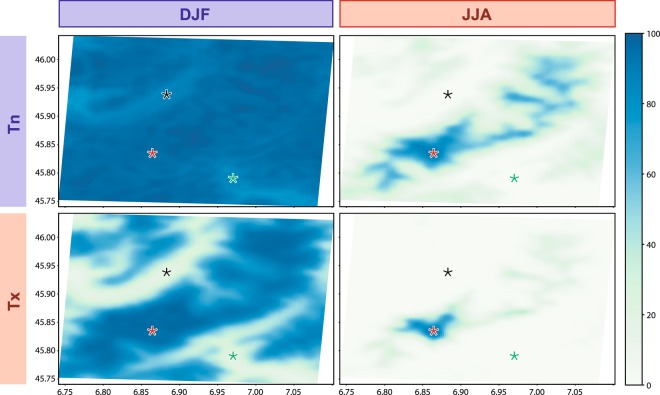
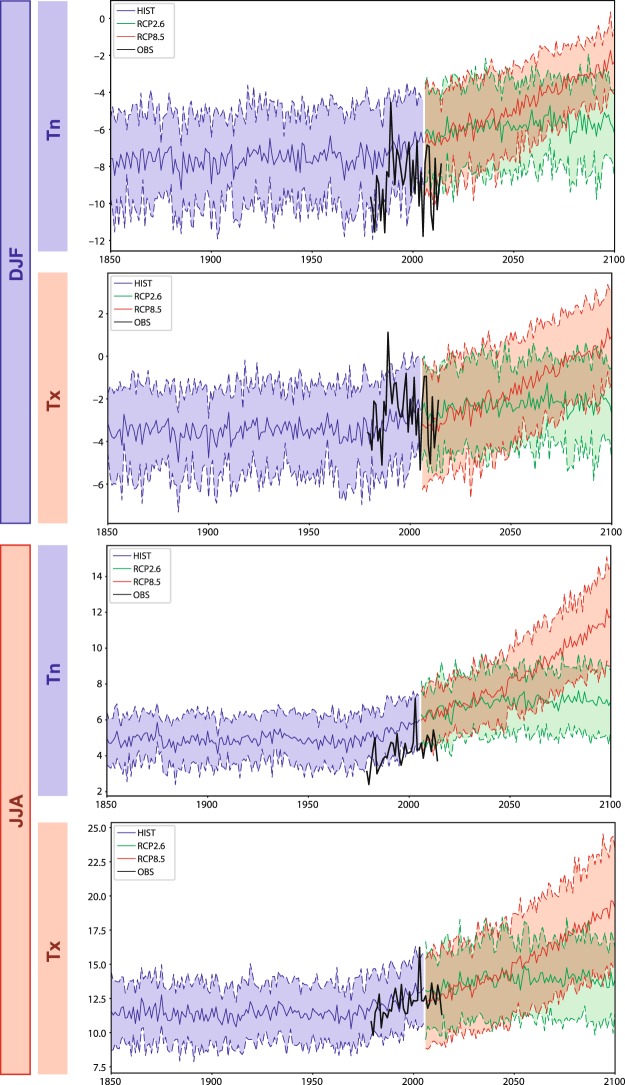
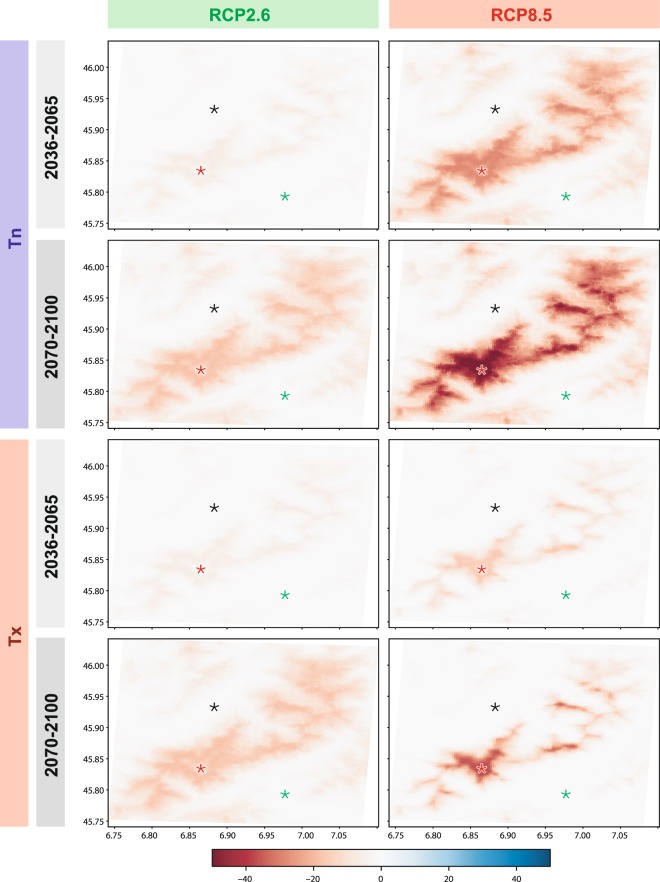
Mountains are a sensitive indicator of climate change and these areas are an early glimpse of what could happen in lowland environments. Peaking at 4808 m asl, the Mont-Blanc summit, at the boundary between France and Italy, is the highest of the Alps, in Western Europe. Its Massif is world-famous for outdoor and extreme sport activities, especially since the 1924 Olympic games held in Chamonix. Here, we use a novel statistical downscaling approach to regionalize current and future climate change over the Mont-Blanc Massif at an unequalled spatial resolution of 200 m. The algorithm is applied to daily minimum and maximum temperature derived from global climate models used in the fifth assessment report of the International Panel on Climate Change (IPCC). This new high-resolution database allows for a precise quantification of frost occurrence and its evolution until 2100. In the winter season and by the end of the 21 century, under a pessimistic scenario (RCP8.5), frost frequency in the morning could decrease by 30-35 percentage points in the valley of Chamonix, and in the afternoon, similar changes could occur for elevations comprised between 2000 and 3000 m. In summertime, changes are even larger, reaching a huge drop of 45-50 points in the afternoon between 3500 and 4500 m. These changes are much reduced under an optimistic scenario. They could have huge impacts on the environment (glacier shrinking, permafrost degradation, floods, changes in the distribution of species and ecosystems) and societies (summer tourism for climbing and hiking, and winter tourism for skiing).
山脉是气候变化的敏感指标,这些地区是低地环境可能发生情况的早期迹象。勃朗峰海拔 4808 米,是西欧阿尔卑斯山脉的最高峰,位于法国和意大利的边界上。其山体以户外和极限运动而闻名于世,尤其是自 1924 年在霞慕尼举办的奥运会以来。在这里,我们使用一种新颖的统计降尺度方法,以 200 米的空前空间分辨率对勃朗峰山体的当前和未来气候变化进行区域化。该算法应用于全球气候模型中得出的日最低和最高温度,这些模型被用于国际气候变化专门委员会(IPCC)第五次评估报告。这个新的高分辨率数据库可以精确量化结霜的发生及其在 2100 年前的演变。在冬季和 21 世纪末,如果按照悲观情景(RCP8.5),霞慕尼山谷的清晨结霜频率可能会减少 30-35 个百分点,而在 2000-3000 米之间的海拔高度,下午可能会发生类似的变化。在夏季,变化更大,在 3500-4500 米之间的下午,结霜频率可能会下降 45-50 个百分点。在乐观情景下,这些变化会大大减少。这些变化可能会对环境(冰川退缩、永久冻土退化、洪水、物种和生态系统分布的变化)和社会(登山和徒步旅行的夏季旅游、滑雪的冬季旅游)产生巨大影响。