Kim Choongki, Hong Myeong Ki
Department of Internal Medicine, Yonsei University College of Medicine, Seoul, Korea.
Department of Cardiology, Ewha Womans University Seoul Hospital, Seoul, Korea.
Korean Circ J. 2019 Apr;49(4):283-297. doi: 10.4070/kcj.2019.0044.
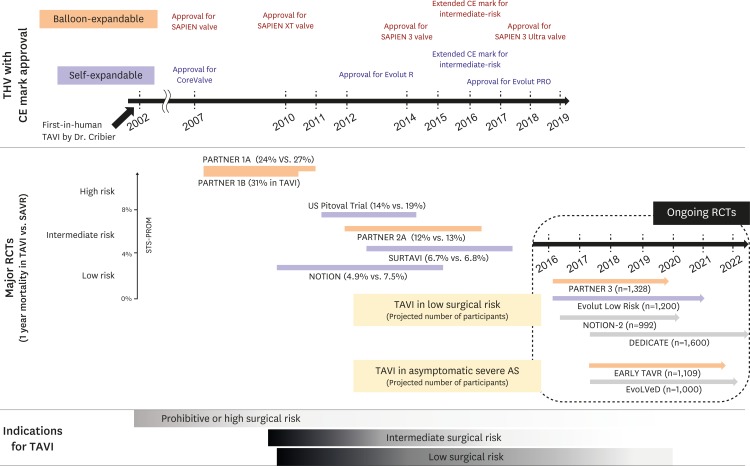
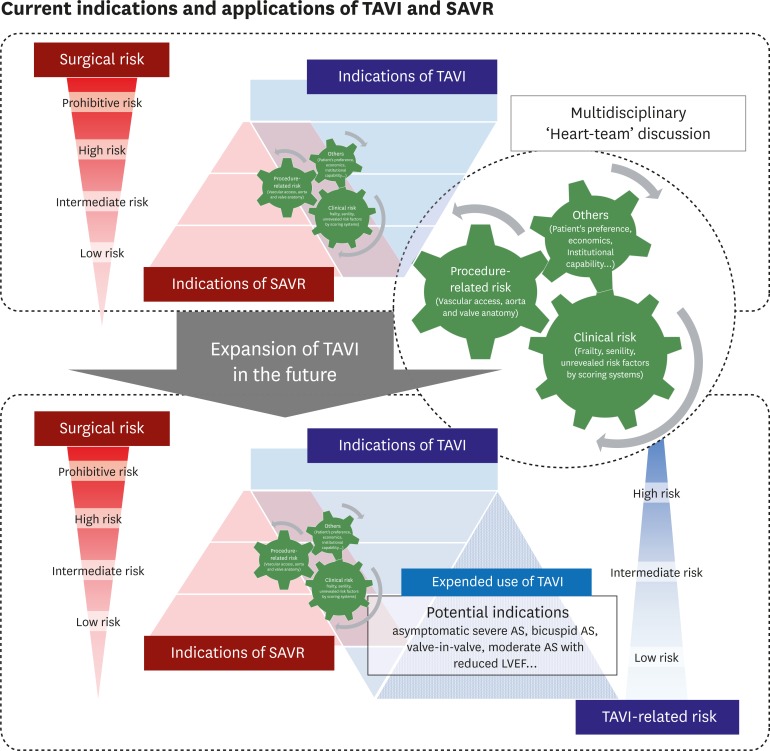
Transcatheter aortic valve implantation (TAVI) has been accepted as one of primary options for treatment of symptomatic severe aortic stenosis. Although TAVI has been predominantly used for patients at high risk or with old age who were not considered optimal candidates for surgical aortic valve replacement (SAVR), its indication is now expanding toward low risk profile and younger age. Many clinical trials are now ongoing to test the possibility of TAVI for use in patients even with uncharted indications who are not eligible for SAVR in current guidelines but may benefit from valve replacement. Current issues including periprocedural safety, long-term adverse events, hemodynamics and durability associated with TAVI should be also solved for expanding use of TAVI. The review presents current status and future directions of TAVI and discusses perspectives in Korea.
经导管主动脉瓣植入术(TAVI)已被公认为是有症状的严重主动脉瓣狭窄的主要治疗选择之一。尽管TAVI主要用于高风险或老年患者,这些患者不被认为是外科主动脉瓣置换术(SAVR)的最佳候选人,但其适应症目前正在向低风险和年轻患者扩展。目前许多临床试验正在进行,以测试TAVI用于目前指南中不符合SAVR标准但可能从瓣膜置换中获益的未明确适应症患者的可能性。为了扩大TAVI的应用,还应解决包括围手术期安全性、长期不良事件、血流动力学和与TAVI相关的耐久性等当前问题。本文综述了TAVI的现状和未来方向,并讨论了韩国的相关前景。