Division of Respiratory Medicine, Department of Internal Medicine, Shiga University of Medical Science, Shiga, Japan.
Health Administration Center, Shiga University of Medical Science, Shiga, Japan.
PLoS One. 2019 Mar 21;14(3):e0214278. doi: 10.1371/journal.pone.0214278. eCollection 2019.
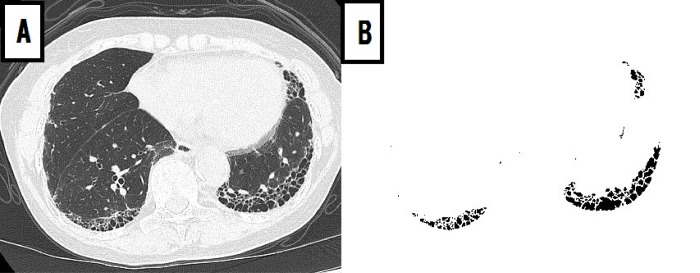
Honeycombing on high-resolution computed tomography (HRCT) images is a key finding in idiopathic pulmonary fibrosis (IPF). In IPF, honeycombing area determined by quantitative CT analysis is correlated with pulmonary function test findings. We hypothesized that quantitative CT-derived honeycombing area (HA) might predict mortality in patients with IPF.
Chest HRCT images of 52 IPF patients with definite usual interstitial pneumonia (UIP) pattern were retrospectively evaluated. Mortality data up to July 31, 2016, were recorded. Using a computer-aided system, HA and percentage of HA (%HA) were measured quantitatively. Predictors of 3-year mortality were evaluated using logistic regression models.
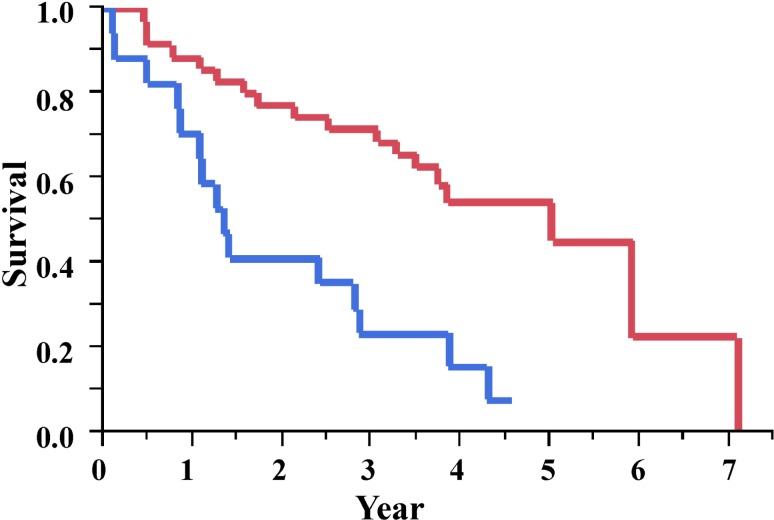
The median %HA, %predicted forced vital capacity (FVC) and composite physiologic index (CPI) were 3.8%, 83.6%, and 33.6, respectively. According to GAP (gender, age, and physiology) stage, 20, 14, and 5 patients were classified under stages I-II-III, respectively. Percentage of HA was significantly correlated with %FVC, CPI, and GAP stage (all, p < 0.001). In univariate analysis, %HA, %FVC, and CPI were statistically significant predictors of mortality. In multivariate analysis using the stepwise regression method, only %HA (odds ratio [OR], 1.27; p = 0.011) was a significant independent predictors of mortality. Patients with %HA ≥ 4.8% had significantly lower survival rates than those with lesser %HA (median survival time, 1.3 vs 5.0 years; log-rank test; p < 0.001).
Quantitative CT-derived HA might be an important and independent predictor of mortality in IPF patients with definite UIP pattern.
高分辨率计算机断层扫描(HRCT)图像上的蜂巢征是特发性肺纤维化(IPF)的一个关键发现。在 IPF 中,定量 CT 分析确定的蜂巢征面积与肺功能测试结果相关。我们假设定量 CT 衍生的蜂巢征面积(HA)可能预测 IPF 患者的死亡率。
回顾性评估了 52 例具有明确普通间质性肺炎(UIP)模式的 IPF 患者的胸部 HRCT 图像。记录截至 2016 年 7 月 31 日的死亡率数据。使用计算机辅助系统,定量测量 HA 和 HA 百分比(%HA)。使用逻辑回归模型评估 3 年死亡率的预测因素。
中位 %HA、%预计用力肺活量(FVC)和综合生理指数(CPI)分别为 3.8%、83.6%和 33.6。根据 GAP(性别、年龄和生理学)分期,20、14 和 5 例患者分别归类于 I-II-III 期。%HA 与 %FVC、CPI 和 GAP 分期均显著相关(均,p < 0.001)。在单变量分析中,%HA、%FVC 和 CPI 是死亡率的统计学显著预测因素。使用逐步回归法的多变量分析中,只有 %HA(比值比[OR],1.27;p = 0.011)是死亡率的显著独立预测因素。%HA≥4.8%的患者生存率明显低于%HA 较少的患者(中位生存时间,1.3 与 5.0 年;对数秩检验;p < 0.001)。
定量 CT 衍生的 HA 可能是具有明确 UIP 模式的 IPF 患者死亡率的重要且独立的预测因素。