Zhong Rongzhen, Xiang Hai, Cheng Long, Zhao Chengzhen, Wang Fei, Zhao Xueli, Fang Yi
Jilin Provincial Key Laboratory of Grassland Farming, Northeast Institute of Geography and Agroecology, Chinese Academy of Sciences, Changchun 130102, China.
CAS Key Laboratory for Agro-Ecological Processes in Subtropical Region, Institute of Subtropical Agriculture, the Chinese Academy of Sciences, Changsha 410125, China.
Animals (Basel). 2019 Mar 20;9(3):102. doi: 10.3390/ani9030102.
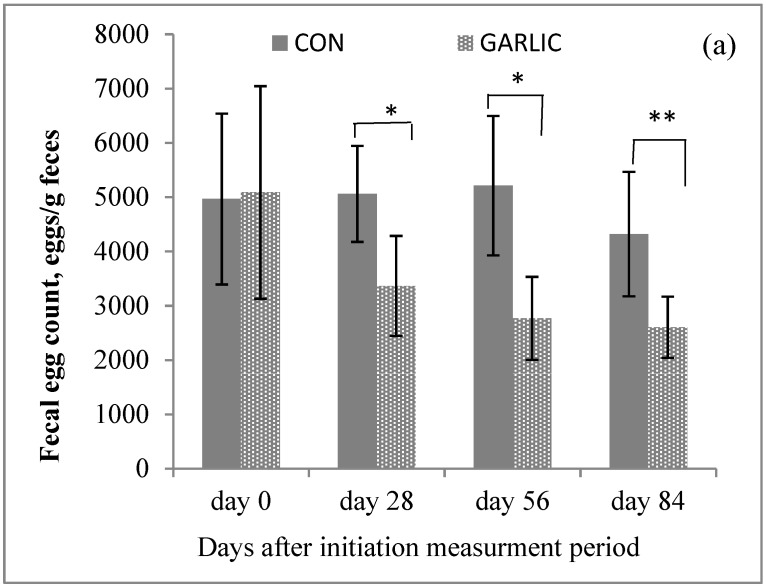
For the study, forty lambs were weighed and assigned into two treatments to determine the effects of feeding garlic powder on growth performance, rumen fermentation, and the health status of lambs infected with gastrointestinal nematodes (GINs). The lambs were fed with a basal diet without or with 50 g/kg garlic powder for 84 d. Data were analyzed by a general linear or mixed model of SAS software and differences were considered statistically significant if ≤ 0.05. Results showed that garlic powder supplementation increased the lambs' average daily gain ( = 0.025), digestibility of dry matter ( = 0.019), and crude protein ( = 0.007). No significant changes were observed on the dry matter intake, feed conversion ratio, as well as the apparent digestibility of lipid and fiber. An interactive effect between treatment and feeding day was observed on ruminal pH ( < 0.001) and ammonia nitrogen concentration ( < 0.001). Ruminal pH ( < 0.001) and ammonia nitrogen concentration ( < 0.001) decreased with garlic powder supplementation, while ammonia nitrogen concentration increased ( = 0.001) with the extension of the feeding period. Garlic powder supplementation increased the total volatile fatty acid concentration ( < 0.001) in the rumen fluid, the molar proportion of acetic acid ( = 0.002), propionic acid ( < 0.001), and isovaleric acid ( = 0.049), but it decreased the ratio of acetic acid to propionic acid ( = 0.015). The lambs' fecal egg count decreased ( < 0.001), but the packed cell volume and body condition scores of lambs increased ( < 0.001) with garlic powder supplementation. In conclusion, feeding garlic powder increased growth performance, feed digestion, rumen fermentation, and the health status of lambs infected with GINs.
在本研究中,对40只羔羊进行称重,并将其分为两种处理组,以确定饲喂大蒜粉对感染胃肠道线虫(GINs)的羔羊生长性能、瘤胃发酵和健康状况的影响。羔羊分别饲喂不含或含有50 g/kg大蒜粉的基础日粮,持续84天。数据采用SAS软件的一般线性或混合模型进行分析,若P≤0.05,则认为差异具有统计学意义。结果表明,添加大蒜粉可提高羔羊的平均日增重(P = 0.025)、干物质消化率(P = 0.019)和粗蛋白消化率(P = 0.007)。干物质采食量、饲料转化率以及脂肪和纤维的表观消化率未观察到显著变化。在瘤胃pH值(P < 0.001)和氨氮浓度(P < 0.001)方面观察到处理与饲喂天数之间的交互作用。添加大蒜粉后,瘤胃pH值(P < 0.001)和氨氮浓度(P < 0.001)降低,而氨氮浓度随饲喂期延长而升高(P = 0.001)。添加大蒜粉可提高瘤胃液中总挥发性脂肪酸浓度(P < 0.001)、乙酸(P = 0.002)、丙酸(P < 0.001)和异戊酸(P = 0.049)的摩尔比例,但降低了乙酸与丙酸的比例(P = 0.015)。添加大蒜粉后,羔羊的粪便虫卵计数降低(P < 0.001),但羔羊的红细胞压积和体况评分升高(P < 0.001)。总之,饲喂大蒜粉可提高感染GINs的羔羊的生长性能、饲料消化率、瘤胃发酵和健康状况。