Osiemo Mercy Mandere, Ogendi George Morara, M'Erimba Charles
Department of Environmental Science, Egerton University, Nakuru, Kenya.
Chemeron Dryland Research Training and Ecotourism Centre, Egerton University, Nakuru, Kenya.
Environ Health Insights. 2019 Mar 14;13:1178630219836988. doi: 10.1177/1178630219836988. eCollection 2019.
Accessibility to potable water is a fundamental right for dignity and well-being. Despite this observation, more than 1.1 billion people lack access to safe drinking water. This is particularly true in the Sub-Saharan Africa and South East Asia regions.
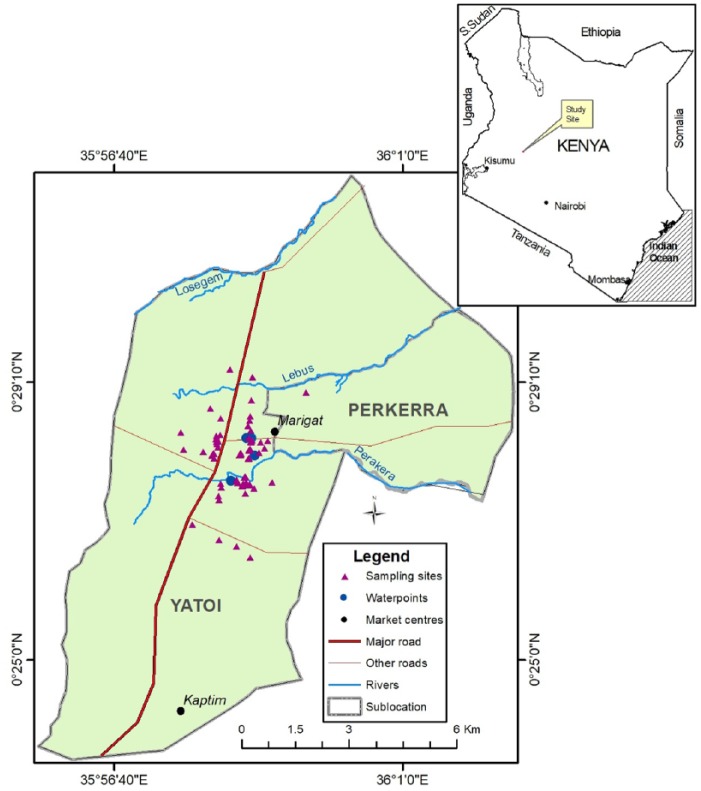
The main aim of this study was to assess microbial quality of drinking water and prevalence of water-related diseases in Marigat town, Baringo County, Kenya.
Samples of drinking water were collected from water sources (boreholes, rivers, and wells) and at the point of use (households) and analyzed for and total coliform (TC) bacteria using the most probable number method. In situ measurements of pH and temperature were performed using a Wagtech International portable meter. Clinical health records from the local health centers were also reviewed to assess the prevalence rates of some of the water-related diseases.
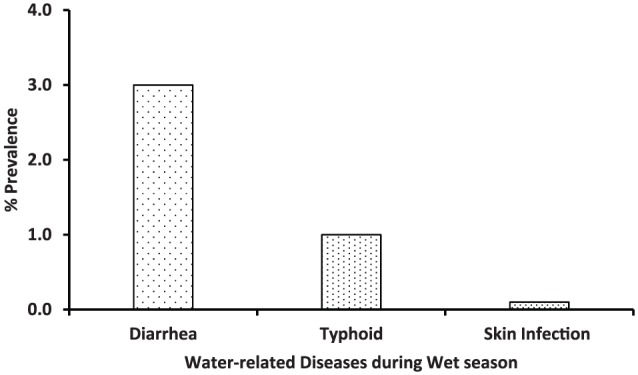
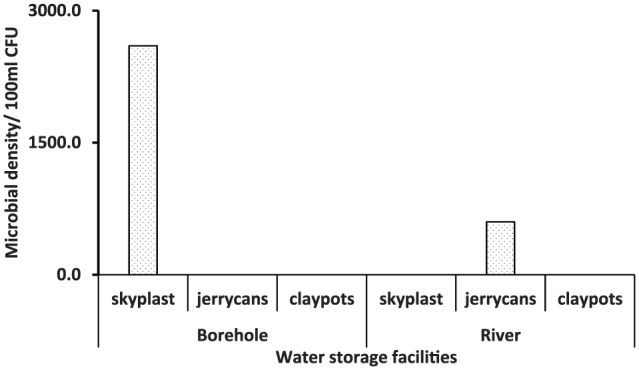
There were significant differences among water sources during dry season for (F = 3.629, < .05) and TC (F = 4.041, < .05). Similar observations were made during wet season for (F = 4.090, < .05) and TC (F = 1.893, < .05). Furthermore, there were significant interactions between the water sources and season for (F = 7.66, < .01) and TC (F = 5.494, < .05). Drinking water in large plastic storage containers (herein referred to as sky-plast) had the highest and TC concentrations. Typhoid was the most prevalent water-related disease during the dry season (10%), whereas diarrhea (3%) was the most prevalent during the wet season.
All drinking water at abstraction and point of use for Marigat residents are microbiologically contaminated and therefore pose serious health risks to consumers of such water. Thus, there is need for public health awareness campaigns on household water management to curb incidences of water-related diseases. Public health practitioners at county and national levels need to ensure that households have adequate access to potable water and improved sanitation.
获得饮用水是保障尊严和福祉的一项基本权利。尽管如此,仍有超过11亿人无法获得安全饮用水。撒哈拉以南非洲和东南亚地区尤其如此。
本研究的主要目的是评估肯尼亚巴林戈县马里加特镇饮用水的微生物质量以及与水相关疾病的患病率。
从水源(钻孔、河流和水井)以及使用点(家庭)采集饮用水样本,采用最大可能数法分析其中的大肠杆菌和总大肠菌群细菌。使用Wagtech International便携式仪表现场测量pH值和温度。还查阅了当地卫生中心的临床健康记录,以评估一些与水相关疾病的患病率。
旱季期间,不同水源的大肠杆菌(F = 3.629,P < 0.05)和总大肠菌群(F = 4.041,P < 0.05)存在显著差异。雨季期间,大肠杆菌(F = 4.090,P < 0.05)和总大肠菌群(F = 1.893,P < 0.05)也有类似情况。此外,水源和季节之间在大肠杆菌(F = 7.66,P < 0.01)和总大肠菌群(F = 5.494,P < 0.05)方面存在显著交互作用。大型塑料储存容器(以下简称天空塑料桶)中的饮用水大肠杆菌和总大肠菌群浓度最高。伤寒是旱季最常见的与水相关疾病(10%),而腹泻(3%)是雨季最常见的。
马里加特居民取用的所有饮用水在微生物方面均受到污染,因此给此类水的消费者带来严重健康风险。因此,需要开展关于家庭用水管理的公共卫生宣传活动,以遏制与水相关疾病的发生。县和国家层面的公共卫生从业者需要确保家庭能够充分获得饮用水并改善卫生条件。