Zhao Bochao, Zhang Jiale, Chen Xiuxiu, Xu Huimian, Huang Baojun
Department of Surgical Oncology, First Affiliated Hospital, China Medical University, Shenyang, China.
Arch Med Sci. 2019 Mar;15(2):498-503. doi: 10.5114/aoms.2018.73315. Epub 2018 Feb 7.
Gastric cancer is one of the most common cancers of the digestive system and is associated with high morbidity and mortality. The aim of this study was to investigate whether miR-26b is involved in the proliferation and resistance to paclitaxel chemotherapy in gastric cancer cells.
The expression of miR-26b in gastric cancer cell lines was determined by quantitative real-time PCR. Bioinformatics software was used to predict potential target genes of miR-26b. Luciferase assay was used to verify the interactions between target genes and miR-26b. CDC6 protein expression was measured by Western blot. The proliferation and chemotherapy resistance were analyzed by MTT assay. Cell invasion was evaluated by Transwell assay.
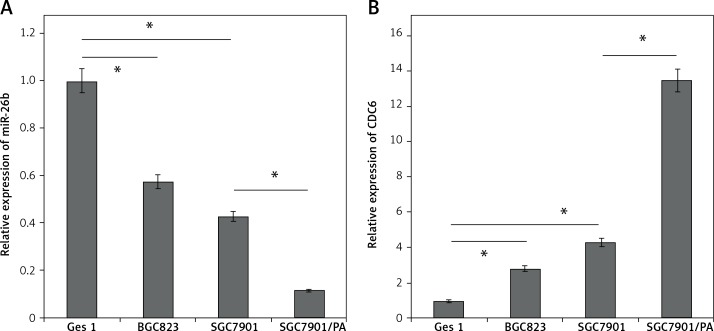
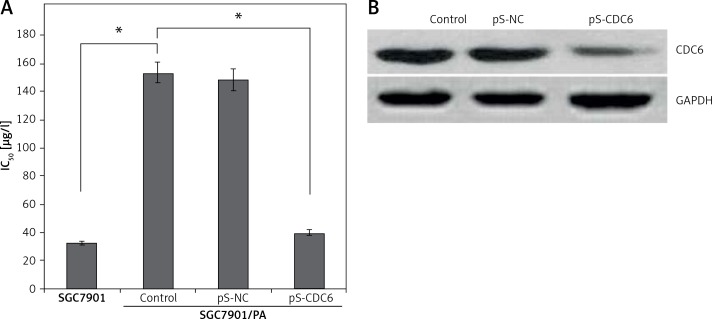
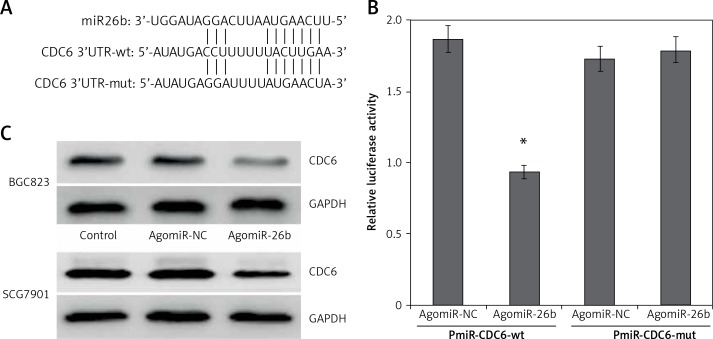
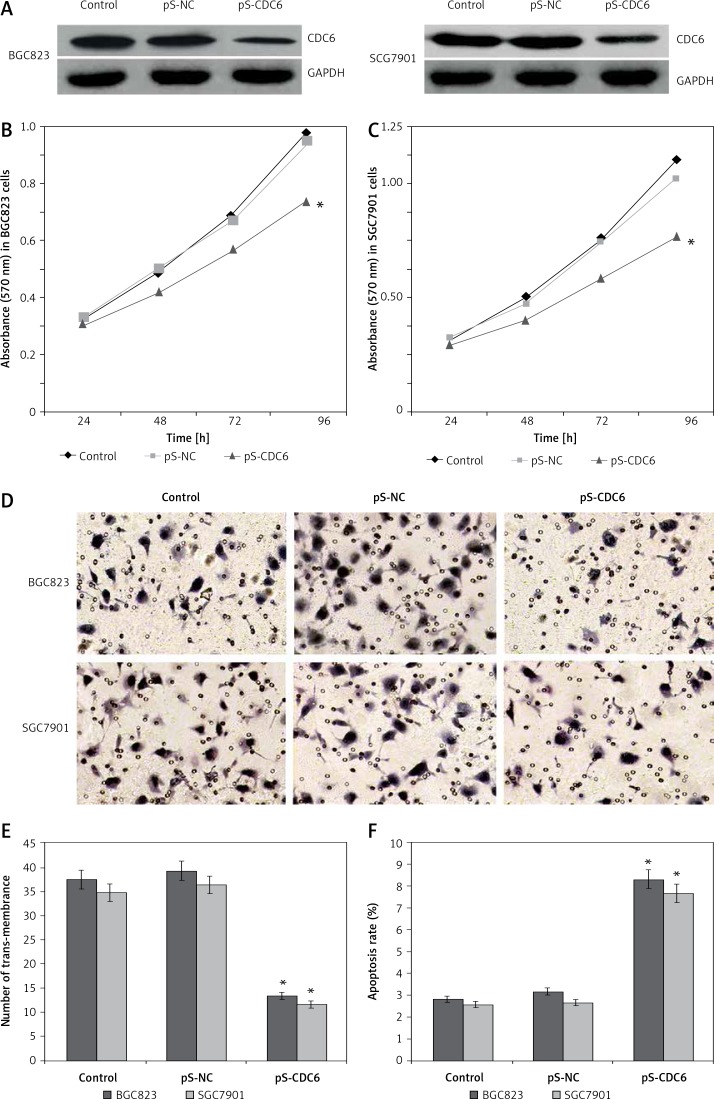
MiR-26b was down-regulated in gastric cancer cell lines compared to normal control cells, and its expression in drug resistance cells was even lower ( < 0.05). CDC6 was identified as a potential target gene of miR-26b by using bioinformatics analysis software. The expression of CDC6 was inhibited by miR-26b both at RNA level, which was determined by luciferase assay, and at protein level, which was determined by Western blot ( < 0.05). Silencing CDC6 inhibited cell proliferation, invasion, and promoted apoptosis of gastric cancer cell lines, BGC823 and SGC7901 ( < 0.05). Moreover, CDC6 knockdown inhibited chemotherapy resistance to paclitaxel, IC50 to paclitaxel decreased from 153.17 ±0.49 μg/l to 39.81 ±0.28 μg/l ( < 0.05).
miR-26b inhibits growth and resistance to paclitaxel chemotherapy by silencing the CDC6 gene in the gastric cancer cell line SGC7901.
胃癌是消化系统最常见的癌症之一,其发病率和死亡率都很高。本研究旨在探讨miR-26b是否参与胃癌细胞的增殖以及对紫杉醇化疗的耐药性。
通过定量实时PCR测定胃癌细胞系中miR-26b的表达。使用生物信息学软件预测miR-26b的潜在靶基因。荧光素酶报告基因检测用于验证靶基因与miR-26b之间的相互作用。通过蛋白质免疫印迹法检测细胞分裂周期蛋白6(CDC6)的蛋白表达。采用MTT法分析细胞增殖和化疗耐药性。通过Transwell实验评估细胞侵袭能力。
与正常对照细胞相比,miR-26b在胃癌细胞系中表达下调,并且其在耐药细胞中的表达更低(<0.05)。使用生物信息学分析软件确定CDC6为miR-26b的潜在靶基因。荧光素酶报告基因检测显示,在RNA水平上miR-26b抑制CDC6的表达,蛋白质免疫印迹法检测显示在蛋白质水平上miR-26b也抑制CDC6的表达(<0.05)。沉默CDC6可抑制胃癌细胞系BGC823和SGC7901的细胞增殖、侵袭并促进其凋亡(<0.05)。此外,敲低CDC6可抑制对紫杉醇的化疗耐药性,紫杉醇的半数抑制浓度(IC50)从153.17±0.49μg/l降至39.81±0.28μg/l(<0.05)。
miR-26b通过沉默胃癌细胞系SGC7901中的CDC6基因来抑制细胞生长和对紫杉醇化疗的耐药性。