Sani Dahiru, Khatab Nasir I O, Kirby Brian P, Yong Audrey, Hasan Shariful, Basri Hamidon, Stanslas Johnson
Pharmacotherapeutics Unit, Department of Medicine, Faculty of Medicine and Health Sciences, Universiti Putra Malaysia, Serdang, Selangor, Malaysia.
Perdana University - RCSI School of Medicine, Serdang, Selangor, Malaysia.
J Adv Res. 2018 Nov 30;16:87-97. doi: 10.1016/j.jare.2018.11.005. eCollection 2019 Mar.
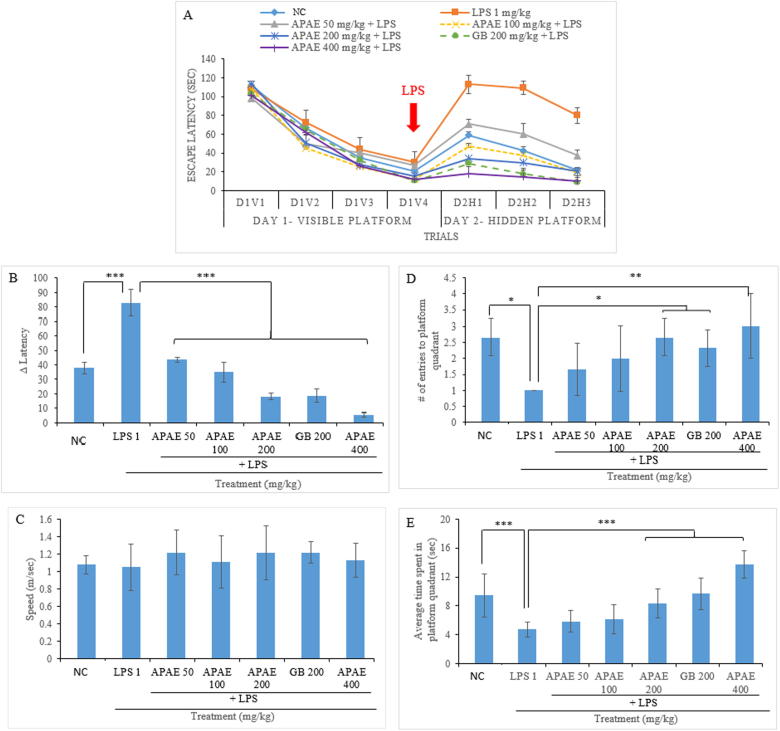
Substantial evidence has shown that most cases of memory impairment are associated with increased neuroinflammation and oxidative stress. In this study, the potential of a standardised aqueous extract (APAE) to reverse neuroinflammation and cognitive impairment induced by lipopolysaccharide (LPS) was examined . Rats were treated with APAE (50, 100, 200, and 400 mg·kg, p.o.) for 7 consecutive days prior to LPS (1 mg·kg, i.p.)-induced neuroinflammation and cognitive impairment. Spatial learning and memory were evaluated using the Morris water maze (MWM) test, while neuroinflammation and oxidative stress were assessed through the measurement of specific mediators, namely, tumour necrosis factor-α (TNF-α), interleukin-6 (IL-6), IL-1β, superoxide dismutase (SOD), catalase (CAT), antioxidant glutathione (GSH), reactive oxygen species (ROS), and thiobarbituric acid reactive substance (TBARS). Acetylcholinesterase (AChE) and butyrylcholinesterase (BChE) were also evaluated. LPS caused significant memory deficits in the 2-day MWM protocol, whereas pretreatment with standardised APAE dose-dependently improved performance in the MWM test. APAE treatment also blocked the LPS-induced hippocampal increase in the concentration and expression of proinflammatory cytokines (TNF-α, IL-1β, and IL-6) and production of ROS and TBARS and enhanced the activities of AChE and BChE. Furthermore, APAE enhanced the decrease in the levels and expression of hippocampal antioxidant enzymes (SOD and CAT) following LPS-induced neuroinflammation and cognitive deficit. The findings from these studies suggested that standardised APAE improved memory and had potent neuroprotective effects against LPS-induced neurotoxicity.
大量证据表明,大多数记忆障碍病例与神经炎症和氧化应激增加有关。在本研究中,研究了标准化水提取物(APAE)逆转脂多糖(LPS)诱导的神经炎症和认知障碍的潜力。在LPS(1mg·kg,腹腔注射)诱导神经炎症和认知障碍之前,大鼠连续7天接受APAE(50、100、200和400mg·kg,口服)治疗。使用莫里斯水迷宫(MWM)试验评估空间学习和记忆,同时通过测量特定介质,即肿瘤坏死因子-α(TNF-α)、白细胞介素-6(IL-6)、IL-1β、超氧化物歧化酶(SOD)、过氧化氢酶(CAT)、抗氧化谷胱甘肽(GSH)、活性氧(ROS)和硫代巴比妥酸反应物质(TBARS)来评估神经炎症和氧化应激。还评估了乙酰胆碱酯酶(AChE)和丁酰胆碱酯酶(BChE)。在为期2天的MWM实验中,LPS导致显著的记忆缺陷,而标准化APAE预处理在MWM试验中剂量依赖性地改善了表现。APAE治疗还阻断了LPS诱导的海马中促炎细胞因子(TNF-α、IL-1β和IL-6)浓度和表达的增加以及ROS和TBARS的产生,并增强了AChE和BChE的活性。此外,APAE增强了LPS诱导的神经炎症和认知缺陷后海马抗氧化酶(SOD和CAT)水平和表达的降低。这些研究结果表明,标准化APAE改善了记忆,并对LPS诱导的神经毒性具有强大的神经保护作用。