Jiangsu Key Laboratory of Infection and Immunity, Institutes of Biology and Medical Sciences, Soochow University, Suzhou, China.
Front Cell Infect Microbiol. 2019 Mar 7;9:57. doi: 10.3389/fcimb.2019.00057. eCollection 2019.
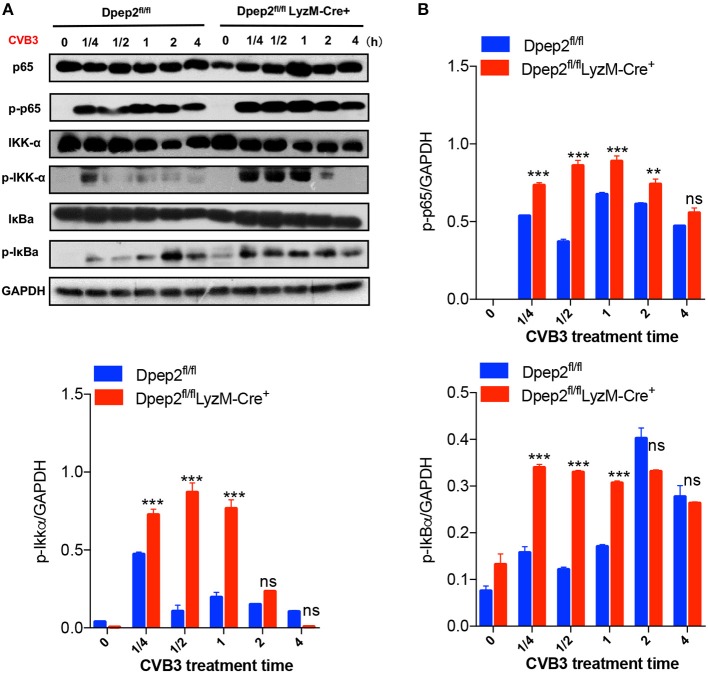
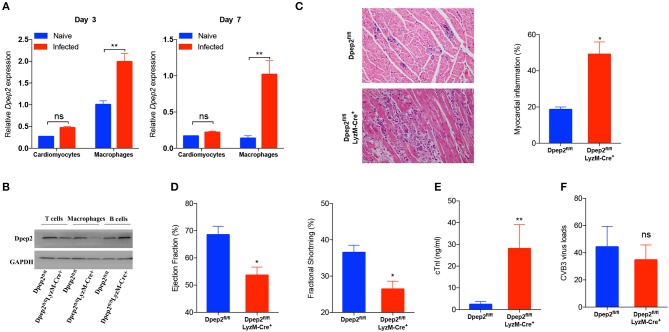
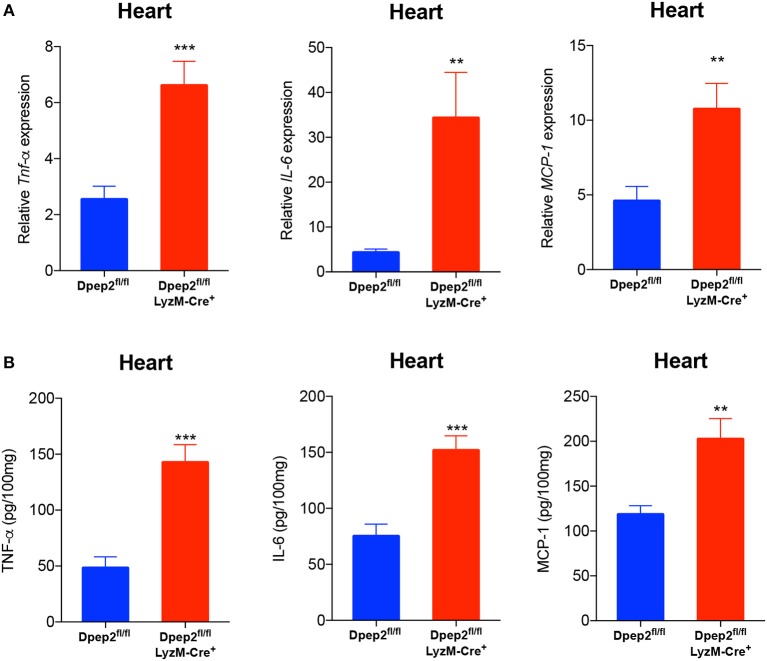
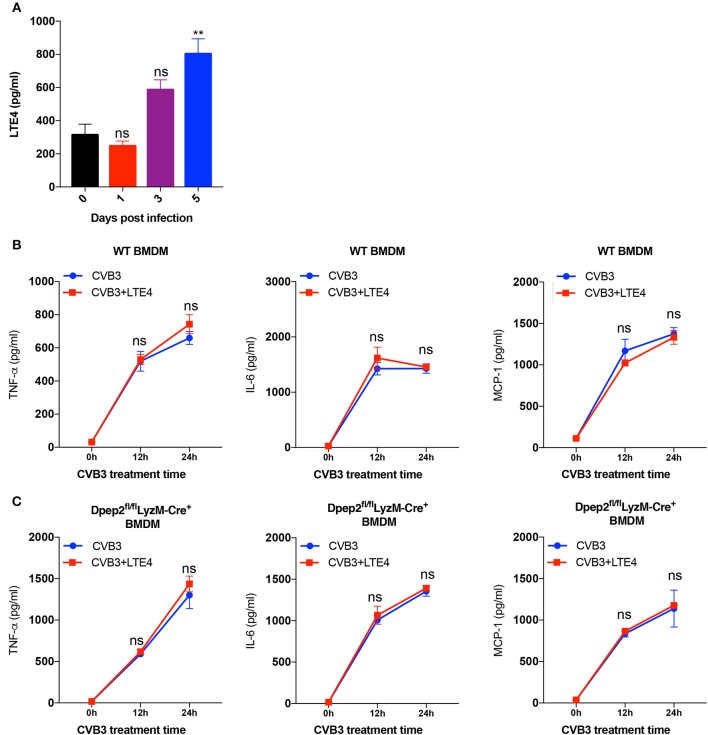
Overwhelming cardiac inflammation has been reported to be the pathogenic mechanism of Coxsackievirus B3 (CVB3)-induced viral myocarditis (VMC), while the detailed molecular mechanisms remain unknown. Membrane-bound dipeptidases (MBD, also known as Dpep) have been shown to be involved in inflammatory diseases. However, the clear and direct evidence of their impacts on inflammation is still lacking. In this study, our results revealed that Dpep2 expression was remarkably increased during CVB3 infection, and primarily produced by the cardiac tissue-infiltrating macrophages instead of constitutive cardiomyocytes. Macrophages have been reported to play an important pathological role in driving VMC. Interestingly, macrophage-specific Dpep2 deletion robustly aggravated CVB3-induced cardiac inflammation, evidenced by augmented expression of TNF-α, IL-6, and MCP-1 in heart tissue. In addition, Dpep2-deficient bone-marrow derived macrophages (BMDMs) generated more TNF-α, IL-6, and MCP-1 after CVB3 stimulation compared with the control BMDMs. Moreover, this suppressive effect of Dpep2 on macrophages relied on its repression on NF-κB signaling pathway, but not on its conventional hydrolysate LTE4. Taken together, this study revealed that Dpep2 could protect against CVB3-induced VMC by acting as a suppressor of macrophage inflammation. Better understanding how macrophage Dpep2 dampened the cardiac inflammation would provide us with insights for the efficient control of CVB3-induced VMC.
已有研究报道,柯萨奇病毒 B3(CVB3)引起的病毒性心肌炎(VMC)的发病机制是心肌的炎症反应过度,但其详细的分子机制尚不清楚。膜结合二肽酶(MBD,也称为 Dpep)已被证明与炎症性疾病有关。然而,其对炎症的影响仍缺乏明确和直接的证据。在本研究中,我们的结果表明,Dpep2 的表达在 CVB3 感染期间显著增加,主要由心脏组织浸润的巨噬细胞而不是组成型心肌细胞产生。巨噬细胞已被报道在驱动 VMC 中发挥重要的病理作用。有趣的是,巨噬细胞特异性 Dpep2 缺失可显著加重 CVB3 诱导的心脏炎症,表现为心脏组织中 TNF-α、IL-6 和 MCP-1 的表达增加。此外,与对照组 BMDMs 相比,Dpep2 缺陷型骨髓来源的巨噬细胞(BMDMs)在 CVB3 刺激后产生更多的 TNF-α、IL-6 和 MCP-1。此外,Dpep2 对巨噬细胞的抑制作用依赖于其对 NF-κB 信号通路的抑制,而不是其常规水解产物 LTE4。综上所述,本研究揭示了 Dpep2 可以通过抑制巨噬细胞炎症来保护心脏免受 CVB3 诱导的 VMC。更好地了解巨噬细胞 Dpep2 如何抑制心脏炎症,将为我们提供有效控制 CVB3 诱导的 VMC 的思路。