Department of Ecology, Leibniz Centre for Tropical Marine Research (ZMT), Bremen, Germany.
Research Centre for Oceanography, Indonesian Institute of Science (LIPI), Lombok, Indonesia.
PLoS One. 2019 Mar 22;14(3):e0214373. doi: 10.1371/journal.pone.0214373. eCollection 2019.
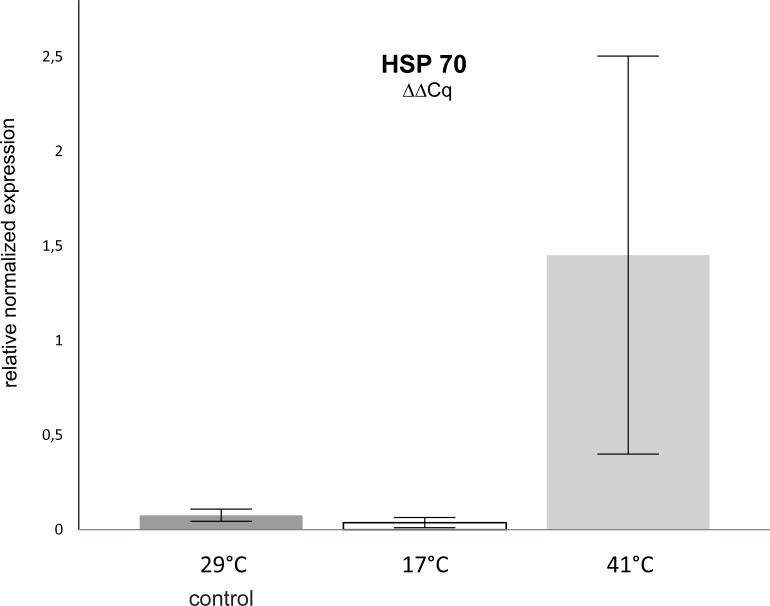
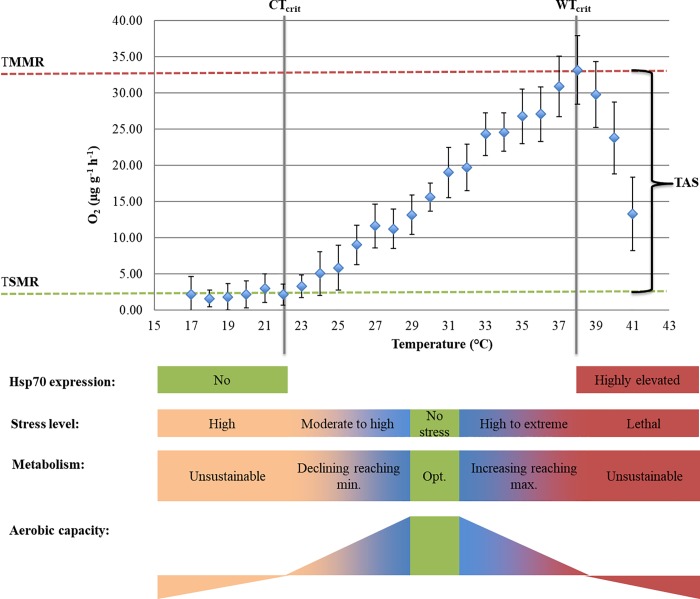
The Aerobic Scope (AS), which reflects the functional capacity for biological fitness, is a highly relevant proxy to determine thermal tolerance in various taxa. Despite the importance of this method, its implementation is often hindered, due to lacking techniques to accurately measure standard- (SMR) and maximal- (MMR) metabolic rates, especially in sluggish marine invertebrates with low oxygen consumption rates, such as sea cucumbers. In this study the AS concept was modified to define a Temperature-induced Aerobic Scope (TAS), based on metabolic rate changes due to temperature adjustments rather than traditionally used physical activity patterns. Consequentially, temperature dependent peak and bottom O2 consumption rates, defined as Temperature-induced Maximal- (TMMR) and Standard Metabolic Rates (TSMR), respectively, served as MMR and SMR alternatives for the sea cucumber Holothuria scabra. TMMR and TSMR were induced through acute temperature change (2°C per hour; 17-41°C) until critical warm (WTcrit) and cold (CTcrit) temperatures were reached, respectively. In addition, Hsp70 gene expression linked to respiration rates served as synergistic markers to confirm critical threshold temperatures. O2 consumption of H. scabra peaked distinctly at WTcrit of 38°C (TMMR = 33.2 ± 4.7 μgO2 g-1 h-1). A clear metabolic bottom line was reached at CTcrit of 22°C (TSMR = 2.2 ± 1.4 μgO2 g-1 h-1). Within the thermal window of 22-38°C H. scabra sustained positive aerobic capacity, with assumed optimal performance range between 29-31.5°C (13.85-18.7 μgO2 g-1 h-1). Between 39-41°C H. scabra decreased respiration progressively, while gene expression levels of Hsp70 increased significantly at 41°C, indicating prioritization of heat shock response (HSR) and homeostatic disruption. At the cold end (17-22°C) homeostatic disruption was visible through incrementally increasing energetic expenses to fuel basal maintenance costs, but no Hsp70 overexpression occurred. TMMR, TSMR and TAS proved to be reliable metrics, similar to the traditional energetic key parameters MMR, SMR and AS, to determine a specific aerobic performance window for the sluggish bottom dwelling species H. scabra. In addition, the linkage between respiration physiology and molecular defense mechanisms showed valuable analytical synergies in terms of mechanistic prioritization as response to thermal stress. Overall, this study will help to define lethal temperatures for aquaculture and to predict the effects of environmental stress, such as ocean warming, in H. scabra.
有氧范围(AS)反映了生物适应性的功能能力,是确定各种分类群热耐受性的一个非常相关的指标。尽管该方法非常重要,但由于缺乏准确测量标准代谢率(SMR)和最大代谢率(MMR)的技术,其实施往往受到阻碍,特别是在新陈代谢率低的缓慢海洋无脊椎动物中,如海参。在这项研究中,基于温度调整引起的代谢率变化而不是传统使用的物理活动模式,对 AS 概念进行了修改,定义了温度诱导的有氧范围(TAS)。因此,温度依赖性的峰值和底部耗氧量分别定义为温度诱导的最大代谢率(TMMR)和标准代谢率(TSMR),作为海参 Holothuria scabra 的 MMR 和 SMR 的替代品。TMMR 和 TSMR 通过急性温度变化(每小时 2°C;17-41°C)诱导,直到达到临界暖(WTcrit)和冷(CTcrit)温度。此外,与呼吸速率相关的 Hsp70 基因表达作为协同标志物,用于确认临界温度阈值。H. scabra 的耗氧量在 38°C 的 WTcrit 时明显达到峰值(TMMR = 33.2 ± 4.7 μgO2 g-1 h-1)。在 22°C 的 CTcrit 时达到明显的代谢底线(TSMR = 2.2 ± 1.4 μgO2 g-1 h-1)。在 22-38°C 的热窗口内,H. scabra 维持着积极的有氧能力,假定最佳性能范围在 29-31.5°C(13.85-18.7 μgO2 g-1 h-1)之间。在 39-41°C 之间,H. scabra 的呼吸逐渐减少,而 Hsp70 的基因表达水平在 41°C 时显著增加,表明优先考虑热休克反应(HSR)和体内平衡破坏。在低温端(17-22°C),通过增加能量消耗来为基础维持成本提供燃料,可见体内平衡破坏,但没有发生 Hsp70 的过度表达。TMMR、TSMR 和 TAS 被证明是可靠的指标,与传统的能量关键参数 MMR、SMR 和 AS 相似,可确定缓慢的底栖物种 H. scabra 的特定有氧性能窗口。此外,呼吸生理学与分子防御机制之间的联系在热应激响应的机制优先级方面显示出有价值的分析协同作用。总的来说,这项研究将有助于确定水产养殖的致死温度,并预测海洋变暖等环境压力对 H. scabra 的影响。