Du Juan, Cao Xuemei, Diao Junlin, Zhang Qijuan, Peng Chuan, Li Jibin, Xiao Xiaoqiu
Laboratory of Lipid & Glucose Metabolism, PR China.
Department of Clinical Nutrition, The First Affiliated Hospital of Chongqing Medical University, PR China.
Genes Dis. 2018 Jan 5;6(1):68-77. doi: 10.1016/j.gendis.2017.12.008. eCollection 2019 Mar.
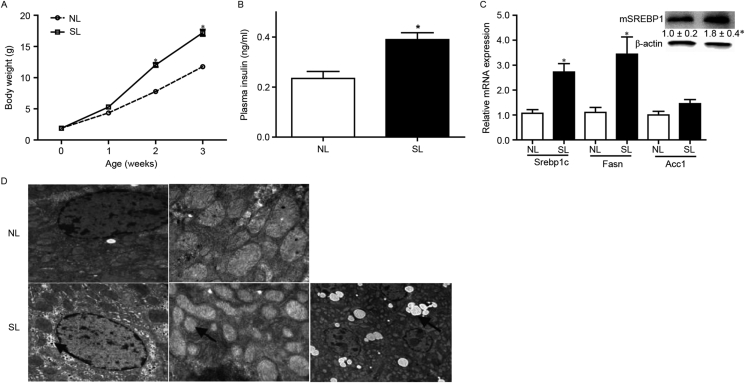
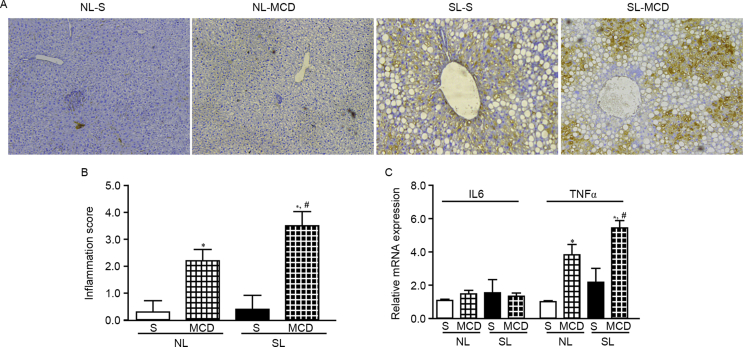
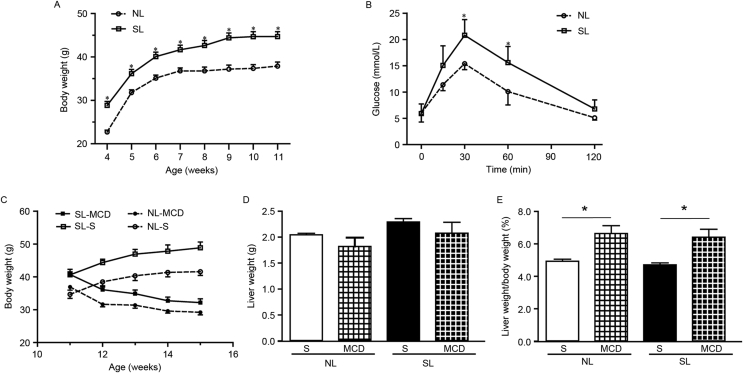
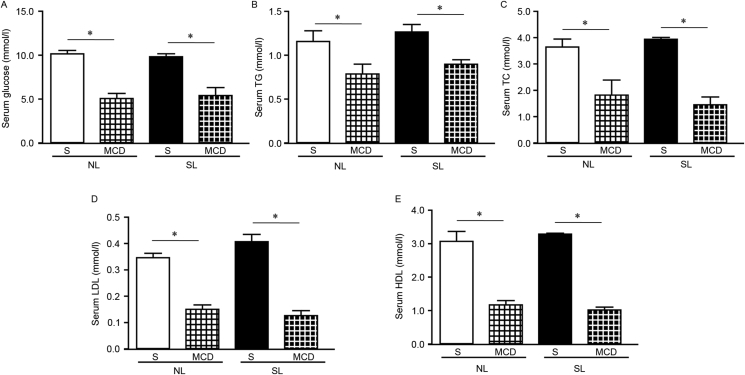
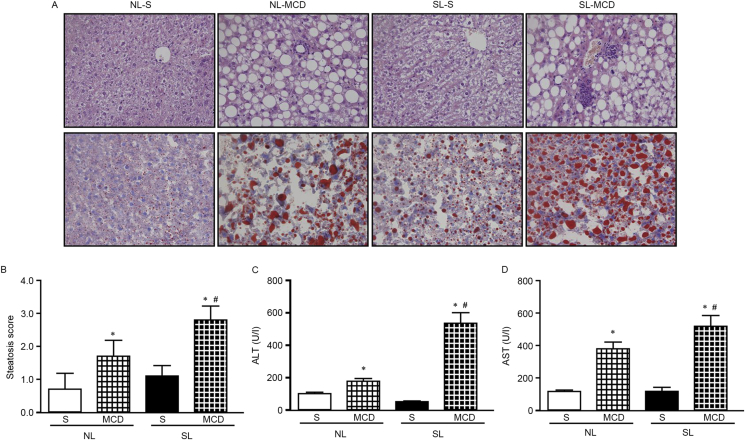
Overfeeding in early life is associated with obesity and insulin resistance in adulthood. In the present study, a well-characterized mouse model was used to investigate whether neonatal overfeeding increases susceptibility to the development of non-alcoholic steatohepatitis (NASH) following feeding with a methionine and choline- deficient (MCD) diet. Neonatal overfeeding was induced by adjusting litters to 3 pups per dam (small litter size, SL) in contrast to 10 pups per dam as control (normal litter size, NL). At 11 weeks of age, mice were fed with standard (S) or a methionine and choline-deficient (MCD) diet for 4 weeks. Glucose tolerance tests, tissue staining with haematoxylin and eosin, oil-red O and immunohistochemistry for F4/80, reverse transcription-quantitative polymerase chain reaction (RT-qPCR) and western blotting were performed. Compared with NL mice, SL mice exhibited higher body weight gain from 2 weeks of age throughout adulthood, and more profound glucose intolerance as adults. Sterol regulatory element-binding protein 1c and fatty acid synthase mRNA expression levels in liver were upregulated in SL mice at 3 weeks of age. MCD diet induced typical NASH, especially in SL-MCD mice, evidenced by marked fat accumulation, macrovescular steatosis, ballooned hepatocytes, inflammatory cells infiltration and tumour necrosis factor-α mRNA upregulation in the liver, as well as increased alanine aminotransferase and aspartate aminotransferase levels in the serum. There were no significant differences in liver fibrosis in all groups. Overfeeding during early life exhibited effect with administration of MCD diet in inducing adverse effects on the metabolic function and in promoting the progression of NASH in mice, possibly mediated through dysregulated lipid metabolism in hepatocytes and aggravated hepatic inflammation.
生命早期的过度喂养与成年期的肥胖和胰岛素抵抗有关。在本研究中,使用了一种特征明确的小鼠模型来研究新生儿期过度喂养是否会增加在给予蛋氨酸和胆碱缺乏(MCD)饮食后发生非酒精性脂肪性肝炎(NASH)的易感性。与每只母鼠产10只幼崽作为对照(正常窝仔数,NL)相比,通过将窝仔数调整为每只母鼠3只幼崽(小窝仔数,SL)来诱导新生儿期过度喂养。在11周龄时,给小鼠喂食标准(S)或蛋氨酸和胆碱缺乏(MCD)饮食4周。进行了葡萄糖耐量试验、苏木精和伊红组织染色、油红O染色以及F4/80免疫组织化学、逆转录定量聚合酶链反应(RT-qPCR)和蛋白质免疫印迹分析。与NL小鼠相比,SL小鼠从2周龄到成年期体重增加更高,成年后葡萄糖不耐受更严重。SL小鼠在3周龄时肝脏中固醇调节元件结合蛋白1c和脂肪酸合酶的mRNA表达水平上调。MCD饮食诱导了典型的NASH,尤其是在SL-MCD小鼠中,表现为肝脏中明显的脂肪堆积、大泡性脂肪变性、肝细胞气球样变、炎性细胞浸润和肿瘤坏死因子-α mRNA上调,以及血清中丙氨酸氨基转移酶和天冬氨酸氨基转移酶水平升高。所有组的肝纤维化无显著差异。生命早期的过度喂养在给予MCD饮食时对小鼠的代谢功能产生不利影响并促进NASH进展,可能是通过肝细胞脂质代谢失调和肝炎症加重介导的。