Research Team for Neuroimaging, Tokyo Metropolitan Institute of Gerontology, Tokyo, Japan; Department of Neurology, Tokyo Metropolitan Cancer and Infectious Diseases Center Komagome Hospital, Tokyo, Japan.
Department of Neurology, Tokyo Metropolitan Cancer and Infectious Diseases Center Komagome Hospital, Tokyo, Japan.
Neuroimage Clin. 2019;22:101783. doi: 10.1016/j.nicl.2019.101783. Epub 2019 Mar 16.
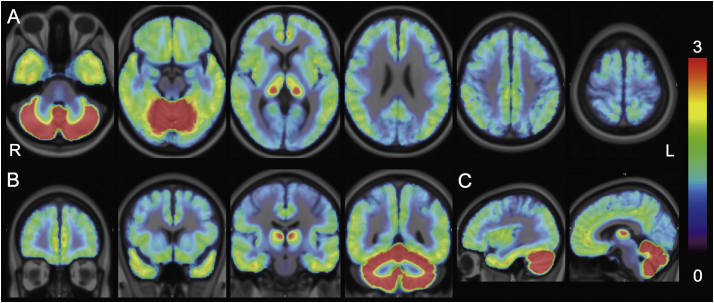
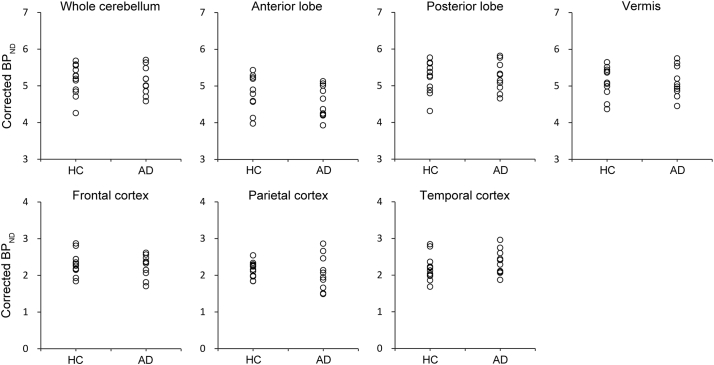
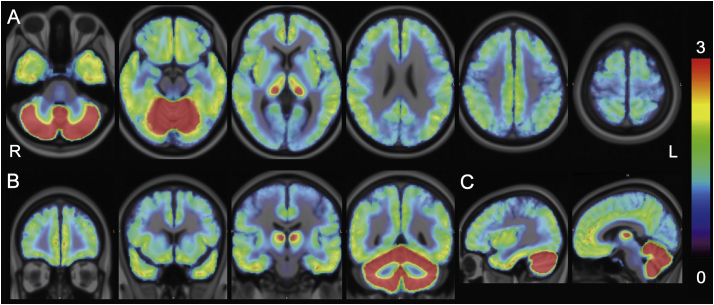
Imaging of type 1 metabotropic glutamate receptor (mGluR1) has recently become possible using positron emission tomography (PET). To date, little evidence exists on the role of mGluR1 in the pathophysiology of Alzheimer's disease (AD). We aimed to examine mGluR1 availability in patients with AD. Ten patients with AD (78.9 ± 5.9 years) and 12 age-matched volunteers (74.6 ± 2.6 years) underwent PET using an mGluR1 radiotracer. All patients were anti-dementia drug-naive. Volumes-of-interest were placed on the anterior and posterior lobes and vermis in the cerebellum and frontal, parietal, and temporal cortices. The binding potential (BP) was calculated to estimate mGluR1 availability, and partial volume correction was applied to the BP values. Mini Mental State Examination (MMSE) scores were also obtained (22.0 ± 4.8). No significant difference was observed in BP between the AD and control groups in the anterior lobe (p = .30), posterior lobe (p = .95), vermis (p = .96), frontal cortex (p = .61), parietal cortex (p = .59), or temporal cortex (p = .27). No significant correlation was observed between BP and MMSE scores in the anterior lobe (p = .59), posterior lobe (p = .35), vermis (p = .92), frontal cortex (p = .78), parietal cortex (p = .83), or temporal cortex (p = .82). In conclusions, this study suggests that mGluR1 availability is unchanged in the relatively early stage of AD. However, because regional mGluR1 availability may change with the progression of AD, further longitudinal follow-up is necessary.
1 型代谢型谷氨酸受体(mGluR1)的成像最近已经可以通过正电子发射断层扫描(PET)实现。迄今为止,关于 mGluR1 在阿尔茨海默病(AD)病理生理学中的作用的证据很少。我们旨在检查 AD 患者中 mGluR1 的可用性。10 名 AD 患者(78.9±5.9 岁)和 12 名年龄匹配的志愿者(74.6±2.6 岁)接受了 mGluR1 放射性示踪剂的 PET 检查。所有患者均未使用抗痴呆药物。在小脑的前叶和后叶以及蚓部以及额叶、顶叶和颞叶皮质上放置了感兴趣区。计算结合潜力(BP)以估计 mGluR1 的可用性,并对 BP 值应用部分体积校正。还获得了迷你精神状态检查(MMSE)评分(22.0±4.8)。在前叶(p=0.30)、后叶(p=0.95)、蚓部(p=0.96)、额叶皮质(p=0.61)、顶叶皮质(p=0.59)或颞叶皮质(p=0.27)中,AD 组和对照组之间的 BP 没有显着差异。在前叶(p=0.59)、后叶(p=0.35)、蚓部(p=0.92)、额叶皮质(p=0.78)、顶叶皮质(p=0.83)或颞叶皮质(p=0.82)中,BP 与 MMSE 评分之间没有显着相关性。总之,这项研究表明,在 AD 的相对早期阶段,mGluR1 的可用性没有改变。然而,由于区域 mGluR1 可用性可能随着 AD 的进展而改变,因此需要进一步的纵向随访。