Cellular Functional Nanobiomaterials Group, Research Center for Functional Materials, National Institute for Materials Science, 1-1 Namiki, Tsukuba, Ibaraki 305-0044, Japan.
Graduate School of Advanced Science and Engineering, Waseda University, 3-4-1 Okubo, Shinjuku-ku, Tokyo 169-8555, Japan.
Int J Mol Sci. 2019 Mar 22;20(6):1458. doi: 10.3390/ijms20061458.
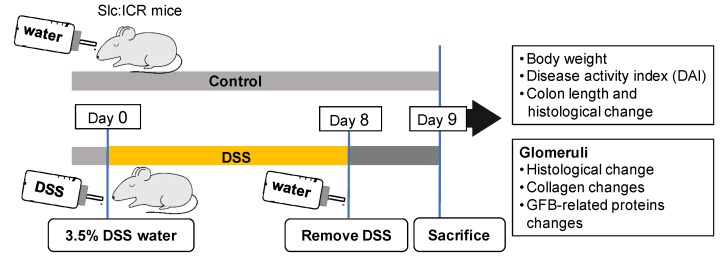
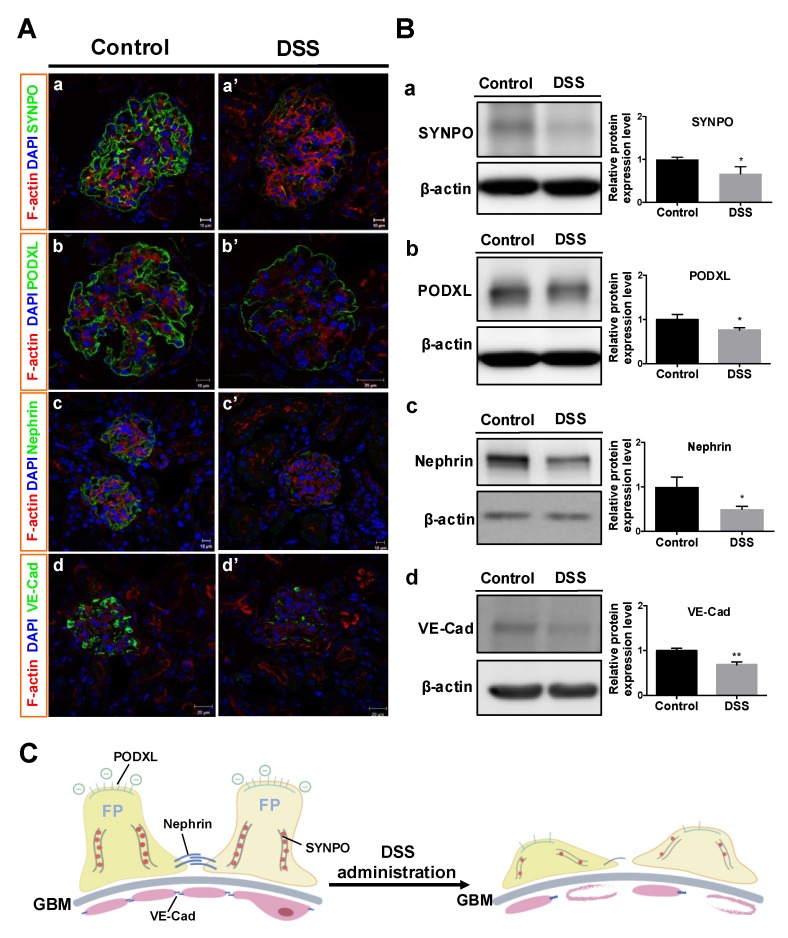
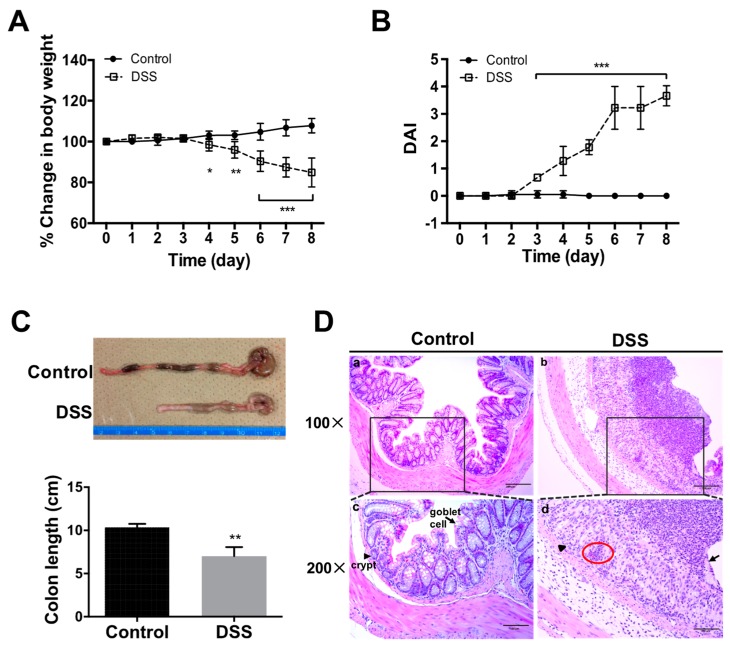
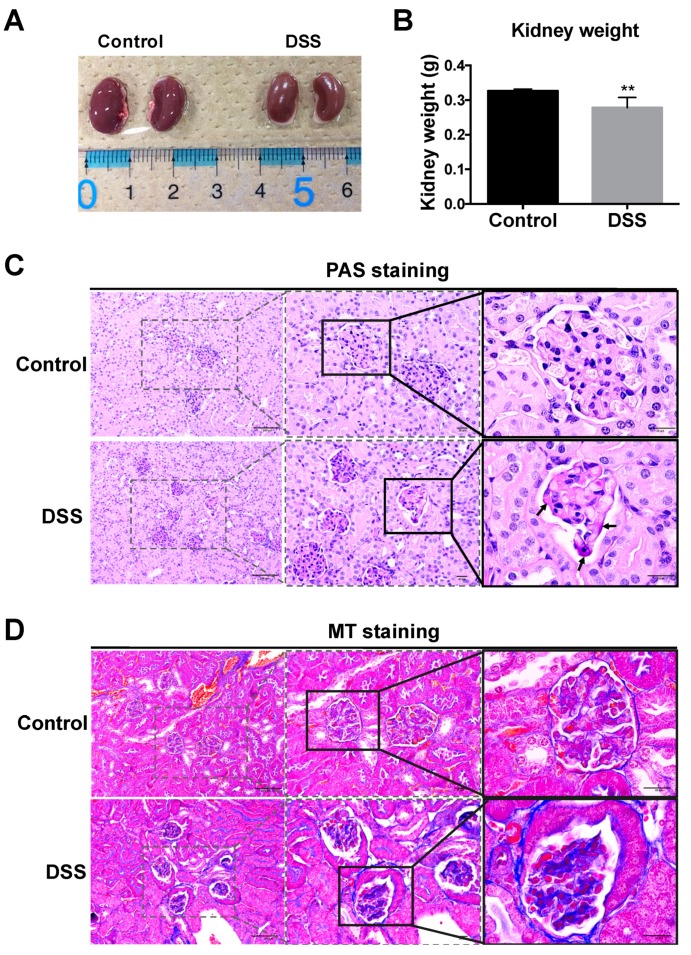
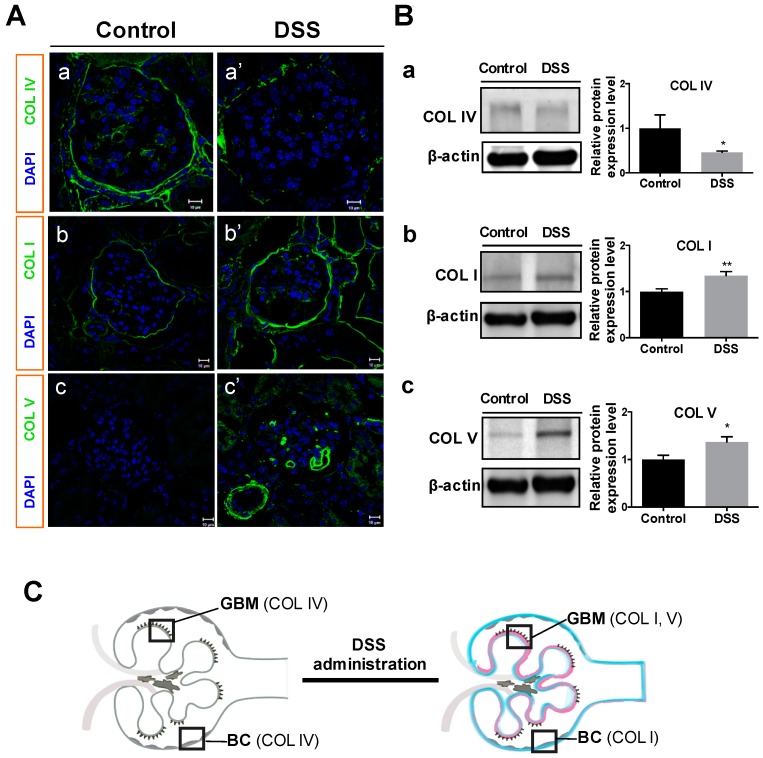
Renal disease is not rare among patients with inflammatory bowel disease (IBD) and is gaining interest as a target of research. However, related changes in glomerular structural have rarely been investigated. This study was aimed at clarifying the changes in collagens and glomerular filtration barrier (GFB)-related proteins of glomeruli in a dextran sulfate sodium (DSS)-induced colitis mouse model. Acute colitis was induced by administering 3.5% DSS in Slc:ICR strain mice for eight days. Histological changes to glomeruli were examined by periodic acid-Schiff (PAS) and Masson's trichrome staining. Expressions of glomerular collagens and GFB-related proteins were analyzed by immunofluorescent staining and Western blot analysis. DSS-colitis mice showed an elevated disease activity index (DAI), colon shortening, massive cellular infiltration and colon damage, confirming that DSS-colitis mice can be used as an IBD animal model. DSS-colitis mice showed increased glycoprotein and collagen deposition in glomeruli. Interestingly, we observed significant changes in glomerular collagens, including a decrease in type IV collagen, and an increment in type I and type V collagens. Moreover, declined GFB-related proteins expressions were detected, including synaptopodin, podocalyxin, nephrin and VE-cadherin. These results suggest that renal disease in DSS-colitis mice might be associated with changes in glomerular collagens and GFB-related proteins. These findings are important for further elucidation of the clinical pathological mechanisms underlying IBD-associated renal disease.
在炎症性肠病(IBD)患者中,肾脏疾病并不罕见,并且作为研究的目标越来越受到关注。然而,肾小球结构的相关变化很少被研究。本研究旨在阐明葡聚糖硫酸钠(DSS)诱导的结肠炎小鼠模型中肾小球胶原和肾小球滤过屏障(GFB)相关蛋白的变化。在 Slc:ICR 品系小鼠中用 3.5%的 DSS 处理 8 天诱导急性结肠炎。通过过碘酸-Schiff(PAS)和 Masson 三色染色检查肾小球的组织学变化。通过免疫荧光染色和 Western blot 分析分析肾小球胶原和 GFB 相关蛋白的表达。DSS-结肠炎小鼠表现出升高的疾病活动指数(DAI)、结肠缩短、大量细胞浸润和结肠损伤,证实 DSS-结肠炎小鼠可用作 IBD 动物模型。DSS-结肠炎小鼠的肾小球中糖蛋白和胶原沉积增加。有趣的是,我们观察到肾小球胶原发生了显著变化,包括 IV 型胶原减少,I 型和 V 型胶原增加。此外,还检测到 GFB 相关蛋白表达下降,包括突触蛋白、足细胞蛋白、nephrin 和 VE-钙黏蛋白。这些结果表明,DSS-结肠炎小鼠的肾脏疾病可能与肾小球胶原和 GFB 相关蛋白的变化有关。这些发现对于进一步阐明 IBD 相关肾脏疾病的临床病理机制非常重要。