Department of Cell Biology and Physiology, Washington University School of Medicine, Saint Louis, MO, 63110, USA.
Center for the Investigation of Membrane Excitability Diseases, Washington University School of Medicine, Saint Louis, MO, 63110, USA.
Nat Commun. 2019 Mar 27;10(1):1386. doi: 10.1038/s41467-019-09376-7.
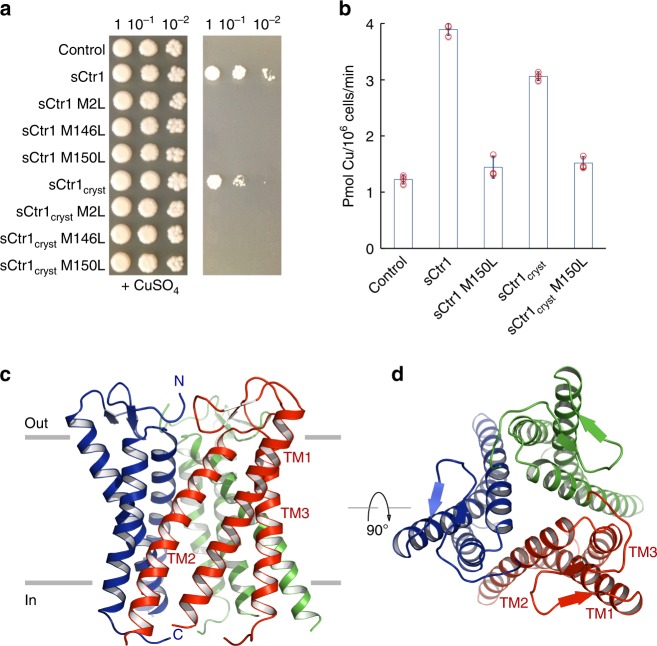
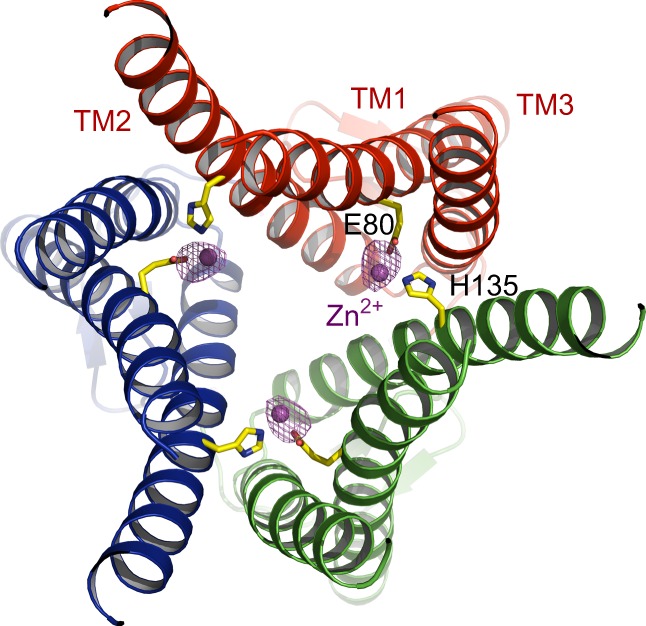
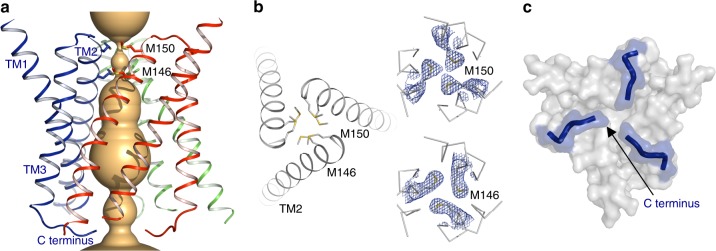
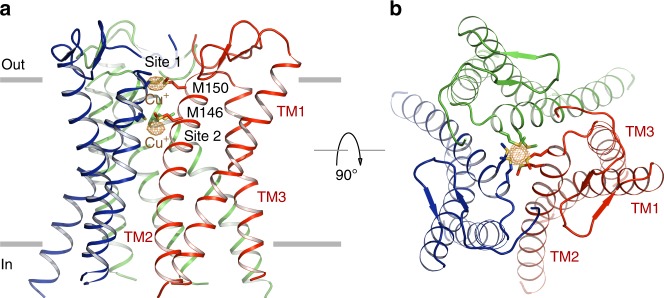
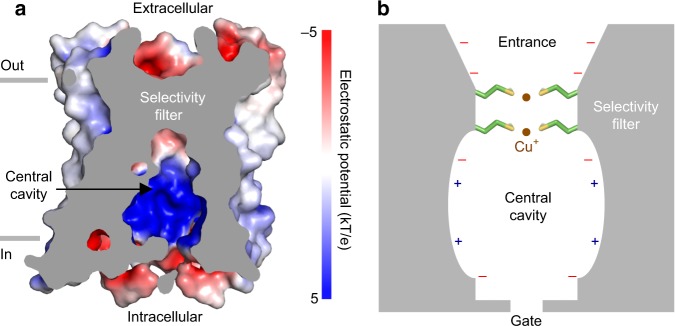
Copper (Cu) is an essential trace element for growth and development and abnormal Cu levels are associated with anemia, metabolic disease and cancer. Evolutionarily conserved from fungi to humans, the high-affinity Cu transporter Ctr1 is crucial for both dietary Cu uptake and peripheral distribution, yet the mechanisms for selective permeation of potentially toxic Cu ions across cell membranes are unknown. Here we present X-ray crystal structures of Ctr1 from Salmo salar in both Cu-free and Cu-bound states, revealing a homo-trimeric Cu-selective ion channel-like architecture. Two layers of methionine triads form a selectivity filter, coordinating two bound Cu ions close to the extracellular entrance. These structures, together with Ctr1 functional characterization, provide a high resolution picture to understand Cu import across cellular membranes and suggest therapeutic opportunities for intervention in diseases characterized by inappropriate Cu accumulation.
铜(Cu)是生长和发育所必需的微量元素,异常的 Cu 水平与贫血、代谢疾病和癌症有关。从真菌到人类,高亲和力的 Cu 转运蛋白 Ctr1 是饮食中 Cu 摄取和外周分布所必需的,然而,潜在有毒 Cu 离子穿过细胞膜的选择性渗透的机制尚不清楚。在这里,我们展示了鲑鱼 Ctr1 在无 Cu 和 Cu 结合状态下的 X 射线晶体结构,揭示了一种同源三聚体的 Cu 选择性离子通道样结构。两层蛋氨酸三联体形成一个选择性过滤器,将两个结合的 Cu 离子配位到细胞外入口附近。这些结构,以及 Ctr1 的功能表征,提供了一个高分辨率的图片,以了解 Cu 穿过细胞膜的导入,并为干预以不适当的 Cu 积累为特征的疾病提供了治疗机会。