Jiangxi Provincial Institute of Parasitic Diseases, No. 239, First Gaoxin Rd., Gaoxin District, 330096, Nanchang, Jiangxi Province, People's Republic of China.
Molecular Parasitology Laboratory, Infectious Diseases Division, QIMR Berghofer Medical Research Institute, Brisbane, Australia.
Infect Dis Poverty. 2019 Mar 29;8(1):23. doi: 10.1186/s40249-019-0534-8.
With the closure of the Three Gorges Dam in 2003 the hydrology of Poyang Lake was altered dramatically leading to significant changes in the environment. In order to assess the impact on schistosomiasis this study assessed the spatial and temporal patterns of the snail intermediate host, Oncomelania hupensis in the Poyang Lake tributaries. The results of the study have important implications for future snail control strategies leading to disease elimination.
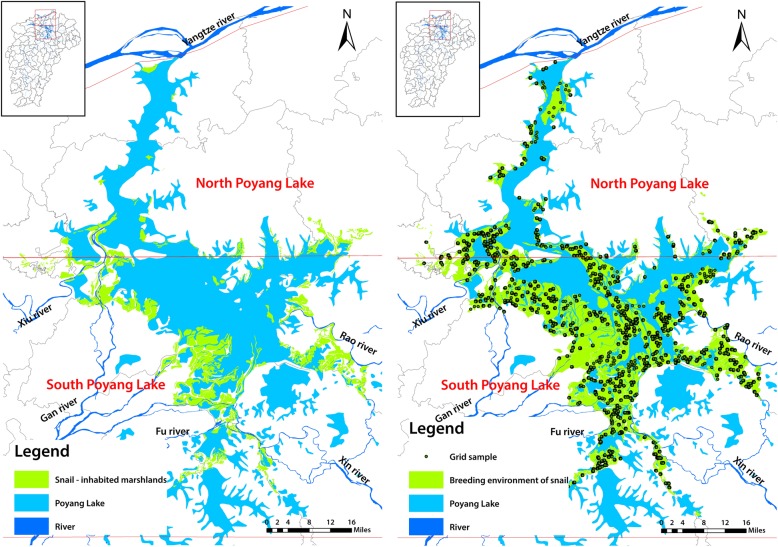
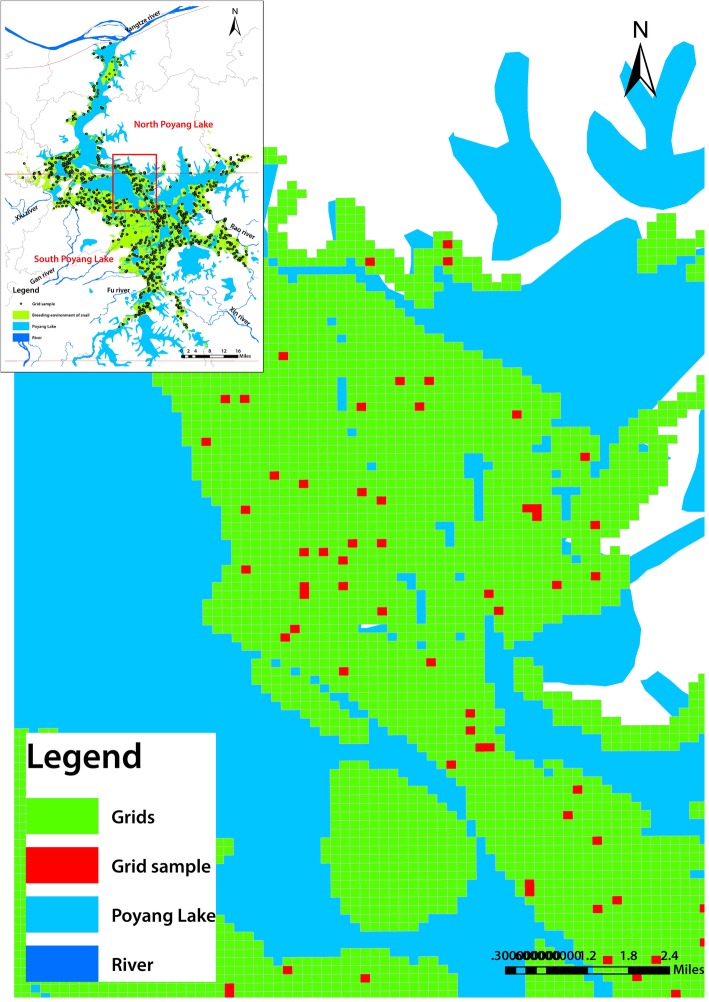
The marshland area surrounding Poyang Lake was divided randomly into 200 × 200 m vector grids using ArcGIS software, and the surveyed grids were randomly selected by the software. The snail survey was conducted in each selected grid using a survey frame of 50 × 50 m with one sideline of each grid serving as the starting line. No less than ten frames were used in each surveyed grid with Global Positioning System (GPS) recordings for each. All snails in each frame were collected to determine infection status by microscopy. Altitude data for all frames were extracted from a lake bottom topographic map in order to analyze the average altitude. All snail survey data were collected and statistically analyzed with SPSS 20.0 software in order to determine the difference of the percentage of frames with living snails and mean density of living snails in different regions of Poyang Lake. The altitude of the snail-infested marshlands and snail dens were subsequently identified.
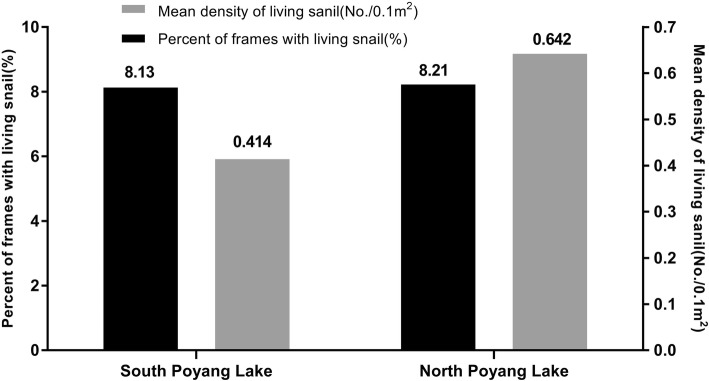
A total of 1159 potential snail sampling grids were surveyed, of which 15 231 frames (0.1 m/frame) were investigated. 1241 frames had live Oncomelania snails corresponding to 8.15% of the total number of frames. The mean density of living snails was 0.463/0.1 m with a maximum of 57 snails per frame. The percent of frames with snails in the southern sector (8.13%) of Poyang Lake did not differ statistically from the north (8.21%). However, the mean density of live snails in the northern sector (0.164/0.1 m) of the lake was statistically higher (F = 6.727; P = 0.010) than the south (0.141/0.1 m). In the south of the lake, the elevation of snail-inhabited marshland ranged between 11 - 16 m, and could be further subdivided into two snail-concentrated belts at 12-13 m of elevation and 15-16 m of elevation respectively. In the north of the lake, the elevation of snail-inhabited marshland ranged between 9- 16 m with the elevation of 12-14 m being the snail-concentrated zone.
The elevation of snail-infested marshlands in the Poyang Lake region ranged from 9 to 16 m. The snail distribution and habitat has moved north of the lake and to a lower altitude due to changes in the water level post dam closure. Based on the current geological features of the snail habitant focused mollusciciding should occur in snail dense northern regions with frequent bovine and human traffic. Targeting these identified 'hotspots' of transmission will assist in elimination efforts.
随着 2003 年三峡大坝的关闭,鄱阳湖的水文学发生了巨大变化,导致环境发生了重大变化。为了评估对血吸虫病的影响,本研究评估了鄱阳湖支流中间宿主钉螺的时空格局。该研究的结果对未来的钉螺控制策略具有重要意义,可导致疾病消除。
使用 ArcGIS 软件将鄱阳湖周围的沼泽地随机划分为 200×200m 的矢量网格,然后使用软件随机选择调查网格。在每个选定的网格中使用 50×50m 的调查框架进行钉螺调查,每个网格的一条侧线作为起始线。每个调查网格至少使用十个框架,并使用全球定位系统(GPS)进行记录。每个框架中的所有钉螺均收集起来,通过显微镜检查确定感染状况。从湖底地形图中提取所有框架的海拔数据,以便分析平均海拔。使用 SPSS 20.0 软件收集和统计所有钉螺调查数据,以确定不同湖区活钉螺框架百分比和活钉螺平均密度的差异。随后确定了有螺沼泽地和螺密集区的海拔。
共调查了 1159 个潜在钉螺采样网格,其中调查了 15231 个框架(0.1m/框架)。有 1241 个框架有活钉螺,占总框架数的 8.15%。活钉螺的平均密度为 0.463/0.1m,最高达 57 只/框架。鄱阳湖南部(8.13%)的钉螺框架百分比与北部(8.21%)没有统计学差异。然而,湖泊北部(0.164/0.1m)的活钉螺密度(F=6.727;P=0.010)明显高于南部(0.141/0.1m)。在湖泊南部,有螺沼泽地的海拔在 11-16m 之间,可进一步细分为海拔 12-13m 和 15-16m 的两个螺密集带。在湖泊北部,有螺沼泽地的海拔在 9-16m 之间,海拔 12-14m 是螺密集区。
鄱阳湖地区有螺沼泽地的海拔在 9-16m 之间。由于大坝关闭后水位变化,钉螺的分布和栖息地已经向北移动到较低的海拔。根据钉螺栖息地目前的地质特征,应该在钉螺密集、牛和人经常出没的北部地区进行有针对性的灭螺。针对这些确定的“热点”传播将有助于消除工作。