Department of Preventive Medicine, School of Medicine, Kyung Hee University, Seoul, Korea.
Department of Preventive Medicine, University of Ulsan College of Medicine, Seoul, Korea.
J Korean Med Sci. 2019 Mar 7;34(Suppl 1):e80. doi: 10.3346/jkms.2019.34.e80. eCollection 2019 Mar 26.
Disease burden can be represented by health-related parameters such as disability-adjusted life years and economic burden. Economic burden is an important index, as it estimates the maximum possible cost reduction if a disease is prevented. This study aimed to determine the economic burden of 238 diseases and 22 injuries in Korea in 2015.
Economic burden was estimated with a human resources approach from a social perspective, and direct and indirect costs were calculated from insurance claims data and a cause of death database. Direct costs were divided into medical costs (including hospital admission, outpatient visit, and medication use) and nonmedical costs (including transportation and caregiver costs). Indirect costs from lost productivity, either from the use of healthcare service or premature death, were analyzed.
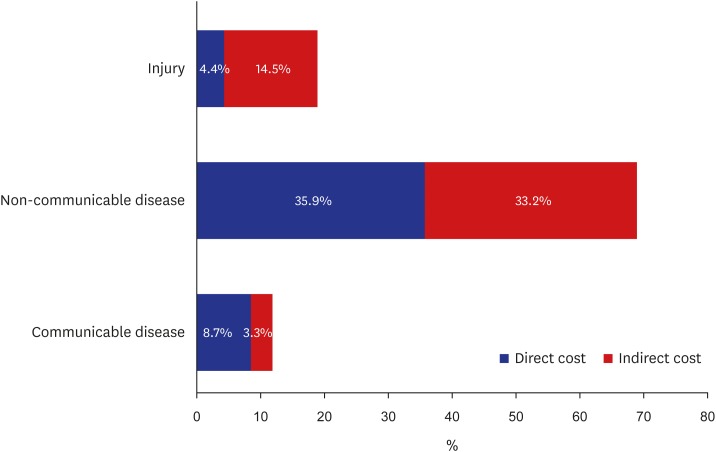
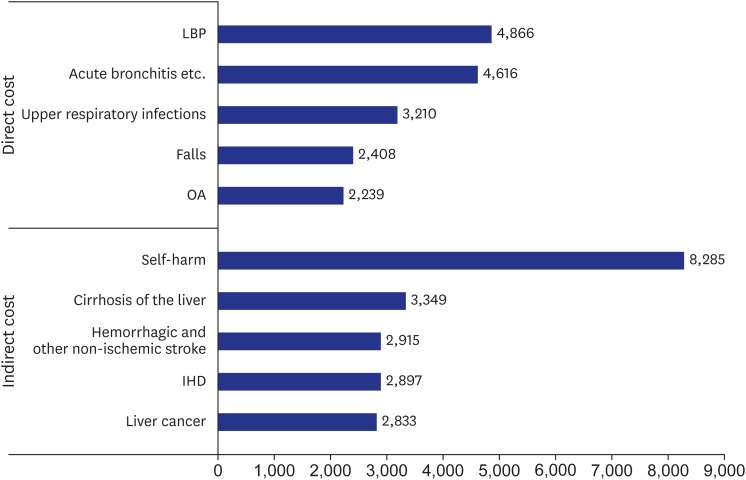
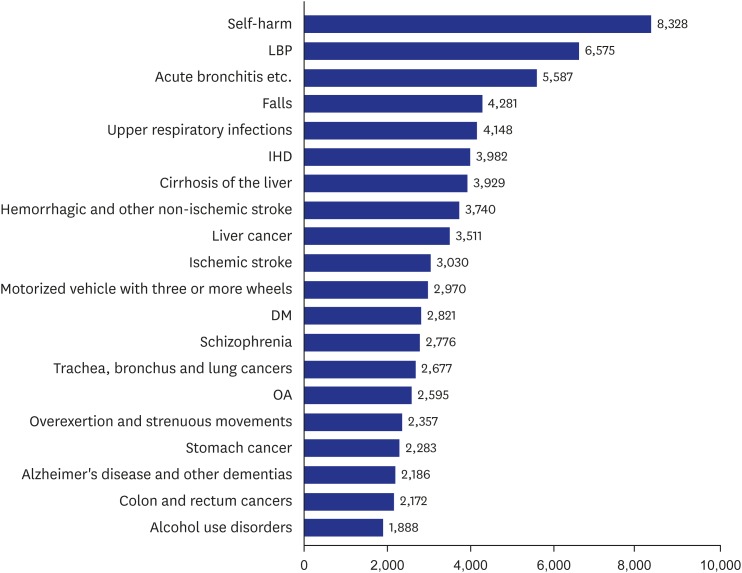
In 2015, the estimated economic burden was USD 133.7 billion (direct: USD 65.5 billion, indirect: USD 68.2 billion). The total cost of communicable diseases was USD 16.0 billion (11.9%); non-communicable diseases, USD 92.3 billion (69.1%); and injuries, USD 25.4 billion (19.0%). Self-harm had the highest costs (USD 8.3 billion), followed by low back pain (LBP, USD 6.6 billion). For men, self-harm had the highest cost (USD 7.1 billion), while LBP was the leading cost (USD 3.7 billion) for women.
A high percentage of Korea's total socioeconomic disease burden is due to chronic diseases; however, unnoticed conditions such as infectious diseases, injuries, and LBP are high in certain age groups and differ by gender, emphasizing the need for targeted social interventions to manage and prevent disease risk factors.
疾病负担可以通过残疾调整生命年来表示,也可以通过经济负担来表示。经济负担是一个重要的指标,因为它可以估算出如果预防某种疾病,最大可能的成本降低。本研究旨在确定 2015 年韩国 238 种疾病和 22 种损伤的经济负担。
从社会角度出发,采用人力资源法来估算经济负担,从保险索赔数据和死因数据库中计算直接和间接成本。直接成本分为医疗费用(包括住院、门诊和用药)和非医疗费用(包括交通和护理人员费用)。从使用医疗服务或过早死亡而导致的生产力损失中分析了间接成本。
2015 年,预计经济负担为 1337 亿美元(直接:655 亿美元,间接:682 亿美元)。传染病的总成本为 160 亿美元(11.9%);非传染性疾病为 923 亿美元(69.1%);损伤为 254 亿美元(19.0%)。自伤的费用最高(83 亿美元),其次是腰痛(LBP,66 亿美元)。对于男性,自伤的费用最高(71 亿美元),而对于女性,LBP 是最高的费用(37 亿美元)。
韩国总疾病负担的很大一部分是由慢性病造成的;然而,一些被忽视的疾病,如传染病、损伤和 LBP,在某些年龄组中发病率较高,且因性别而异,这强调了需要有针对性的社会干预措施来管理和预防疾病风险因素。