Alqefari Jana, Albelaihi Reema, Elmoazen Ramy, Bilal Rabia
College of Dentistry, Qassim University, Buraydah, Saudi Arabia.
College of Dentistry, Qassim Private Colleges, Buraydah, Saudi Arabia.
J Int Soc Prev Community Dent. 2019 Jan-Feb;9(1):72-76. doi: 10.4103/jispcd.JISPCD_350_18. Epub 2019 Feb 14.
Discomfort associated with the use of fixed orthodontic appliances may have a negative influence on the patient's oral health-related quality of life (OHRQoL). In general, OHRQoL assessments have the potential to provide information on the need to improve the overall quality of care. This study aims to assess the impact of fixed orthodontic appliances on OHRQoL of Saudi population and to explore the impact of the patient's gender and age on perceived treatment.
This cross-sectional study used a generic measure of OHRQoL the Arabic version of the Oral Health Impact Profile (OHIP-14), which is a responsive measure to changes in oral health conditions. Data were collected using self-completed e-questionnaire which was distributed through social media and were analyzed using Statistical Package for Social Sciences (SPSS) version 21.0.
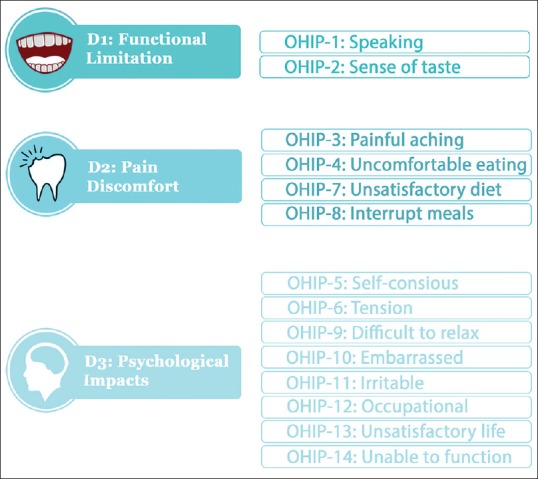
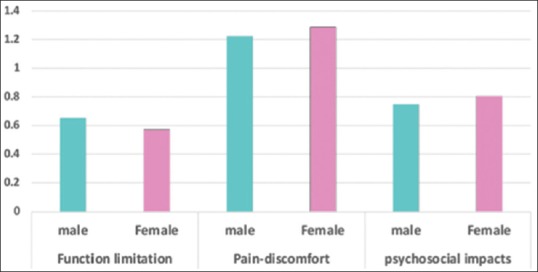
A total of 149 subjects, 110 (73.8%) were females and 39 (26.2%) were males. Adolescents between 13 and 20 years were 63 (42.3%) and adults between 21 and 30 years were 86 (75.7%). A response rate of 100% was obtained. The prevalence of oral health impacts according to OHP-14 was 22.5%. OHIP-14 consists of 14 items covering seven domains. A three-dimensional structure was used to test the existence of separate dimensions: functional limitation, pain discomfort, and psychosocial impact. A significant difference was found between males and females in the first dimension ( = 0.038) and the third dimension ( = 0.022). In addition, a significant difference was also found between the two age groups included in the study within the third dimension ( = 0.025).
Fixed orthodontic appliances had an evident impact on OHRQoL. However, males had significantly altered functional limitations while females had a higher psychological impact. Furthermore, adults had a significantly higher psychological impact than adolescents.
使用固定正畸矫治器带来的不适可能会对患者与口腔健康相关的生活质量(OHRQoL)产生负面影响。一般来说,OHRQoL评估有潜力提供有关改善整体护理质量需求的信息。本研究旨在评估固定正畸矫治器对沙特人群OHRQoL的影响,并探讨患者性别和年龄对感知治疗的影响。
本横断面研究使用了一种通用的OHRQoL测量方法——口腔健康影响程度量表(OHIP - 14)的阿拉伯语版本,它是对口腔健康状况变化的一种敏感测量方法。数据通过使用自行填写的电子问卷收集,该问卷通过社交媒体分发,并使用社会科学统计软件包(SPSS)21.0版进行分析。
共有149名受试者,其中110名(73.8%)为女性,39名(26.2%)为男性。13至20岁的青少年有63名(42.3%),21至30岁的成年人有86名(75.7%)。获得了100%的回复率。根据OHP - 14,口腔健康影响的患病率为22.5%。OHIP - 14由涵盖七个领域的14个项目组成。使用三维结构来测试不同维度的存在:功能受限、疼痛不适和心理社会影响。在第一维度(= 0.038)和第三维度(= 0.022)中,男性和女性之间存在显著差异。此外,在研究纳入的两个年龄组的第三维度内也发现了显著差异(= 0.025)。
固定正畸矫治器对OHRQoL有明显影响。然而,男性的功能受限有显著改变,而女性有更高的心理影响。此外,成年人的心理影响明显高于青少年。