Department of Neurology, Division Behavioral and Cognitive Neurology, Vanderbilt University Medical Center, 1161 21st Avenue, A-0118 MCN, Nashville, TN, 37232, USA.
Drugs Aging. 2019 Jul;36(7):647-653. doi: 10.1007/s40266-019-00655-y.
Psychosis is common in Parkinson's disease-related disorders and is associated with significant morbidity. Pimavanserin is a newly approved treatment for Parkinson's disease psychosis, but real-world experience with pimavanserin has been limited by small sample sizes and limited assessment of longitudinal outcomes.
The aim was to summarize the clinical experience with pimavanserin in a large cohort of patients with Parkinson's disease-related psychosis.
We conducted a retrospective chart review of patients who were prescribed pimavanserin at Vanderbilt University Medical Center in the southeast United States between May 2016 and July 2018. We used Chi-squared analyses to compare efficacy and tolerability of pimavanserin, considering patient diagnosis, presence of dementia or delusions, use of deep brain stimulation, and prior antipsychotic failure. Additionally, we compared the clinical characteristics of patients who started treatment and those who did not, to evaluate safety outcomes.
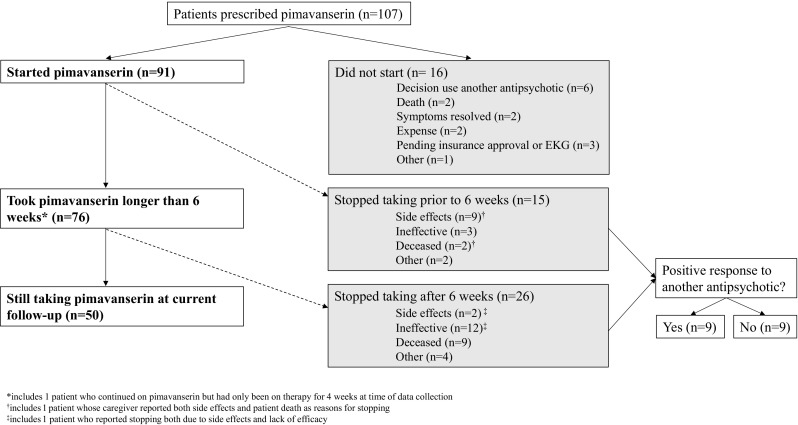
We identified 107 patients prescribed pimavanserin, and 91 began treatment. Clinical improvement in psychosis was documented in 76% of patients (69/91) and did not differ based on diagnosis, presence of dementia, delusions, use of deep brain stimulation, or prior antipsychotic failure. Adverse effects were reported in 20 patients (22%), the most common of which was worsening gait instability (5/91, 5%). Side effects led to cessation of therapy in 11 of the 91 patients (12%). At current follow-up, 50 (65%) of 77 living patients remain on treatment, with a mean treatment duration of 14.6 months. Although most of these patients are on pimavanserin monotherapy (33/50, 66%), 17 patients (34%) are on a dual-antipsychotic regimen. The living patients no longer on treatment stopped pimavanserin primarily because of a lack of perceived benefit (11/77, 14%), side effects (9/77, 12%), or both (1/77, 1%), though six patients (8%) stopped for reasons unrelated to medication effects, including the desire to reduce overall medication burden and negative media reporting on pimavanserin.
Study results emphasize long-term efficacy and tolerability of pimavanserin for psychosis in Parkinson's disease-related disorders, including patients with dementia, delusions, deep brain stimulation use, or prior antipsychotic failure.
精神病在帕金森病相关疾病中很常见,并且与显著的发病率有关。Pimavanserin 是一种新批准用于治疗帕金森病精神病的药物,但由于样本量小且纵向结局评估有限,实际应用 Pimavanserin 的经验有限。
本研究旨在总结帕金森病相关精神病大量患者使用 Pimavanserin 的临床经验。
我们对 2016 年 5 月至 2018 年 7 月在美国东南部范德比尔特大学医学中心接受 Pimavanserin 治疗的患者进行了回顾性图表审查。我们使用卡方分析比较了 Pimavanserin 的疗效和耐受性,考虑了患者的诊断、是否存在痴呆或妄想、是否使用深部脑刺激以及是否存在抗精神病药物治疗失败。此外,我们比较了开始治疗和未开始治疗的患者的临床特征,以评估安全性结果。
我们确定了 107 名接受 Pimavanserin 治疗的患者,其中 91 名开始治疗。76%(69/91)的患者记录到精神病改善,且诊断、痴呆、妄想、深部脑刺激的使用或抗精神病药物治疗失败均不影响疗效。20 名患者(22%)报告了不良反应,最常见的是步态不稳恶化(5/91,5%)。11 名(12%)患者因副作用而停止治疗。在目前的随访中,77 名存活患者中有 50 名(65%)仍在接受治疗,平均治疗持续时间为 14.6 个月。虽然这些患者大多数(33/50,66%)接受 Pimavanserin 单药治疗,但 17 名(34%)患者接受了双重抗精神病药物治疗。不再接受治疗的存活患者主要因无明显获益(11/77,14%)、副作用(9/77,12%)或两者(1/77,1%)而停止治疗,尽管 6 名患者(8%)因与药物效果无关的原因停止治疗,包括减少整体药物负担的愿望和对 Pimavanserin 的负面媒体报道。
研究结果强调了 Pimavanserin 治疗帕金森病相关疾病精神病的长期疗效和耐受性,包括痴呆、妄想、深部脑刺激使用或抗精神病药物治疗失败的患者。