Monterey Bay Aquarium Research Institute, Moss Landing, CA, USA.
Department of the Geophysical Sciences, University of Chicago, Chicago, IL, USA.
Environ Microbiol. 2019 Jun;21(6):2148-2170. doi: 10.1111/1462-2920.14608. Epub 2019 May 13.
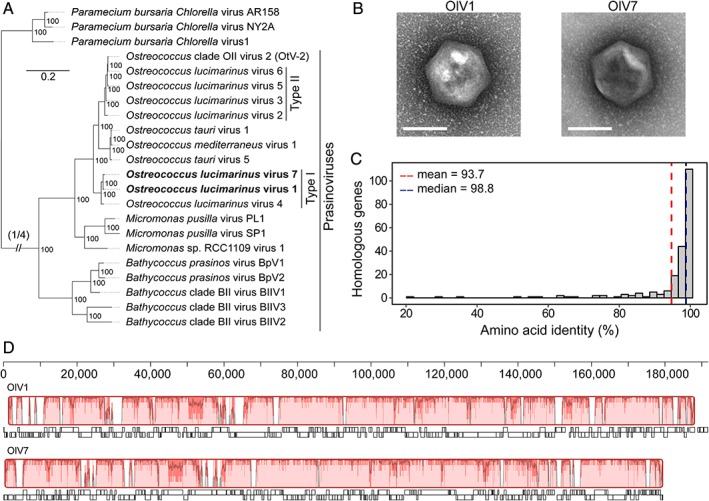
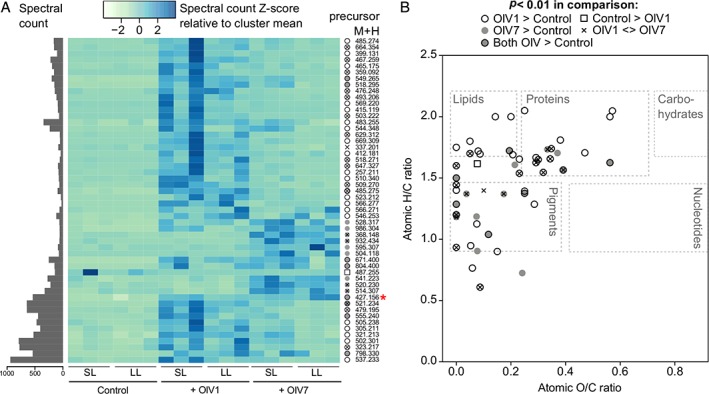
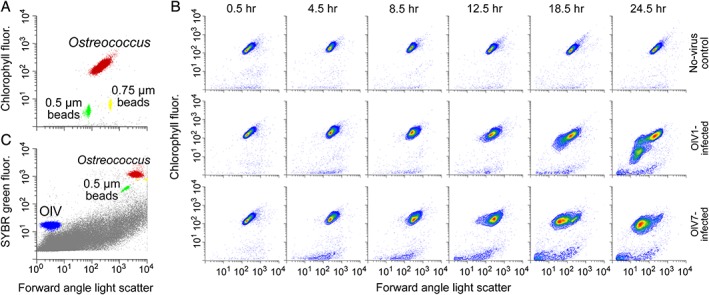
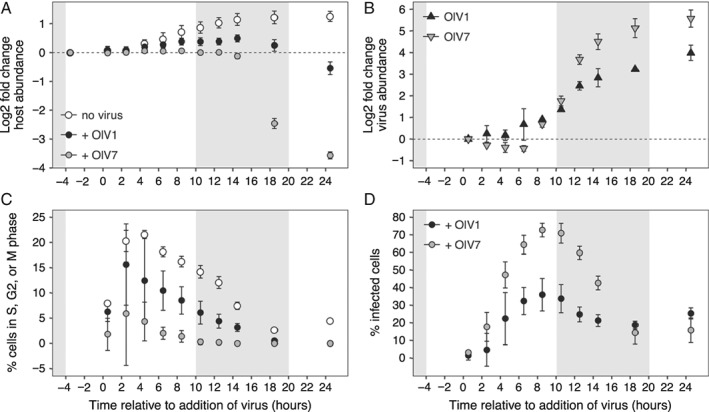
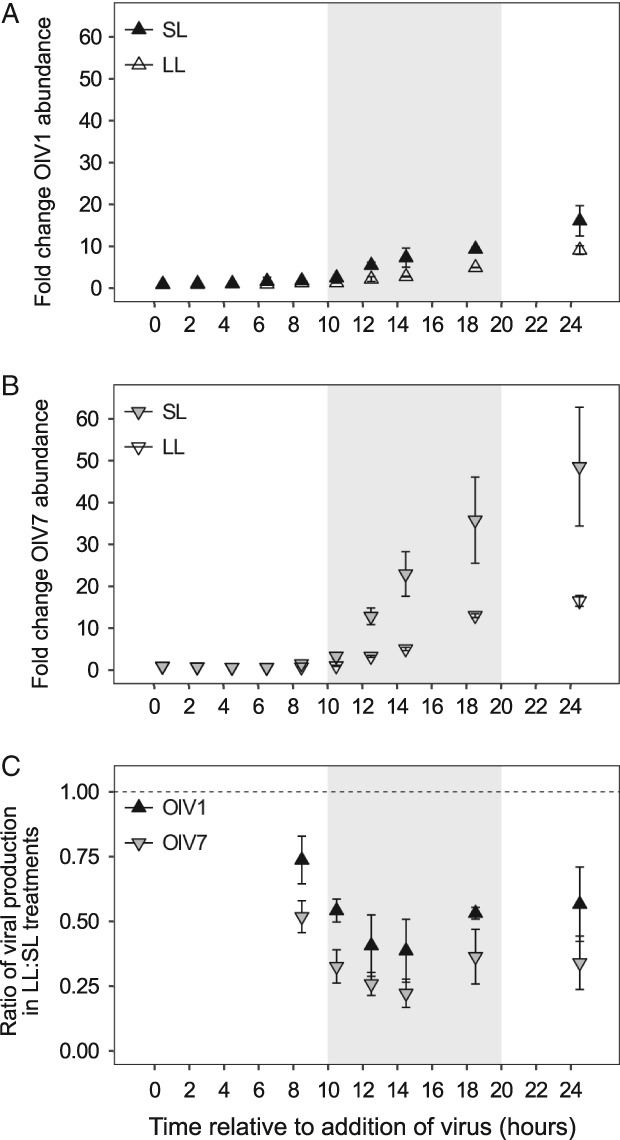
In marine ecosystems, viruses are major disrupters of the direct flow of carbon and nutrients to higher trophic levels. Although the genetic diversity of several eukaryotic phytoplankton virus groups has been characterized, their infection dynamics are less understood, such that the physiological and ecological implications of their diversity remain unclear. We compared genomes and infection phenotypes of the two most closely related cultured phycodnaviruses infecting the widespread picoprasinophyte Ostreococcus lucimarinus under standard- (1.3 divisions per day) and limited-light (0.41 divisions per day) nutrient replete conditions. OlV7 infection caused early arrest of the host cell cycle, coinciding with a significantly higher proportion of infected cells than OlV1-amended treatments, regardless of host growth rate. OlV7 treatments showed a near-50-fold increase of progeny virions at the higher host growth rate, contrasting with OlV1's 16-fold increase. However, production of OlV7 virions was more sensitive than OlV1 production to reduced host growth rate, suggesting fitness trade-offs between infection efficiency and resilience to host physiology. Moreover, although organic matter released from OlV1- and OlV7-infected hosts had broadly similar chemical composition, some distinct molecular signatures were observed. Collectively, these results suggest that current views on viral relatedness through marker and core gene analyses underplay operational divergence and consequences for host ecology.
在海洋生态系统中,病毒是阻碍碳和营养物质直接流向更高营养级的主要因素。尽管已经对几种真核浮游植物病毒群的遗传多样性进行了描述,但它们的感染动态却知之甚少,因此其多样性对生理和生态的影响仍不清楚。我们比较了在标准(每天 1.3 分裂)和有限光照(每天 0.41 分裂)营养充足条件下,感染广泛分布的微微鞭毛藻的两种最密切相关的培养噬藻体病毒的基因组和感染表型。OlV7 感染导致宿主细胞周期早期停滞,与 OlV1 处理相比,感染细胞的比例显著更高,而与宿主生长速率无关。在更高的宿主生长速率下,OlV7 处理的病毒粒子产量增加了近 50 倍,而 OlV1 仅增加了 16 倍。然而,OlV7 病毒粒子的产生比 OlV1 更敏感,对宿主生长速率降低更敏感,这表明在感染效率和对宿主生理的弹性之间存在适应度权衡。此外,尽管 OlV1 和 OlV7 感染宿主释放的有机物具有相似的化学组成,但也观察到一些不同的分子特征。总的来说,这些结果表明,通过标记和核心基因分析来评估病毒亲缘关系的当前观点低估了操作上的差异及其对宿主生态学的影响。