Department of Statistics, Rice University, Houston, Texas.
Children's Environmental Health Initiative, Rice University, Houston, Texas.
Prev Chronic Dis. 2019 Mar 28;16:E36. doi: 10.5888/pcd16.180445.
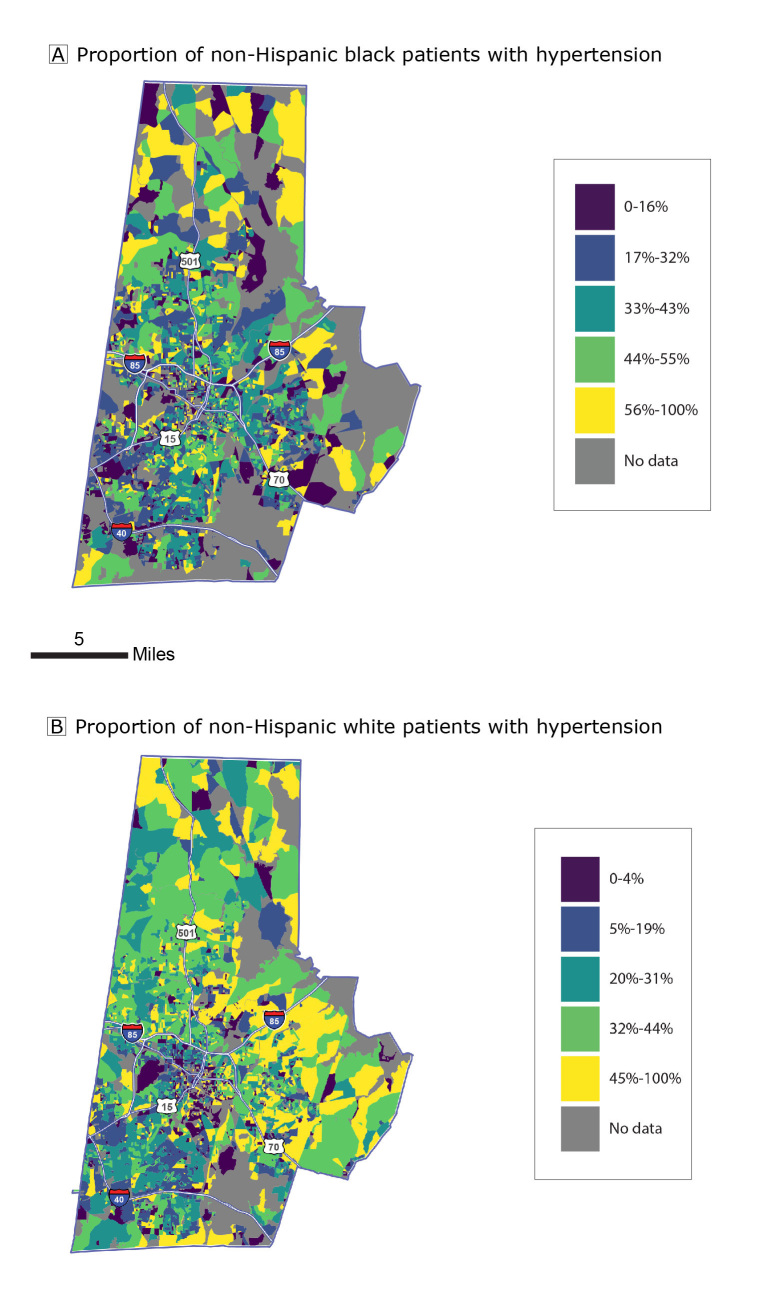
Neighborhood characteristics such as racial segregation may be associated with hypertension, but studies have not examined these relationships using spatial models appropriate for geographically patterned health outcomes. The objectives of our study were to 1) evaluate the geographic heterogeneity of hypertension; 2) describe whether and how patient-level risk factors and racial isolation relate to geographic heterogeneity in hypertension; and 3) examine cross-sectional associations of hypertension with racial isolation.
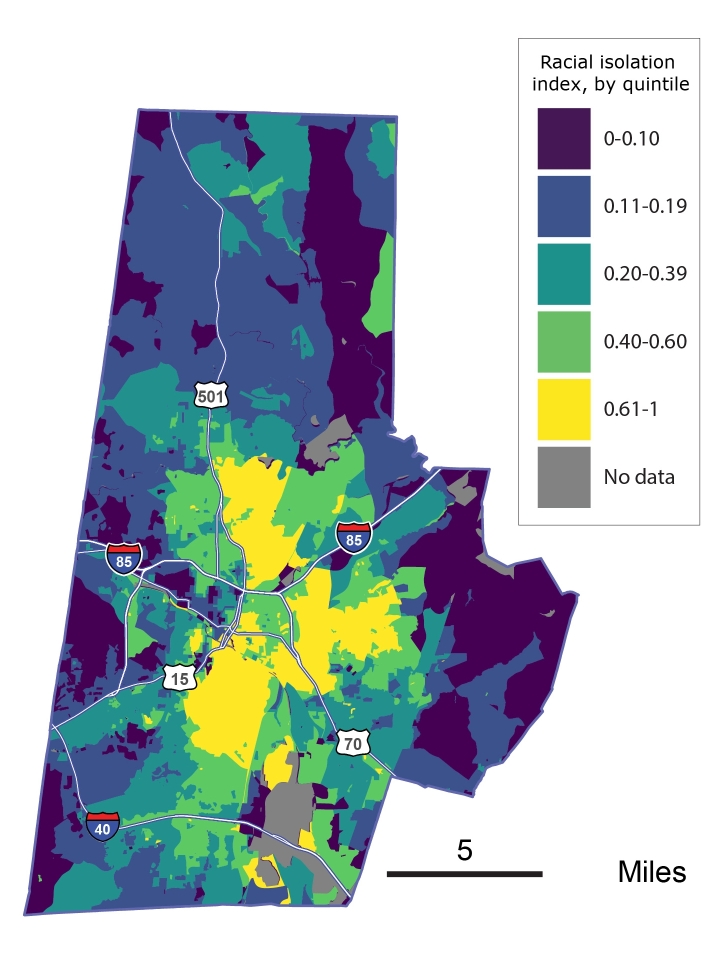
We obtained electronic health records from the Duke Medicine Enterprise Data Warehouse for 2007-2011. We linked patient data with data on racial isolation determined by census block of residence. We constructed a local spatial index of racial isolation for non-Hispanic black patients; the index is scaled from 0 to 1, with 1 indicating complete isolation. We used aspatial and spatial Bayesian models to assess spatial variation in hypertension and estimate associations with racial isolation.
Racial isolation ranged from 0 (no isolation) to 1 (completely isolated). A 0.20-unit increase in racial isolation was associated with 1.06 (95% credible interval, 1.03-1.10) and 1.11 (95% credible interval, 1.07-1.16) increased odds of hypertension among non-Hispanic black and non-Hispanic white patients, respectively. Across Durham, census block-level odds of hypertension ranged from 0.62 to 1.88 among non-Hispanic black patients and from 0.32 to 2.41 among non-Hispanic white patients. Compared with spatial models that included patient age and sex, residual heterogeneity in spatial models that included age, sex, and block-level racial isolation was 33% lower for non-Hispanic black patients and 20% lower for non-Hispanic white patients.
Racial isolation of non-Hispanic black patients was associated with increased odds of hypertension among both non-Hispanic black and non-Hispanic white patients. Further research is needed to identify latent spatially patterned factors contributing to hypertension.
邻里特征(如种族隔离)可能与高血压有关,但尚未有研究使用适用于地理模式健康结果的空间模型来检验这些关系。我们的研究目的是:1)评估高血压的地理异质性;2)描述患者层面的风险因素和种族隔离与高血压地理异质性的关系;3)检验高血压与种族隔离的横断面关联。
我们从 2007 年至 2011 年杜克医疗企业数据仓库中获取电子健康记录。我们将患者数据与居住的普查块确定的种族隔离数据相链接。我们为非西班牙裔黑人患者构建了一个种族隔离的局部空间指数;该指数的范围从 0 到 1,1 表示完全隔离。我们使用非空间和空间贝叶斯模型来评估高血压的空间变异性,并估计与种族隔离的关联。
种族隔离程度从 0(无隔离)到 1(完全隔离)不等。种族隔离程度增加 0.20 个单位,与非西班牙裔黑人患者高血压的比值比(95%可信区间,1.03-1.10)和 1.11(95%可信区间,1.07-1.16)分别增加 1.06 和 1.11。在达勒姆,非西班牙裔黑人患者的普查块级高血压的比值比从 0.62 到 1.88 不等,非西班牙裔白人患者的比值比从 0.32 到 2.41 不等。与纳入患者年龄和性别的空间模型相比,纳入年龄、性别和街区级种族隔离的空间模型中的剩余异质性,对于非西班牙裔黑人患者降低了 33%,对于非西班牙裔白人患者降低了 20%。
非西班牙裔黑人患者的种族隔离与非西班牙裔黑人患者和非西班牙裔白人患者的高血压发病风险增加相关。需要进一步研究以确定导致高血压的潜在空间模式因素。