Bazzichetto Chiara, Conciatori Fabiana, Pallocca Matteo, Falcone Italia, Fanciulli Maurizio, Cognetti Francesco, Milella Michele, Ciuffreda Ludovica
Medical Oncology 1, IRCCS - Regina Elena National Cancer Institute, Rome 00144, Italy.
Department of Molecular Medicine, University of Rome, La Sapienza, Rome 00185, Italy.
Cancers (Basel). 2019 Mar 28;11(4):435. doi: 10.3390/cancers11040435.
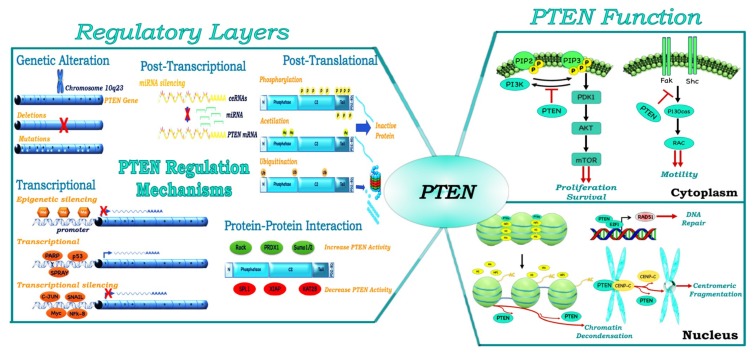
Identifying putative biomarkers of clinical outcomes in cancer is crucial for successful enrichment, and for the selection of patients who are the most likely to benefit from a specific therapeutic approach. Indeed, current research in personalized cancer therapy focuses on the possibility of identifying biomarkers that predict prognosis, sensitivity or resistance to therapies. Phosphatase and tensin homolog deleted on chromosome 10 (PTEN) is a tumor suppressor gene that regulates several crucial cell functions such as proliferation, survival, genomic stability and cell motility through both enzymatic and non-enzymatic activities and phosphatidylinositol 3-kinase (PI3K)-dependent and -independent mechanisms. Despite its undisputed role as a tumor suppressor, assessment of PTEN status in sporadic human tumors has yet to provide clinically robust prognostic, predictive or therapeutic information. This is possibly due to the exceptionally complex regulation of PTEN function, which involves genetic, transcriptional, post-transcriptional and post-translational events. This review shows a brief summary of the regulation and function of PTEN and discusses its controversial aspects as a prognostic/predictive biomarker.
识别癌症临床结局的潜在生物标志物对于成功富集以及选择最有可能从特定治疗方法中获益的患者至关重要。事实上,当前个性化癌症治疗的研究重点在于识别能够预测预后、对治疗的敏感性或耐药性的生物标志物。10号染色体缺失的磷酸酶和张力蛋白同源物(PTEN)是一种肿瘤抑制基因,它通过酶活性和非酶活性以及磷脂酰肌醇3激酶(PI3K)依赖性和非依赖性机制调节多种关键细胞功能,如增殖、存活、基因组稳定性和细胞运动。尽管PTEN作为肿瘤抑制因子的作用无可争议,但在散发性人类肿瘤中评估PTEN状态尚未提供临床上可靠的预后、预测或治疗信息。这可能是由于PTEN功能的调控异常复杂,涉及遗传、转录、转录后和翻译后事件。本综述简要总结了PTEN的调控和功能,并讨论了其作为预后/预测生物标志物的争议性方面。