Department of Epidemiology, School of Public Health, Nanjing Medical University, Nanjing, Jiangsu, China.
Department of Tuberculosis, The Third People's Hospital of Zhenjiang affiliated to Jiangsu University, Zhenjiang, China.
BMJ Open. 2019 Mar 30;9(3):e027321. doi: 10.1136/bmjopen-2018-027321.
Tuberculosis (TB) continues to be an important public health problem throughout much of the world. Drug treatment is the only effective treatment method, but adverse drug events (ADEs) and adverse drug reactions (ADRs) can affect medication adherence. As the number of drug-resistant TB patients and the number of anti-TB drugs have increased, it is necessary to explore the risk factors for ADEs/ADRs to reduce their occurrence. This study aims to build a home-based anti-TB treatment cohort and to recognise the incidences, prognosis and risk factors of anti-TB drug-induced ADEs/ADRs in real-world experiences.
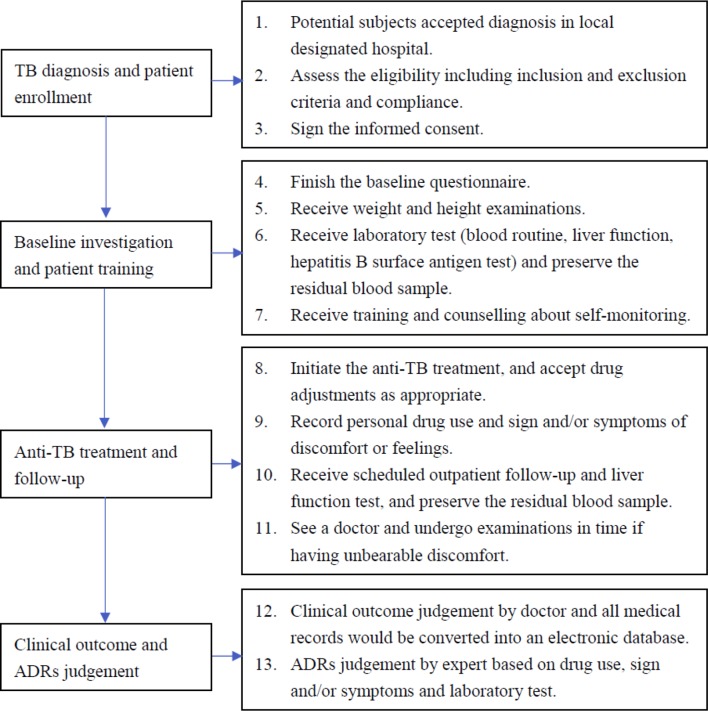
This study is a multicentre, prospective observational cohort study. The study population will consist of 3200 newly diagnosed TB patients between January 2019 and December 2020. After initiating the anti-TB treatment, all patients will be followed up until finishing treatment unless they withdraw, and we will record personal drug use and signs and/or symptoms of discomfort. Patients will receive scheduled laboratory tests in designated hospitals every 2 weeks during the first 2 months, and the residual blood sample after conducting the laboratory tests will be preserved. The ADEs/ADRs will be placed into eight categories: liver dysfunction, gastrointestinal reactions, drug allergy, arthralgia or muscle pain, nervous system disorders, haematological system disorders, renal impairment and others.
This study protocol has been approved by the ethics committees of Nanjing Medical University. All patients will give written informed consent before enrollment. The findings of the study will be published in peer-reviewed journals and will be presented at national and international conferences.
结核病(TB)在世界许多地区仍然是一个重要的公共卫生问题。药物治疗是唯一有效的治疗方法,但药物不良反应(ADEs)和药物不良反应(ADRs)会影响药物的依从性。随着耐多药结核病患者数量和抗结核病药物数量的增加,有必要探讨 ADEs/ADRs 的风险因素,以减少其发生。本研究旨在建立一个基于家庭的抗结核治疗队列,并在真实世界的经验中识别抗结核药物引起的 ADEs/ADRs 的发生率、预后和风险因素。
这是一项多中心、前瞻性观察性队列研究。研究人群将包括 2019 年 1 月至 2020 年 12 月期间新诊断的 3200 例结核病患者。开始抗结核治疗后,所有患者将在完成治疗之前进行随访,除非他们退出,并且我们将记录个人用药情况和不适的迹象和/或症状。患者将在头 2 个月每 2 周在指定医院进行预定的实验室检查,并且在进行实验室检查后保留剩余的血样。将 ADEs/ADRs 分为八类:肝功能障碍、胃肠道反应、药物过敏、关节痛或肌肉痛、神经系统障碍、血液系统障碍、肾功能损害和其他。
本研究方案已获得南京医科大学伦理委员会的批准。所有患者在入组前将签署书面知情同意书。研究结果将发表在同行评议的期刊上,并将在国内外会议上展示。