Department of Laboratory Medicine, Third Affiliated Hospital, Sun Yat-sen University, Guangzhou, Guangdong, China (mainland).
Department of Hepatic Surgery and Liver Transplantation Center of The Third Affiliated Hospital, Organ Transplantation Institute, Sun Yat-sen University, Guangzhou, Guangdong, China (mainland).
Med Sci Monit. 2019 Apr 1;25:2361-2367. doi: 10.12659/MSM.913700.
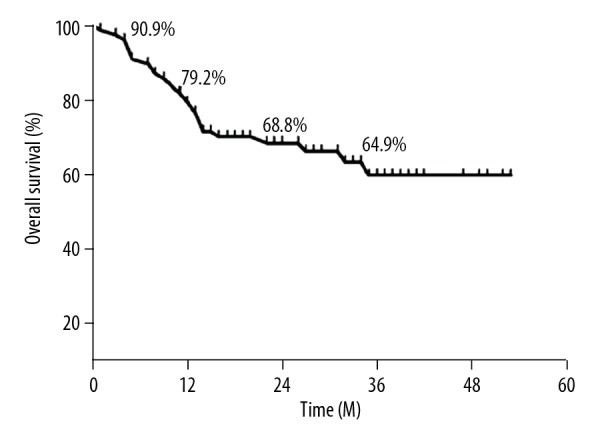
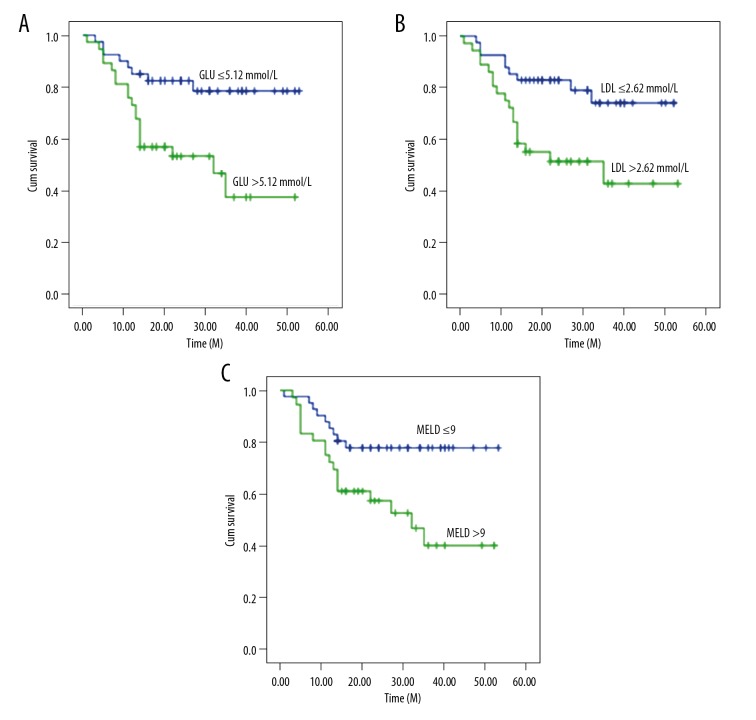
BACKGROUND The disordered metabolism of liver function in liver cancer patients can affect postoperative survival after liver transplantation. We assessed whether the levels of various chemicals in liver metabolism prior to receiving a liver transplant were prognostic factors and metabolism markers in predicting survival rate. MATERIAL AND METHODS Seventy-seven patients received a donor liver transplant between June 2012 and April 2016. The basic level of fasting serum GLU, Crea, TBil, TC, TG, HDL, LDL, ApoA1, ApoB100, INR, and MELD scores of 77 patients were retrospectively analyzed. Each patient's survival was monitored to evaluate prognosis and long-term survival. RESULTS The overall survival rates of all patients post-transplant at 6-, 12-, 24-, and 36-month follow-up were 90.9%, 79.2%, 68.8%, and 64.9% respectively. Fasting serum levels of GLU (P=0.004), HDL (P=0.010), LDL (P=0.008), ApoA1 (P=0.028), and MELD scores (P=0.013) prior to liver transplantation were closely associated with the cumulative survival post-transplant in univariate analyses. Controlled fasting GLU of ≤5.12 mmol/L (P=0.019), LDL of ≤2.62 mmol/L (P=0.031), and MELD scores of ≤9 (P=0.013) before LT were significantly and independently associated with increased cumulative survival in the multivariate analyses. CONCLUSIONS Decreased fasting serum GLU, LDL, and MELD scores as independent risk factors prior to liver transplantation markedly increase cumulative survival.
肝癌患者肝功能代谢紊乱会影响肝移植术后的生存。我们评估了接受肝移植前肝脏代谢中各种化学物质的水平是否是预测生存率的预后因素和代谢标志物。
77 例患者于 2012 年 6 月至 2016 年 4 月接受供体肝移植。回顾性分析 77 例患者空腹血清 GLU、Crea、TBil、TC、TG、HDL、LDL、ApoA1、ApoB100、INR 和 MELD 评分的基础水平。监测每位患者的生存情况,以评估预后和长期生存情况。
所有患者移植后 6、12、24 和 36 个月的总体生存率分别为 90.9%、79.2%、68.8%和 64.9%。移植前空腹血清 GLU(P=0.004)、HDL(P=0.010)、LDL(P=0.008)、ApoA1(P=0.028)和 MELD 评分(P=0.013)与移植后累积生存率密切相关。单因素分析中,控制空腹 GLU≤5.12mmol/L(P=0.019)、LDL≤2.62mmol/L(P=0.031)和 MELD 评分≤9(P=0.013)与移植后累积生存率显著相关。
移植前空腹血清 GLU、LDL 和 MELD 评分降低作为独立危险因素,显著增加累积生存率。