Montagnani Valentina, Stecca Barbara
Core Research Laboratory⁻Institute for Cancer Research, Prevention and Clinical Network (ISPRO), 50139 Florence, Italy.
Cancers (Basel). 2019 Mar 29;11(4):449. doi: 10.3390/cancers11040449.
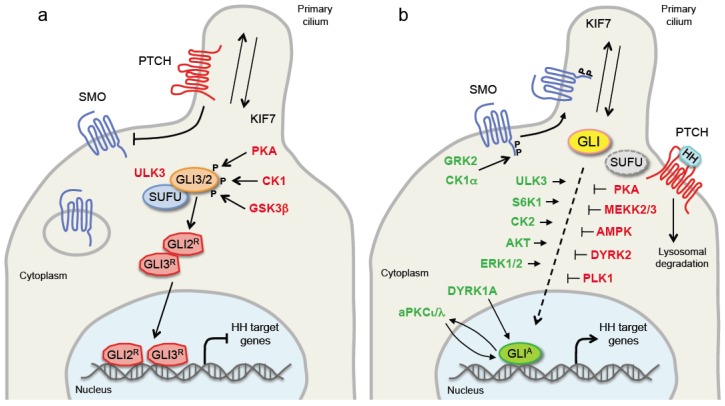
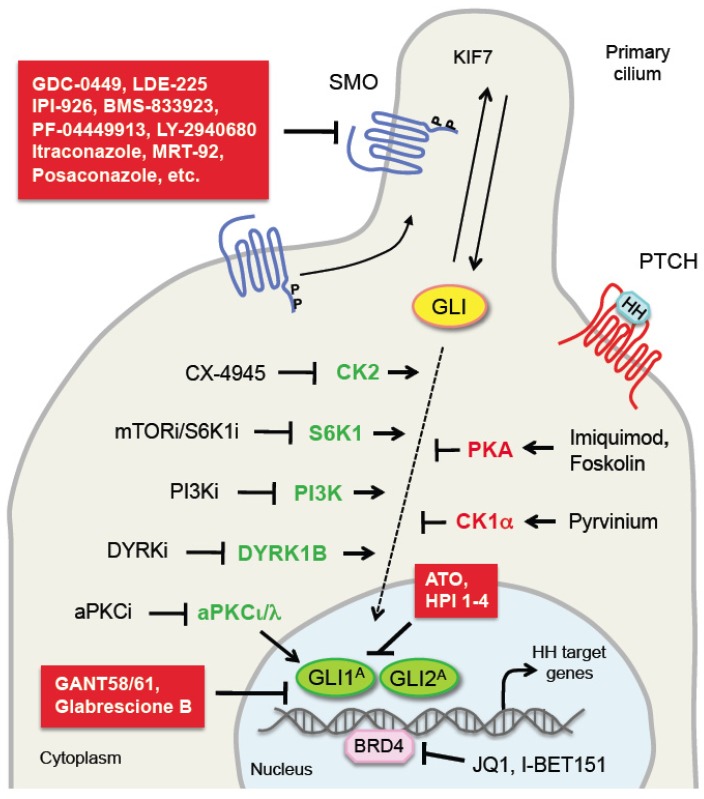
Hedgehog (HH) signaling is an evolutionarily conserved pathway that is crucial for growth and tissue patterning during embryonic development. It is mostly quiescent in the adult, where it regulates tissue homeostasis and stem cell behavior. Aberrant reactivation of HH signaling has been associated to several types of cancer, including those in the skin, brain, prostate, breast and hematological malignancies. Activation of the canonical HH signaling is triggered by binding of HH ligand to the twelve-transmembrane protein PATCHED. The binding releases the inhibition of the seven-transmembrane protein SMOOTHENED (SMO), leading to its phosphorylation and activation. Hence, SMO activates the transcriptional effectors of the HH signaling, that belong to the GLI family of transcription factors, acting through a not completely elucidated intracellular signaling cascade. Work from the last few years has shown that protein kinases phosphorylate several core components of the HH signaling, including SMO and the three GLI proteins, acting as powerful regulatory mechanisms to fine tune HH signaling activities. In this review, we will focus on the mechanistic influence of protein kinases on HH signaling transduction. We will also discuss the functional consequences of this regulation and the possible implications for cancer therapy.
刺猬信号通路(HH)是一条在进化上保守的信号通路,在胚胎发育过程中对生长和组织模式形成至关重要。在成体中它大多处于静止状态,在成体中它调节组织稳态和干细胞行为。HH信号通路的异常重新激活与多种类型的癌症相关,包括皮肤癌、脑癌、前列腺癌、乳腺癌和血液系统恶性肿瘤。经典HH信号通路的激活是由HH配体与十二次跨膜蛋白PTCH结合触发的。这种结合解除了对七次跨膜蛋白SMOOTHENED(SMO)的抑制,导致其磷酸化并激活。因此,SMO激活HH信号通路的转录效应器,这些效应器属于转录因子GLI家族,通过一个尚未完全阐明的细胞内信号级联发挥作用。过去几年的研究表明,蛋白激酶使HH信号通路的几个核心成分磷酸化,包括SMO和三种GLI蛋白,作为强大的调节机制来微调HH信号通路的活性。在这篇综述中,我们将重点关注蛋白激酶对HH信号转导的机制性影响。我们还将讨论这种调节的功能后果以及对癌症治疗的可能影响。